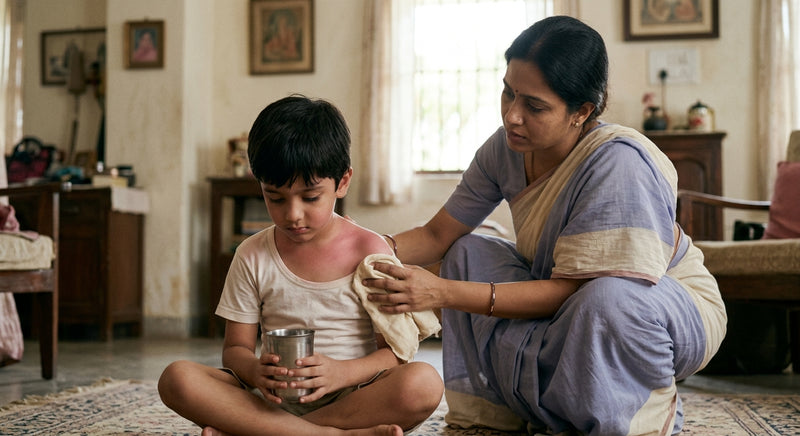
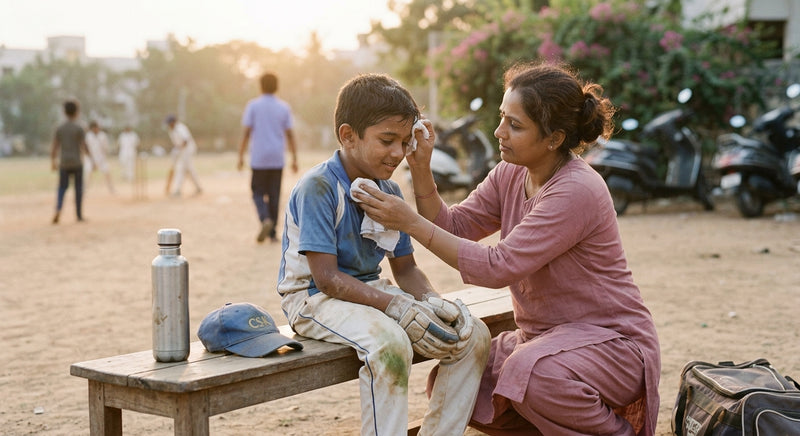
Four days at his nani's. Cricket every afternoon, a pool on day three. He walks back in and he is visibly darker — and you cannot stop looking at him. You were on the same terrace, in the same sun, all week. You look exactly as you did on Monday. Parents ask me this constantly, and there is usually a little worry sitting underneath it: why him so fast, and not me?
Three things stack up. A child's skin is thinner, so more UV reaches the pigment-making cells at the base of the epidermis. Those cells — melanocytes — are metabolically busier in a growing child, and they switch on pigment production quickly. And children simply collect far more UV than we do. Games period, the cycle to tuition, an hour at the park. Almost all of it at the worst hours of the day.
A tan is the skin's response to UV that has already reached it. What it tells you is that the sun is reaching your child's skin more efficiently than it reaches yours. The routine has to account for that.
At a glance
- A tan is not dirt. It is new melanin the skin made in response to UV — you cannot scrub it off, and you should not try.
- Thinner skin means more UV gets through to the melanocytes; a child's pigment response is faster than an adult's.
- SPF measures protection from burning (UVB). The PA rating measures tanning (UVA). For a child who tans rather than burns, the PA rating matters more than a big SPF number.
- A tan from a holiday fades on its own over several weeks as skin cells turn over. Uneven patches that keep spreading are a different question — see a doctor.
- What works in India: sunscreen before school, a hat, shifted play timings, and a barrier-supporting moisturiser at night.
So what is a tan, actually?
Melanocytes sit in the deepest layer of the epidermis. They package pigment into little parcels called melanosomes and hand them to the surrounding skin cells, which carry them upward and hold them like tiny umbrellas over each cell nucleus. That is what a tan is. A shield, built after the UV has already landed.
Two separate things darken skin. They run on different clocks.
- Immediate pigment darkening. Within minutes of UVA exposure, the melanin already sitting in the skin oxidises and goes darker. This is the greyish-brown you notice the same evening, at bath time. It fades over hours to a day or two.
- Delayed tanning. UVB (and UVA) upregulate the tyrosinase enzyme and the melanocyte starts manufacturing new pigment. This peaks around three to five days later. That is the tan still sitting on him when school reopens.
Most Indian children fall in Fitzpatrick types IV and V — skin that makes eumelanin readily and tans much more easily than it burns. That is protective, and worth being glad about. It also explains two things parents notice here: one hot week can shift a child's tone visibly, and post-inflammatory marks — a scratched mosquito bite, a healed rash — hang around for months in a way they don't on paler skin.
Why does thinner skin matter so much?
The stratum corneum, that outermost layer of dead flattened cells, is the skin's first optical filter. It scatters and absorbs a share of the UV before anything reaches the living tissue underneath. In children that layer is thinner and less densely stacked. So a larger fraction of what lands on the skin travels all the way down to where the melanocytes are waiting.
Now add faster cell turnover. A child's epidermis renews more quickly than yours, so the fresh pigment reaches the upper layers sooner. The tan shows up faster. It also looks more even.
Then there is dose, which nobody actually measures. Your UV for the day is the walk from the gate to the car. A nine-year-old's is a games period at 12:30, a cycle to tuition at 4, and the whole of Sunday on somebody's terrace. A large share of a person's lifetime UV exposure is collected in childhood. Which is why the habit ends up mattering more than any single bottle.
SPF or PA — which number stops tanning?
Labels rarely explain this, and it matters here more than anywhere. SPF is measured by how long skin takes to go red. An erythema test — a burn test, essentially — and burning is mostly a UVB business. The PA rating comes from an entirely different method: persistent pigment darkening. It is literally a tanning test, and it grades UVA protection.
Which means a sunscreen can carry a huge SPF, a weak UVA rating, help protect your child from sunburn, and still let them go several shades darker over a fortnight. On Indian skin, which rarely burns and readily tans, PA is the number I read first.
| What's on the bottle | What it measures | What it means for tanning |
|---|---|---|
| SPF 40 | Protection against redness/burning, mostly UVB | Helps protect against sunburn. Only partly limits tanning. |
| PA+++ | UVA protection, graded by persistent pigment darkening | This is the rating that tracks tanning directly. |
| Broad spectrum | Meaningful cover across both UVA and UVB | Don't buy without it — a UVB-only filter leaves the tanning wavelengths wide open. |
| Water/sweat resistance | How much film survives sweat or a swim | In 38°C Nagpur heat, an unresistant film is gone before lunch. |
A note on formulation. Zinc oxide does the UVA work in a mineral sunscreen, and it needs to be there at a meaningful level rather than a token amount listed for the label. Non-nano zinc sits on the surface of the skin and scatters light. The cost of that is the white cast every Indian parent complains about, and no, it isn't a myth. It is a real formulation challenge, and it is solved with particle size and dispersion.
The other half of the job is the vehicle — the base the filters sit in. A thin watery lotion feels lovely on the arm and slides off with the first proper sweat. A film with some ester or silicone structure holds through a games period. If it vanishes the moment your child starts running, it is protecting nobody by 11am.
The morning routine, and the two minutes it takes
Two minutes before school. About three at night. That's the whole thing.
- Apply 15 minutes before leaving, not at the door. A mineral film needs a couple of minutes to settle and even out; rushing it gives you a patchy layer. Warm the product between your palms first. It spreads far better and casts less white.
- Measure it. Don't guess. Roughly half a teaspoon — a one-rupee-coin blob — for face and neck, and a similar blob for each exposed arm or leg. Underapplication is the commonest reason a good sunscreen underperforms. Two thin layers beat one thick smear.
- The spots everyone misses. Tops of the ears. The back of the neck, below the collar. The hairline and the parting. Backs of the hands. Tops of the feet, if they're in sandals. On children, the nape and the ears are where I see the sharpest tan lines.
- Shift the timing. Add a hat. If play can move to before 10am or after 4pm, that beats any product on the shelf. If it can't — and school timetables don't negotiate — a wide-brimmed hat or cap plus a full-sleeve cotton kurta over the games kit shades the face and neck all day, with nothing to reapply.
- At night: cool bath, no scrubbing, then moisturise. A lukewarm rinse, a gentle cleanser, moisturiser while the skin is still slightly damp. Sun leaves skin drier and rougher, and rough skin scatters light in a way that reads as duller and patchier than it really is.
For that last step, look for a lotion built on emollients and a humectant — almond oil, oats, a light occlusive — rather than a heavy balm that will feel suffocating in a Chennai May. Our Hydrating & Soothing Moisturizing Lotion was built for that post-bath window.
What about reapplication at school?
It mostly won't happen. Most Indian schools won't let a child carry and use a sunscreen mid-day, and a seven-year-old wouldn't remember if they did. So build the morning application to carry the whole load — enough product, a resistant base — and treat the hat and the sleeves as the real reapplication. Then reapply properly on the days you actually control. Weekends. Swimming. Beach and hill trips. Sports day. Every two hours outdoors, and always straight after a swim or a towel-dry.
How do you fade a child's tan safely?
You wait. A holiday tan fades over several weeks as the pigmented cells shed and new ones come up. Parents usually want a product name at this point, and there isn't one.
What helps meanwhile is dull, ordinary work. Keep the sun off him, or you're topping up the pigment every afternoon. Keep the skin well moisturised so the surface reflects light evenly instead of looking flat and dull. And wait it out. Children's skin turns over fast, which is on your side here.
Please don't do these to a child's skin. No lemon juice. No bleach. No "de-tan" facials. No besan-and-curd scrubbing until the cheeks go red. No acid packs assembled from the kitchen shelf. Citrus juice on skin plus sunlight can set off a phototoxic reaction (phytophotodermatitis) that leaves a darker mark than the tan you started with. And hard scrubbing damages the barrier — on Indian skin, inflammation reliably makes more pigment, not less. Skip anything marketed to lighten a child's complexion, too. It isn't a goal worth having, and some of those products have a genuinely unsafe ingredient history.
When to see a doctor
Most childhood tanning is ordinary. Book a paediatrician or dermatologist if you see:
- Sunburn with blistering, fever, or a child who is lethargic after sun exposure.
- A patch of darkening that keeps spreading, has an irregular edge, or looks quite different from the surrounding skin.
- A mole that changes shape, colour or size, or one that itches or bleeds.
- White or pale patches appearing within tanned skin, or skin that seems to react far more than expected to a small amount of sun.
- Any new sun sensitivity after starting a medicine — some antibiotics and other drugs increase photosensitivity, and that's worth a call.
If your child is under six months, skip sunscreen altogether. Shade, clothing and timing instead — and ask your paediatrician before you apply anything.
The short version
He tans faster because more UV reaches his melanocytes, and those cells answer quickly. You can't change that, and you don't need to. What you can change is what lands on the skin each morning: enough broad-spectrum product, a strong PA rating rather than just a big SPF number, a hat, better timings, and a calm evening routine that keeps the barrier in decent shape. None of it is dramatic. All of it compounds.
If you want one product to build the habit around, our Daily Defender Kids Mineral Sunscreen SPF 40 PA++++ was made for this — Indian sun, Indian skin, and children who won't sit still.
In summary
- Children tan faster because thinner skin lets more UV reach the melanocytes, which then respond quickly.
- Check the PA rating, not just SPF — PA grades UVA protection and is measured by a pigment-darkening test.
- Apply about half a teaspoon for face and neck, 15 minutes before leaving, and cover ears, nape, hairline and hands.
- Shift outdoor play outside 10am-4pm where you can, and treat a hat and sleeves as the school-day reapplication.
- Let a tan fade on its own — never use lemon, bleach, de-tan facials or scrubbing on a child's skin.
Frequently asked questions
Why does my child tan so much faster than I do?
Three things stack up. A child's stratum corneum is thinner, so more UV reaches the pigment-producing melanocytes at the base of the epidermis. Those melanocytes are metabolically busier in a growing child and respond quickly. And children get far more sun than adults do — games period, cycling, park time — usually between 10am and 4pm when UV is strongest.
Does SPF alone stop tanning?
Not fully. SPF is measured by how long skin takes to redden, which is mainly a UVB effect. Tanning is driven heavily by UVA, and UVA protection is graded by the PA rating — a test based on persistent pigment darkening. A high SPF with weak UVA cover can prevent a burn while still allowing noticeable tanning, so check for PA+++ and broad spectrum.
How do I fade my child's tan safely?
Time and sun avoidance. A holiday tan fades over several weeks as pigmented skin cells shed and new ones replace them, and children's skin turns over quickly. Keep sunscreen and a hat going so pigment isn't topped up daily, and moisturise well so the surface looks even. Avoid lemon juice, bleach, de-tan facials and hard scrubbing — all of them can make pigmentation worse.
Is a tan actually harmful for a child?
A tan itself is the skin building protection after UV has already arrived, so it signals exposure rather than damage on its own. The concern is cumulative — a large share of lifetime UV exposure is collected in childhood. The sensible response isn't worry, it's habit: sunscreen every morning, a hat, and shifting outdoor play away from the 10am-4pm window where possible.
How much sunscreen does my child actually need?
Roughly half a teaspoon, about a one-rupee-coin blob, for face and neck, and a similar amount for each exposed arm or leg. Underapplication is the commonest reason a good sunscreen underperforms. Apply 15 minutes before leaving, warm it between your palms for even spread, and don't forget ears, nape, hairline, hands and the tops of the feet.
Can my child use sunscreen every day, even in monsoon?
Yes. UVA passes through cloud cover and window glass, so overcast and indoor-adjacent days still contribute. A daily broad-spectrum mineral sunscreen on exposed skin is fine for regular use from six months onward. For babies under six months, use shade, clothing and timing instead, and check with your paediatrician before applying any product.