It's 9:40 on a Saturday night. The arangetram is over. The gajra is half out, there's pancake in her hairline, the kumkum bindi has slid off-centre, and she has fallen asleep in the car with her alta-red feet up on the seat.
The short answer: a few hours of pancake, a bindi and alta on a healthy 6-, 9- or 12-year-old's skin is almost never the problem. How it comes off at the end of the night is. Dissolve first with an oil or a balm, then wash with a mild cleanser, then moisturise - two passes, about four minutes, no scrubbing. More often than not, the red, stingy forehead on Sunday morning came from a rough towel, a bottle of surgical spirit, or a wipe meant for an adult's face. Not from the makeup.
At a glance
- Pancake is water-activated, pigment-heavy and designed to survive stage lights and sweat - plain water and a facecloth will not shift it.
- Take it off in two passes: an oil or balm to loosen the film, then a mild, soap-free cleanser to lift the residue.
- Patch-test any new kumkum, pancake or sticker bindi on the inner forearm about 48 hours before the show.
- Alta on soles and palms will fade over a few days. Don't scrub it off, and never use nail-polish remover or spirit on a child.
- Face first, always. Feet, nails and the last of the alta can wait for morning if she's asleep.
- A pale, itchy or scaly patch exactly where the bindi sat needs a paediatrician or dermatologist - not a home remedy.
Dance mothers ask me this more than almost anything else between October and January. Navratri, then the margazhi programmes, one sabha after another - ten weeks in which a child might be made up six or eight times. There's a broader version of this in our complete guide to festival and seasonal skincare for kids. Performance makeup, repeated, is a different animal from one school annual day.
What is pancake makeup actually doing on her skin?
Stage pancake - the cake you wet with a sponge - has to stay opaque under harsh lighting and hold while a child sweats through a varnam. High pigment load. Waxes and talc-type powders. A film that sits on the surface instead of sinking in. When it refuses to come off with water, it is doing exactly what it was built to do.
So it is occlusive. Three or four hours under lights, sweat and heat trapped beneath a closed layer - that's why you sometimes see tiny bumps along the hairline, on the upper back, across the chest under a heavy costume blouse. The places that got both pigment and no air. The bigger problem is the other half of the same property: it resists removal, so parents escalate. Out comes the hardest thing in the bathroom.
Her skin isn't a newborn's any more. It isn't yours either. It hasn't had fifteen years of practice at being stripped and re-coated. That's the whole brief: get the film off, keep the barrier.
Kumkum, sindoor and the bindi: what to actually watch for
Kumkum ground at home from turmeric and slaked lime is one thing. The little plastic boxes stacked near temple gates and in dance-costume shops are another. Commercial kumkum can carry synthetic azo dyes, fragrance, preservatives and binders, and the label, where there is one, tells you almost nothing. The glue on stick-on bindis is the same story.
Dermatologists in India know the pattern. An itchy, scaly or oddly pale patch sitting exactly where the bindi was, sometimes showing up only after months of regular use. The shape gives it away. A bindi reaction is bindi-shaped. A pancake reaction spreads across the whole made-up area.
Before a new kumkum, pancake brand or sticker bindi goes anywhere near her face, put a little on the inner forearm, leave it two days, and look. Same method as any new product. It is dull, it takes five minutes, and it is the cheapest thing you will ever do for her skin.
The four-minute clean-up, step by step
Do this in the bathroom with her sitting on a stool, not standing in a tired slump at the basin. Face, then hair, then body.
- Tie the hair back and off the face. Pins out first, counted into a bowl - a missed hairpin is tomorrow's scalp scratch.
- Pass one: dissolve. A coin-sized blob of plain oil or a thick balm on dry fingertips. Massage over the whole made-up area - forehead, bindi, around the closed eyes, jaw, ears, neck - for a slow 60 to 90 seconds. Then leave it sitting there another minute. The pigment will loosen and turn into a slurry you can see. You are waiting, not working.
- Wipe gently, once. A soft damp cloth or cotton pad, flat against the skin, pulled in one direction. No circles, no pressure, no second and third angry pass over the same spot.
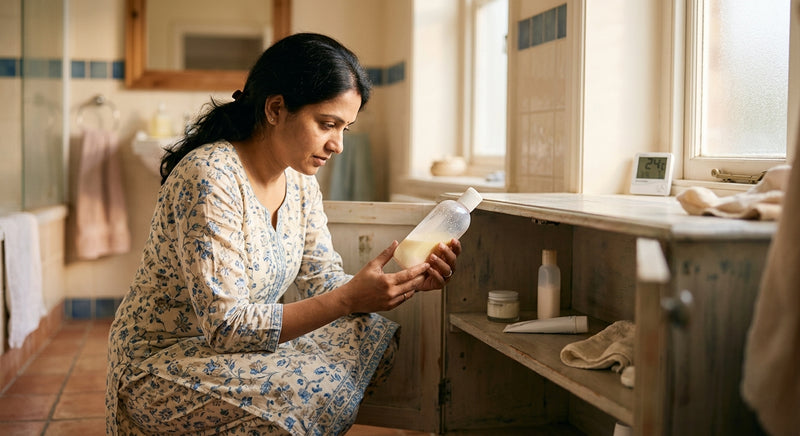
- Pass two: wash. Lukewarm water and a small amount of a mild, soap-free cleanser to lift the oily residue. Our Kids Gentle Body Cleanser is formulated for exactly this age group, but any low-foam, fragrance-light cleanser that doesn't leave her face feeling tight will do the job.
- Eyes, carefully. Eyes closed, a cotton pad with a little oil, held still for ten seconds, then one wipe outward. If liner went on the waterline, it has to come off that night - and ask the teacher to keep liner above the lash line next time.
- Moisturise within three minutes of patting dry, while the skin is still slightly damp. Everyone skips this step at 10pm. It is the one that decides whether Sunday morning is comfortable.
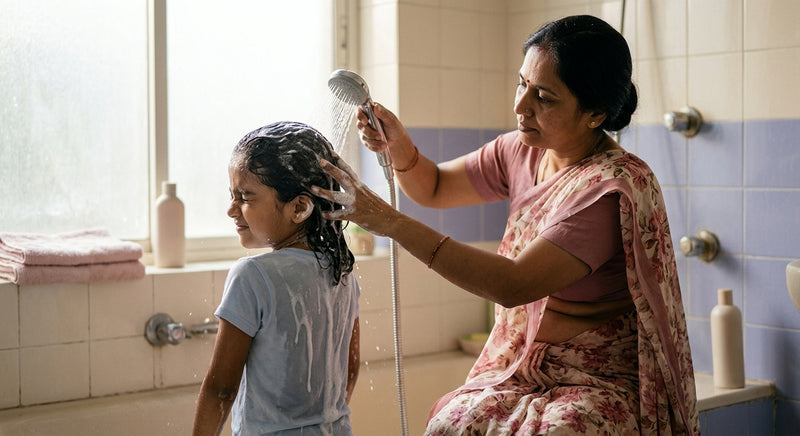
- Body, if there's any left in her. A quick lukewarm rinse to get sweat and pigment out of the neck folds and off the back under the costume blouse. If she's half-asleep, a damp cloth on the neck and chest holds until morning.

What to reach for, and what to put away
| On her for the show | Take it off with | Never |
|---|---|---|
| Pancake / cake foundation | Oil or balm, 2 minutes soak, then a mild cleanser | Scrubbing with a towel; adult micellar wipes with high fragrance |
| Kumkum or sindoor bindi | Oil on a cotton pad, held still, then wash | Rubbing the same spot repeatedly - it's the thinnest skin you're working on |
| Sticker bindi | Peel slowly after softening the edge with oil | Spirit, acetone or picking at dry adhesive |
| Alta on soles and palms | Oil massage, then a cleanser; accept 2-4 days of fading | Nail-polish remover, bleach, a pumice stone, hot water soaks |
| Eyeliner and kajal | Oil on a pad, eyes closed, one outward wipe | Anything foaming or fragranced near the eye; kajal inside the waterline |
| Heavy oil, gel and spray in the bun | One shampoo, section by section, conditioner on the mid-lengths | Two or three back-to-back washes to "get it all out" |
The hair needs its own line, because the dance bun is engineered against gravity: oil, gel, spray, a false plait, kunjalam, pins, and a pull tight enough to change the shape of her eyebrows. Getting all that out follows the same logic as the post-Holi hair rescue routine - detangle before water, wash in sections, condition the ends, and resist the urge to wash three times in a row. And loosen the bun the moment she's off stage, in the wings if you can. A pull that tight, week after week through performance season, is a slow cost to her hairline.
Two minutes before the makeup goes on
Removal gets ten times easier if you spend two minutes before the makeup goes on.
- Moisturise 20 to 30 minutes before makeup. A thin layer, fully absorbed. Pigment lifts off a conditioned surface far more readily than off dry, slightly flaky skin - and dry skin is what grabs pancake down into the texture. Don't do it five minutes before, or the makeup will slide.
- Don't clean her up too hard that morning. A stripped face before a four-hour makeup session is the worst possible starting point. Plain water is enough.
- Pack her own kit. Her kumkum, her pancake, a small bottle of oil, cotton pads, her cleanser. Green-room sharing is how one child's reaction becomes four children's reaction.

One big night vs ten weeks of rehearsals
A single arangetram, done properly, is a non-event for the skin. The season is what accumulates. Eight performances through a dry December, each ending in a hard clean-up, air-conditioned green rooms in between, hard water in unfamiliar taps - that's when I start hearing about flaking around the nose, chapped lips, a forehead that stings when you touch it.
Through that stretch the fix is boring, and it works. Moisturise twice a day whether or not she performed. Add one extra layer on the face the night after a show. If the performance calendar lands in festival season, with smoke and diyas and crowds, the same thinking applies as in our notes on the post-Diwali week and on smog-season skin care: less cleansing, more barrier. For a school-concert evening rather than a classical programme, our guide to removing annual day stage makeup safely covers the lighter, one-off version of this routine.
When to see a doctor
Take her to a paediatrician or dermatologist - don't wait for the next show - if you see any of this:
- A patch that is clearly bindi-shaped and is itchy, scaly, or paler than the skin around it.
- Redness, swelling or weeping that is still there 48 hours after the makeup came off.
- Any swelling of the eyelids, or an eye that is red, watery or painful.
- Burning or stinging that starts during a performance, or the same reaction twice from the same product.
- Pus, crusting or spreading warmth - that needs same-week medical attention, not a home remedy.
Carry the actual box or bottle to the appointment. Being able to show a doctor the ingredient list of the kumkum turns a guess into an answer.
For the night after a show, when her face has been made up for four hours and then cleaned, a rich layer of our Hydra Healing Moisturizing Balm helps comfort dry, sensitive skin and supports the skin's natural barrier while she sleeps.
In summary
- Pancake, kumkum and alta are usually fine for a few hours - harsh removal is what causes the morning-after redness.
- Remove in two passes: oil or balm to dissolve for two minutes, then a mild soap-free cleanser, then moisturiser within three minutes.
- Patch-test any new kumkum, pancake or sticker bindi on the inner forearm 48 hours before a show, and keep her own kit in her dance bag.
- Never use spirit, acetone, nail-polish remover or a pumice stone on a child's skin - accept that alta takes two to four days to fade.
- Show a doctor any bindi-shaped patch that is itchy, scaly or pale, any swelling near the eye, or redness still present 48 hours later.
Frequently asked questions
Is pancake makeup safe for a 6-year-old classical dancer?
For a few hours on healthy skin, it is generally fine, and generations of young dancers have worn it. The risk sits in two places: sweat trapped under an occlusive layer for hours, and harsh removal afterwards. Keep the made-up time as short as the programme allows, patch-test a new brand 48 hours ahead, and always remove it with oil plus a mild cleanser rather than scrubbing.
How do I remove stage pancake from my child's face without scrubbing?
Work in two passes. Massage a plain oil or a thick balm over the dry made-up skin for about 90 seconds, then let it sit another minute so the pigment loosens into a slurry. Wipe once with a soft damp cloth, flat and in one direction. Then wash with a mild, soap-free cleanser and lukewarm water, and moisturise within three minutes of patting dry.
Can kumkum cause a skin reaction on a child's forehead?
Yes, it can. Commercial kumkum may contain synthetic dyes, fragrance, preservatives and binders, and sticker bindis carry adhesive. The telltale sign is shape: an itchy, scaly or paler patch sitting exactly where the bindi was, sometimes after months of use. Keep one tested box for your child, avoid borrowing from the green room, and show any persistent patch to a doctor.
How do I get alta off my child's feet and hands?
Slowly, and mostly you don't. Alta is a dye and it will fade over roughly two to four days. Massage in a plain oil, wash with a mild cleanser, and repeat the next evening. Never use nail-polish remover, acetone, bleach, a pumice stone or hot soaks on a child's soles - they strip the skin and the stinging lasts far longer than the colour.
Should I moisturise before applying dance makeup?
Yes - about 20 to 30 minutes beforehand, in a thin layer that absorbs fully. Pigment lifts off conditioned skin far more easily than off dry, slightly flaky skin, which grabs pancake into its texture. Don't apply it five minutes before makeup or the foundation will slide. Also skip any hard cleansing that morning; plain water is a better starting point.
She performs weekly through December - what changes?
The accumulation, not any single night. Eight clean-ups across a dry month, plus air-conditioned green rooms and unfamiliar hard water, is what produces flaking and a stingy forehead. Through performance season, moisturise twice daily whether or not she danced, add an extra layer the night after a show, and resist the urge to cleanse more often than usual.