Holi night. The bathroom floor is already pink, your child is standing under the light with green in the parting, and the whole room smells faintly of talc. By the next morning my messages are full of the same question you are asking right now: how hard can I scrub tonight?
Less than you think. Most of the colour that is going to leave will leave in one gentle wash, and then over the next two days. Whether your child's hair feels soft again by the weekend is decided in the ten minutes after the rinse. Not by force. Force is the belief that costs Indian kids a week of tangles every March, and it is the hardest one to talk a parent out of at ten at night.
At a glance
- Comb the dry powder out before water touches the hair — water turns gulaal into paste.
- Lukewarm water, one shampoo, head tilted back. Hot water and repeat washes strip lipids, not pigment.
- Conditioner is the rescue step, not a luxury — it puts back the slip the wash took away.
- Lemon, vinegar, baking soda: none of them dissolve dye, and all of them rough up the cuticle.
- Colour still sitting there on day three has to fade out. It will, with every wash.
This one sits inside our complete guide to festival and seasonal skincare for kids, next to the prep side of the same weekend.
What washes out, and what has to fade
There is no single thing called Holi colour. Dry gulaal made on a cornflour or arrowroot base with a food-grade dye mostly sits on the hair shaft and rinses away. The wet colours are a different animal, and so are the silver and gold pastes and the cheap dark powders sold loose by the kilo: mica, oil bases, dyes meant to stain. Those work into the cuticle. On fine hair, light hair, or hair that was already dry before the day started, they hold on for days. For the buying side of this, we went through it in detail in which Holi colours are actually safe for kids' skin.
Most of what parents call stubborn colour is one of three things. Pigment settled into a porous, already-damaged cuticle. Pigment held in old oil and sebum on the scalp. Or pigment that was never in the hair to begin with — it is on the hairline, the ears, the hair ties. The first one will not come out tonight, however long you stand there with the mug. The other two come off easily. And it is usually the hairline that makes a child look still-coloured from across the room, which is why the skin side of the clean-up matters as much as the hair wash.
The advice that goes around every Holi
| What parents do | What it does | Do this instead |
|---|---|---|
| Hot water, because it "opens the pores" | Heat swells the cuticle and strips the oil that was protecting it. Whatever colour lifts is the same colour lukewarm water would have lifted. The hair just ends up rougher. | Lukewarm water, head tilted back, 2-3 minutes before any shampoo. |
| Three or four shampoos on Holi night | The second wash lifts a little. The third lifts almost nothing and takes the hair's own lipids with it. You get squeaky, tangle-prone hair for a week. | One wash tonight. One more next morning, and only if it is genuinely gritty. |
| A lemon or vinegar rinse to "cut" the colour | Acidic rinses flatten the cuticle, so hair looks shinier. They do not dissolve dye. And on a scalp that has been in the sun and then scrubbed, citrus stings and can leave it red and itchy. | Skip it. Conditioner does the smoothing you were after. |
| Baking soda paste on the scalp | Strongly alkaline. It swells and roughens the cuticle, so hair looks duller and knots worse for days afterwards. | Nothing alkaline on a child's hair, ever. |
| Pouring oil on right after Holi to "pull" colour out | Oil is a barrier before colour, not a solvent after it. Poured onto a colour-coated head it makes a paste that traps pigment, and then needs extra shampoo to get off. | Oil on day two, after the first clean wash, an hour before the next one. |
| Booking a haircut on Monday | Colour on the shaft fades with every wash and grows out. A full chop rarely solves anything except crunchy split ends. | Trim only the ends that feel brittle between your fingers. |
The oiling one deserves a line more, because it surprises parents most. Oil works. Just on the other side of the day. A scalp and lengths oiled an hour before play take up far less pigment, which is the whole point of our pre-Holi oiling checklist. Once the colour is on, oil traps it.
Tonight, in this order
About twelve minutes, start to finish. That is the difference between soft hair on Tuesday and a detangling session that ends in tears.
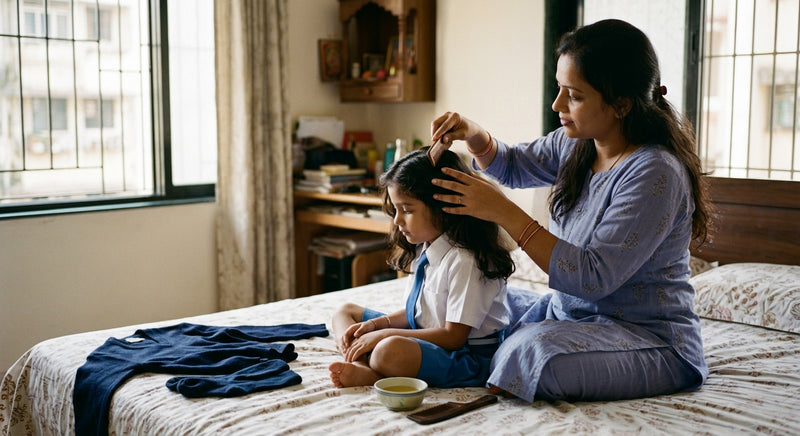
- Take them outside, or stand them over a dustbin. Shake the hair out, then run a wide-tooth comb from the ends upwards to lift the loose powder. Every gram you get out dry is a gram that never becomes paste.
- Wipe the hairline, behind the ears and the nape with a damp cotton pad. That border holds colour longest, and it is where parents always miss it.
- Rinse with plain lukewarm water for a full 2-3 minutes, head tilted back so the coloured water runs away from the eyes. No shampoo yet.
- One coin-sized blob of a mild, tear-free shampoo for shoulder-length hair. Fingerpads into the scalp, never nails — a Holi scalp has usually taken some sun and some scrubbing already. Let the lather rinse down the lengths. Don't pile the hair up on top of the head.
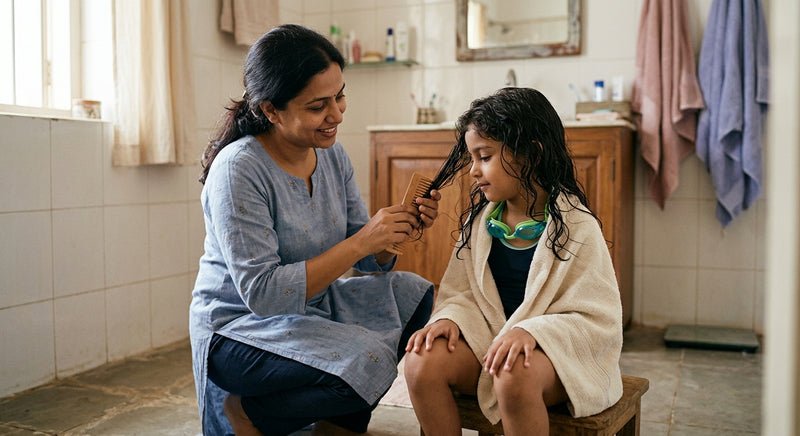
- Conditioner from ear-level down. Leave it 3-5 minutes, then comb through with a wide-tooth comb while it is still in. This is the detangling step. Doing it later, on dry hair, is what causes the tears.
- Rinse. Squeeze the water out with an old cotton t-shirt rather than rubbing with a towel, and let it air dry loose. No damp braid, no tight ponytail tonight.
Day two to day five: the softness-back part
This is where the repair happens, and it is dull work. Shampoo every second day, not daily, however much the leftover tint bothers you. Condition at every wash — every one, no exceptions. On the morning of day two, once the bulk of the colour is off, a light scalp massage with whatever oil you keep at home, an hour before the wash, helps the scalp settle. Detangle in sections, nape then sides then crown, before the hair goes anywhere near water.
And stop reading the mirror for day-one results. A faint pink tint on the ends of light hair is not your routine failing. It is pigment inside a porous cuticle, and it lightens with each wash.
What to look for in the shampoo you reach for tonight
A post-Holi scalp has had a day of it: sun, friction, dust, dye. What matters tonight is not how much colour a shampoo can strip, but how little it takes from a barrier that has already had a rough day. So: a mild surfactant system. Tear-free, because the rinse water will run down a face on Holi night. A pH suited to children's hair. And a light fragrance load rather than a heavy one, on skin that may already be a bit reactive. Anything sold as clarifying, deep-cleansing or anti-residue is built to strip. Leave it on the shelf.
If you want one that fits that brief, our Loving & Balancing Shampoo was built as a mild, tear-free wash for children's hair, and it is made in our own GMP-certified facility.
If tonight's wash has left the ends dry and knotty, look for a conditioner with real slip — enough that a wide-tooth comb passes through while it is still in the hair — in a mild formula suited to children. Ours is the Rejuvenating & Detangling Conditioner, and a few patient minutes with it helps soften and comfort dry ends.
When to see a doctor
Most post-Holi scalps are just dry and a little sensitive for two or three days. See a paediatrician or a dermatologist if scalp redness or intense itching hasn't settled after 48 hours. Go too for any weeping, crusting or pus-filled bumps along the hairline, swelling of the face or eyelids, hives anywhere on the body, colour in the eyes with pain or persistent redness, or any breathing difficulty after exposure to a powder. And go if the itching is keeping your child awake. A child who scratches a scalp raw at night needs treatment, not another wash.
In summary
- Comb dry powder out of the hair before water touches it — water turns gulaal into paste.
- Use lukewarm water and exactly one gentle shampoo on Holi night; extra washes strip lipids, not pigment.
- Leave conditioner on for three to five minutes and comb it through while it is still in — that is the detangling step.
- Skip lemon, vinegar and baking soda, and never use kerosene, spirit, bleach or nail-polish remover on a child.
- Shampoo every second day the following week and let the remaining tint fade rather than scrubbing for it.
Frequently asked questions
How do I get Holi colour out of my child's hair fast?
Comb the dry powder out before any water touches the hair, then rinse with lukewarm water for two to three minutes with the head tilted back. Follow with one mild shampoo and a three to five minute conditioner soak, combing through while it is still in. Anything beyond one wash removes hair lipids rather than pigment.
Why is the colour still in my child's hair after washing?
Because some of it is inside the cuticle, not on top of it. Wet colours, silver and gold pastes and cheap loose powders carry dyes designed to stain, and fine, light or dry hair absorbs them. That pigment fades with each subsequent wash and grows out. Repeated scrubbing on Holi night will not shift it any faster.
Should I oil my child's hair after Holi to remove the colour?
Not straight away. Oil is a barrier before Holi, not a solvent afterwards. Poured onto a colour-coated head it forms a paste that traps pigment and then needs extra shampoo to remove. Wash first, then from day two do a light scalp massage about an hour before the next wash to help the scalp settle.
Is a lemon or baking soda rinse safe for getting Holi colour out?
Neither dissolves dye. Baking soda is strongly alkaline and swells the cuticle, leaving hair duller and far more prone to tangling for several days. Lemon stings a scalp that has had sun and friction all day and can leave it red and itchy. Use a conditioner instead for the smoothing effect you were hoping for.
How often should I wash my child's hair in the week after Holi?
Shampoo every second day, and use conditioner at every wash. Daily shampooing to chase the last of the tint strips the hair faster than the colour fades, which leaves you with more tangles and a drier scalp. Detangle in sections before the hair goes near water, and avoid tight ponytails on damp hair.
When should I take my child to a doctor after Holi?
See a paediatrician or dermatologist if scalp redness or intense itching has not settled within 48 hours, or if there is weeping, crusting or pus-filled bumps at the hairline, facial or eyelid swelling, hives, eye pain or redness, or any breathing difficulty after exposure to a powder. Night-time scratching that breaks the skin also needs medical review.