Ghee is fine on small patches of a baby's intact skin — chapped lips, a dry cheek, rough knees in December. It is a poor all-over moisturiser for a newborn. And there are four places it should never go: inside the nose, in the ears, on the umbilical cord stump, and on any skin that is broken, weeping or angry. The reason sits in one word. Ghee seals. It cannot hydrate. Hold on to that and most of the other ghee questions sort themselves out.
My nani had one method and she never varied it. A spoon of ghee warmed over the gas. Tested on the inside of her wrist. Pressed into a baby's cheeks before the winter air got to them. She wasn't wrong to do that. But the questions that actually reach me are almost never about cheeks. They're "can I put two drops of ghee in his nose for the blockage?", "can I do malish with ghee instead of oil?", "dadi is rubbing ghee and honey on his gums, is that okay?" Three questions, three different answers, and one of them is genuinely unsafe. This piece sits inside our complete guide to Indian baby traditions and which ones are actually safe.
At a glance
- Ghee is an occlusive — close to pure milk fat, with the water driven off. It seals moisture in. It can't put moisture back.
- Reasonable uses: a rice-grain amount on chapped lips, a dry cheek, rough elbows and knees — on damp, unbroken skin.
- Never: inside the nose or ears, on the cord stump, on a burn, or on broken, oozing skin.
- Kitchen ghee carries traces of milk protein and has no preservative system. That matters most on eczema-prone skin.
- Warm it to body temperature, never hot. Test on your own inner wrist, not your palm — the palm is a bad thermometer.
What do Indian families actually use ghee for on a baby?
In most Indian homes ghee lands in about eight places on a baby. Those eight are nothing like each other, and filing them all under "the ghee tradition" is how a harmless habit and a risky one end up sharing one verdict. So here they are, separated out.
| Traditional use | What's really happening | My verdict |
|---|---|---|
| Dry cheeks, elbows, knees in winter | A fat film slows water loss from the surface | Fine — on damp skin, thin layer |
| Chapped lips | Seals a lip that's chapped from drool and licking | Fine — the most benign use of all |
| Full-body malish instead of oil | High-drag fat that needs pressure to spread | Adapt — see below |
| On the navel or cord stump | Traps moisture on a healing wound | No — keep it clean and dry |
| Drops in the nose or ears | Oily fluid near an infant airway | No — real aspiration risk |
| Rubbed on gums while teething | Messy; often paired with honey, which is the actual danger | No under 12 months |
| On cradle cap scales | Adds grease to an already greasy scalp | Poor choice |
| On a burn or a scald | Holds heat in the tissue and adds contamination | Never |
Is ghee actually good for a baby's skin?
Let me answer this as a formulator rather than as a granddaughter. Ghee is butter simmered until the water boils off and the milk solids drop out and get strained away. Butter is roughly 16% water. Ghee is 99%-plus fat — mostly palmitic, stearic and myristic acids with a good slug of oleic, plus the short-chain butyric acid that gives it that unmistakable smell. Almost no water means almost nothing for microbes to grow in. That is why an Indian kitchen can keep a dabba of it on the counter through May and nothing happens.
Skin needs three jobs done. A humectant pulls water into the outer layer. An emollient fills the gaps between skin cells so it feels smooth. An occlusive caps the whole thing so the water doesn't evaporate. Ghee does the third job well. It does the first one not at all.
Which explains something every mother notices without being able to name it: ghee seems wonderful straight after the bath, and useless at four in the afternoon on a dry Delhi winter day. On skin that is already parched, an occlusive simply locks the dryness in. A baby's skin is also 20-30% thinner than an adult's, so it loses water faster to start with. It needs the humectant part more, not less.
When is ghee not right for a newborn's skin?
Seven situations. I hold the line on all seven.
1. On broken, weeping or eczema-prone skin. Home ghee carries traces of milk protein — especially hand-churned bilona ghee, which is prized precisely for keeping some of its character. Up to ~48.6% of babies experience atopic-type skin issues, so this isn't some rare edge case. The honest position: no trial tells us ghee on skin causes milk allergy. But damaged skin is a poor place to introduce a food protein, and dermatologists are cautious about it for good reason. Settle the skin first with a proper moisturiser. Save the ghee for calm days.
2. Through ghamori season. Prickly heat is blocked sweat ducts. Laying an occlusive film over blocked ducts works against you.
3. On a newborn's face in the milia and baby-acne weeks. For those first six weeks, heavy fats on the cheeks and nose tend to make the bumps look worse rather than better.
4. On the umbilical stump. Dry and exposed heals faster than greased and covered. Nothing goes on it. Not ghee, not oil, not haldi.
5. In the nose or ears. This is the one I will interrupt someone mid-sentence for. Oily fluid near a small airway can be inhaled, and the lung inflammation that follows is slow to show and slow to settle. It deserves more room than a bullet point, so we wrote it up separately: oil in a baby's nose and ears — the tradition and the real risk.
6. On a burn or scald. Cool running water for a full 20 minutes. Ghee holds heat against the tissue and gets in the way of anyone assessing the wound afterwards.
7. When the ghee has turned. Fats oxidise. Rancid ghee smells like old crayons, or like drying paint — faint, but once you've caught it you can't un-catch it. Oxidised fat is an irritant. Bin it.
Can I use ghee for baby malish?
You can. Most families who try it are back on oil inside a week, and the reasons are all very ordinary ones.
Ghee is solid below about 30°C, which in a Pune or Lucknow January is exactly when you want it — so you are warming it every single time. Come May in Nagpur it's a liquid that runs off the baby and into the mattress. It has high drag, so you press harder to spread it without realising, and the whole point of infant malish is light, rhythmic, low-pressure contact. It also doesn't come off with water and a hand the way a light oil does. The residue holds dust, marks clothes, and in the hard water most of north and west India lives with, plain soap leaves a scum on top of the grease that makes everything worse.
If you're going to use it anyway: use less than you think — about half a teaspoon for a whole 3-month-old — warm it in a steel katori set in hot water instead of straight over the flame, and plan the wash before you start. What you want is a genuinely mild cleanser. Syndet-style (soap-free) foam, low surfactant load, tear-free, able to lift fat without stripping the skin. Ours is the Head to Toe Baby Foam Wash, and that's the spec worth looking for whoever makes it. Traditionally, of course, families scrubbed the oil off with ubtan instead — which is its own question, answered here: why paediatricians say wait on ubtan for a newborn.
Ghee on lips, gums and cheeks: what's fine and what isn't
Lips — go ahead. Safest ghee use there is. Babies lick their lips, and ghee is food, so the usual worry about what ends up in the mouth doesn't apply here. Fix the cause as well, though: most chapped baby lips come from drool and licking, not from the weather. Wipe the lips dry with a soft cloth first, then seal. Sealing a wet lip is what keeps the cycle running.
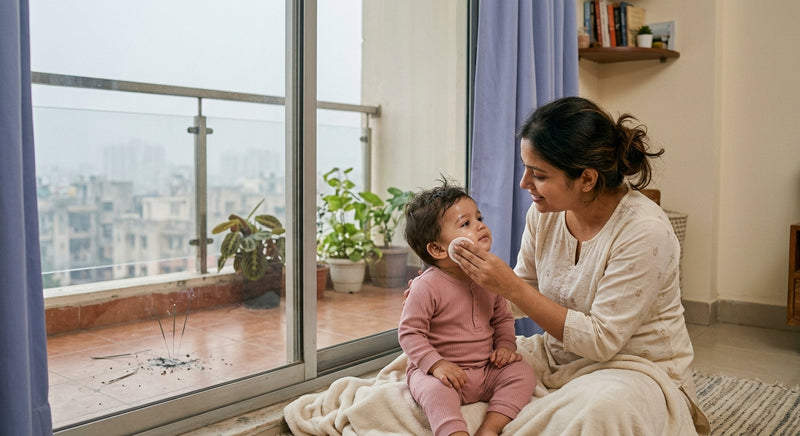
Cheeks — fine, if you're quick. Apply within about three minutes of patting dry after the bath, while there's still water in the skin to trap. The same ghee on a dry cheek at 4pm does very little.
Gums — skip it. No evidence it eases teething, and it's the vehicle honey usually arrives on. A clean finger, or a chilled (not frozen) teether, does more.
- Decant a small amount into a separate steel dabba kept only for skin — never dip fingers into the family cooking ghee.
- Clean, dry spoon every time. Water in the dabba is how ghee spoils.
- Warm to body temperature in a katori set in hot water. Test on your inner wrist — it should feel like nothing at all.
- Patch test first: a smear inside the forearm, leave 24 hours, check for redness before you go anywhere near the face.
- A rice-grain amount per patch, within 3 minutes of patting dry after the bath.
- Skip it altogether on any day the skin is broken, weeping, or showing prickly heat.
- Smell it before every use. Crayon or paint notes mean it's oxidised. Throw it out.
When to see a doctor
Call your paediatrician if redness spreads, weeps, or crusts golden-yellow; if a rash hasn't started settling in three to four days of gentle care; or if your baby is scratching through sleep. Go the same day for any burn, however small, and for a baby under three months with anything spreading quickly. If ghee or oil has gone into the nose and your baby then coughs, wheezes, or breathes faster than usual, that needs to be seen today, not tomorrow. And if a rash keeps coming back to the same spots, name every home application out loud — ghee, oil, ubtan, powder. Doctors can only weigh what they're told about.
So — keep it, adapt it, or stop it?
Keep it for lips, for dry patches on calm skin, and for the two minutes of it that are really about you and the baby, not the skin. Malish needs adapting — less product, proper warming, a real wash afterwards. And stop it outright for the nose, the ears, the cord stump, burns and broken skin. Ghee was one of the traditions we weighed up in Dadi Kehti Hain: 10 traditions to keep, adapt or stop, and it landed in the "adapt" column. For something this old, and this loved, that seems like the fair place for it.
On the nights when skin needs more than a seal — winter cheeks, dry patches, a barrier that's struggling — a formulated balm built for that job is the better tool. Ours is the Hydra Healing Moisturizing Balm.
In summary
- Ghee seals moisture in but cannot add it — so it only works applied to damp skin, within three minutes of patting dry after a bath.
- Keep ghee for chapped lips and small dry patches on calm, unbroken skin; a rice-grain amount is enough.
- Never put ghee in the nose or ears, on the cord stump, on a burn, or on broken, weeping or eczema-prone skin.
- For malish, use half a teaspoon warmed in a katori set in hot water, keep the pressure light, and follow with a mild soap-free wash.
- Store skin-use ghee in a separate steel dabba, scoop with a dry spoon, and discard it the moment it smells like old crayons or paint.
Frequently asked questions
Can I apply ghee on my newborn's face?
On small dry patches of unbroken skin, yes — a rice-grain amount on damp skin after a bath. Avoid it across the whole face in the first six weeks, when milia and baby acne are common and heavy fats tend to make the bumps look worse. Never apply it to broken, weeping or infected skin, and stop if any redness appears.
Is ghee good for baby massage instead of oil?
It works, but it's harder than oil. Ghee solidifies below about 30°C, so you're warming it every time in winter, and it has high drag — you end up pressing harder than infant massage should be. It also doesn't rinse off easily, especially in hard water. If you use it, take half a teaspoon for a 3-month-old, warm it in a katori set in hot water, and follow with a mild soap-free wash.
Why should ghee never go in a baby's nose or ears?
Oily fluid near a small airway can be inhaled into the lungs, causing an inflammation that shows up slowly and takes a long time to settle. Babies can't clear it the way older children can. There is no blocked-nose benefit that justifies the risk — saline drops and a bulb syringe do the job safely. If ghee has gone in and your baby coughs, wheezes or breathes faster, see a doctor the same day.
Is bilona or A2 ghee safer for a baby's skin?
Not meaningfully, for skin. Hand-churned ghee is prized for retaining more character, which also means slightly more residual milk protein — the opposite of what you want on eczema-prone or broken skin. What matters far more is that it's fresh, stored in a separate dry dabba used only for skin, scooped with a clean spoon, and discarded the moment it smells like old crayons.
Can I put ghee on my baby's gums while teething?
There's no evidence it helps, and it's usually the vehicle for honey — which is unsafe for any baby under 12 months because of infant botulism risk, including raw and organic honey. A clean finger massaged on the gums, or a chilled (never frozen) teether, gives more relief. If your baby is in real distress, ask your paediatrician rather than reaching for a home mix.
My mother-in-law puts ghee on the navel. Is that okay?
Not while the cord stump is healing. A stump heals fastest kept clean, dry and exposed to air — ghee traps moisture against what is effectively an open wound. Nothing should go on it: not ghee, not oil, not haldi, not antiseptic powder. Once the stump has dropped off and the area has fully healed, a little ghee on dry skin there is harmless.