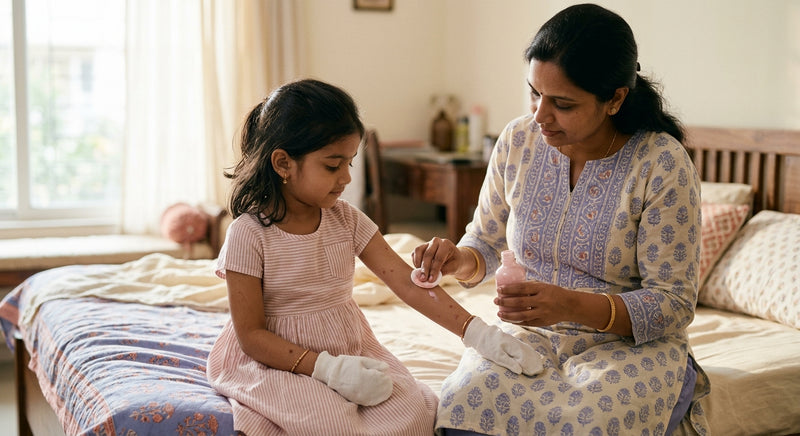
You squeeze a fat blob of lotion onto your palm, look at your tiny baby, and pause. Too much? Not enough? The truth is a newborn needs almost nothing — a pea to a small almond covers most of the body — and the amount only creeps up as they grow. Most of us use two to three times what we actually need. That's how a bottle disappears in three weeks and your baby ends up sticky instead of soothed.
I sit on the other side of this. I formulate and make these products in our own facility in Nagpur, so "how much" is a question I chew on every day. A well-built cream spreads further, which means your hand reaches for less. What follows is what a baby genuinely needs at each stage, put in things you can hold up and see: an almond, a coin, two fingers. And if you want to know when each product first earns a place in the day, our complete guide to buying and age-gating baby skincare sits right alongside this one.
At a glance
- A newborn's whole body needs about a pea-to-almond of moisturiser — roughly one fingertip's worth.
- Amounts grow with the child, not the worry: a junior needs 3-4 fingertips, a newborn barely one.
- For bath, think a coin of wash, not a handful — more foam doesn't mean cleaner.
- Sunscreen starts at 6 months; before that, shade and clothing do the job.
- A good formulation spreads further, so "using less" is often a sign the product is working, not failing.
How much moisturiser does a baby actually need?
Less than you'd think. Dermatologists measure it with the fingertip unit (FTU) — the ribbon of cream you squeeze from the tip of an adult index finger down to the first crease. That's about half a gram, and it's enough for two adult palms of skin.
Scaled to a baby, it looks like this:
- Newborn (0-3 months): a pea to a small almond for the whole body — about 1 FTU, patted on in a thin layer.
- Baby (3-12 months): an almond-size, roughly 1.5-2 FTU.
- Toddler (1-3 years): 2-3 FTU, more if their legs and arms run dry.
- Junior (3+ years): 3-4 FTU for a full body after a bath.
Why so little for the littlest ones? A baby's skin is 20-30% thinner than an adult's. It absorbs faster and reacts faster, so you're tending a delicate barrier, not painting a wall. A thin, even film that sinks in within a minute is doing more than a thick, shiny coat that just sits there.
Formulation does a lot of quiet work here. A moisturiser built on real occlusives and emollients glides and holds; a watery one flashes off and tempts you to reapply. If you're still choosing one, our breakdown of what a baby's routine looks like from month 0 to year 5 shows how the amount and the texture shift with the seasons — more in a dry Nagpur winter, less in a sticky monsoon.
How much wash or shampoo for one bath?
A coin, not a handful. Baby skin doesn't get "dirty" the way we picture it — it's mostly milk, drool, sweat and the odd nappy escape. You're rinsing, not scrubbing. A small amount of a gentle, tear-free cleanser is plenty.
- Newborn: a few drops, or a 5-paisa-coin size, worked into warm water.
- Baby (3-12 months): one small pump, or a rupee-coin size.
- Toddler and junior: one to two pumps, depending on how muddy the day got.
Foam is a texture, not a measure of clean. Over-washing with too much product is actually one of the quiet reasons baby skin turns dry and tight — you strip the natural oils faster than the barrier can rebuild them. Two to three baths a week is enough for most babies in a cool season. Daily is fine in peak summer, but keep them short and gentle.
How much sunscreen — and does a baby even need it?
Under 6 months, skip the sunscreen. What a young baby needs is shade and clothing. The barrier and the metabolism are both still maturing, so the guidance is to keep them out of direct sun, use a pram hood, a wide brim and light long sleeves, and save the cream for later.
From 6 months, sunscreen joins the routine — and now quantity really does decide the outcome, because under-applying is the single most common mistake parents make. Sunscreen is only as strong as the layer you actually put on.
- Face and neck: the two-finger rule — a line of cream along both your index and middle fingers.
- Whole body (toddler): roughly one to two teaspoons, spread generously, nothing rubbed to invisibility.
- Reapply every 2 hours of outdoor play, and after water or heavy sweat.
And mind the spots everyone forgets: ear tops, the back of the neck, the hairline, the tops of little feet in sandals. For a full walk-through of ages, SPF and reapplication at school, we've written a dedicated guide on what age kids can start sunscreen, conditioner, face wash and deodorant. A gentle mineral formula like the Daily Defender Kids Mineral Sunscreen is made for exactly this kind of generous, everyday use.
How long should one bottle actually last?
Here's the commercial question sitting under all the others, and it doubles as a reality check. Moisturise a baby once or twice a day with an almond-size each time, and a 180g tub of balm should comfortably run for weeks, not days. If it's vanishing faster than that, you're almost certainly over-applying.
| Age | Moisturiser (whole body) | Wash per bath | Sunscreen |
|---|---|---|---|
| Newborn (0-3 mo) | Pea–small almond (~1 FTU) | A few drops | Not yet — shade & clothing |
| Baby (3-12 mo) | Almond (~1.5-2 FTU) | Coin-size / 1 small pump | 6 mo+: two fingers face, ~1 tsp body |
| Toddler (1-3 yr) | 2-3 FTU | 1 pump | Two fingers face + 1-2 tsp body |
| Junior (3+ yr) | 3-4 FTU | 1-2 pumps | Two fingers face + generous body, reapply 2h |
Two honest notes on making a bottle last. Buy for the stage you're in, not the whole childhood — a newborn's needs change month to month. And a concentrated, well-made formula genuinely goes further than a diluted one; you're paying for what's in it, not for water. That's part of why we make our own formulations in a GMP-certified facility instead of buying white-label. We get to control how rich, and how spreadable, each batch actually is.
When to see a doctor
Amounts are for everyday care. Book a paediatrician if you notice skin that's cracked, weeping, bleeding or crusting; a rash that spreads or doesn't settle within a few days of gentle care; signs of infection like pus, warmth or fever; or any patch that clearly bothers your baby with itching or pain. No quantity of cream replaces a proper look from your doctor when something's off.
When you do reach for a daily moisturiser, a little of a barrier-supporting balm like the Hydra Healing Moisturizing Balm goes further than a lot of a thin lotion. Which, really, is the whole point.
In summary
- Measure moisturiser in fingertip units: a newborn needs about 1, a junior 3-4 for the whole body.
- Use a coin-size of wash, not a handful — more foam doesn't mean cleaner, and over-washing dries skin out.
- Start sunscreen at 6 months; before that rely on shade, a hat and light clothing.
- Apply sunscreen generously — two fingers for face and neck — and reapply every two hours outdoors.
- A well-made, concentrated formula spreads further, so using less is often a sign it's working.
Frequently asked questions
How much moisturiser does a newborn need?
Very little. About a pea to a small almond-size covers a newborn's whole body — roughly one fingertip unit of cream. A baby's skin is 20-30% thinner than an adult's, so a thin, even film that sinks in within a minute does more than a thick, shiny coat. Warm it between your palms first and go back for a second dab only on dry patches.
What is a fingertip unit for baby skincare?
A fingertip unit (FTU) is the ribbon of cream squeezed from the tip of an adult index finger to the first crease — about half a gram, enough to cover two adult palms of skin. It's a simple way to measure: a newborn needs roughly 1 FTU for the whole body, a toddler 2-3, and a junior 3-4.
How much sunscreen should I put on my child?
Use the two-finger rule for face and neck — a line of cream along your index and middle fingers — and about one to two teaspoons for a toddler's whole body. Apply generously and reapply every two hours of outdoor play, and after water or heavy sweat. Under-applying is the most common mistake; sunscreen only works as strong as the layer you actually put on.
Does a baby under 6 months need sunscreen?
No. For babies under 6 months, the guidance is shade and clothing rather than sunscreen — a pram hood, a wide-brimmed hat and light long sleeves. Their barrier and metabolism are still maturing. From 6 months onwards, a gentle mineral sunscreen joins the routine for exposed skin during outdoor time.
How much baby wash should I use in a bath?
A coin-size, not a handful. A few drops for a newborn, one small pump for an older baby, one to two pumps for a toddler or junior. Baby skin mostly needs rinsing, not scrubbing, and more foam doesn't mean cleaner. Over-washing with too much product is a quiet cause of dry, tight skin, so keep baths short and moisturise afterwards.
How long should a tub of baby moisturiser last?
If you're using an almond-size once or twice a day, a 180g tub should run for weeks, not days. If it disappears far faster, you're likely over-applying. A concentrated, well-made formula also goes further than a diluted, watery one — you're paying for what's in it, not the water — so spreadability is worth checking.