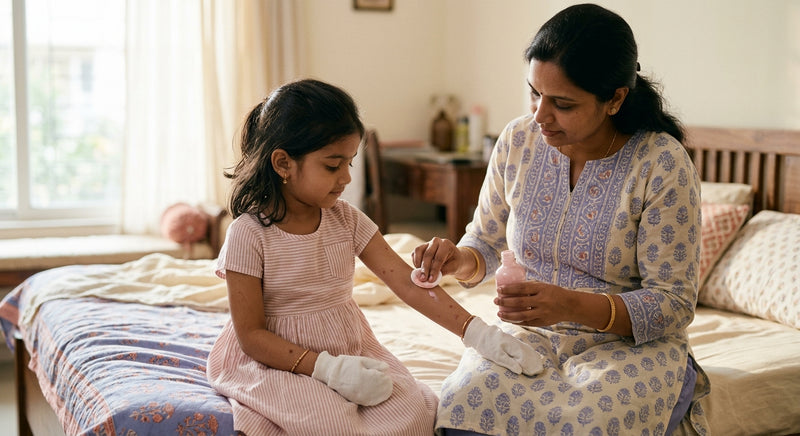
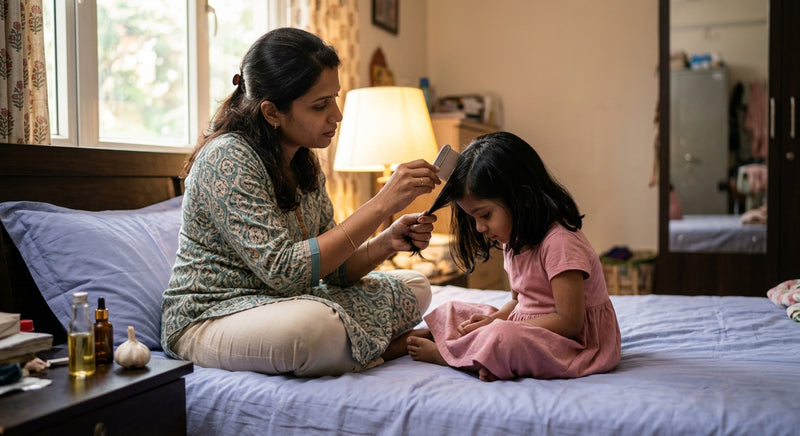
It's 11pm. Your baby has scratched both cheeks raw again, and your phone is full of advice: coconut oil from your mother, besan and haldi paste from your aunt, neem water from a WhatsApp group, heated mustard oil with garlic from someone who swears it fixed their child in a week.
Some of that list is harmless. Two of those things genuinely help: plain virgin coconut oil, short lukewarm baths, and moisturising while the skin is still damp. Several will make a flare visibly worse inside a day or two, almost always for the same three reasons. They raise the skin's pH. They involve rubbing. Or they carry a potent botanical that eczema-prone skin cannot cope with. And a few of them — camphor, boric powder, kajal, antiseptic liquid in the bathwater — should not go on an infant at all.
I formulate baby skincare for a living, in our own GMP facility in Nagpur. Years of that work come down to one question: why does an ingredient behave beautifully in a jar and badly on inflamed skin? That distinction is the whole article. There's a wider view of the traditions themselves in our complete guide to traditional baby-care practices and their safety.
At a glance
- Keep: short lukewarm baths, plain virgin coconut oil as an emollient, moisturising within three minutes of a bath, gentle malish on calm skin.
- Adapt: ghee (lips and small dry patches only, fresh spoon), oats (colloidal, not kitchen oats in a sock), neem (lukewarm strained leaf water at most — never neem oil).
- Stop: besan-haldi scrubbing, multani mitti, reetha, soap, baking soda baths, heated mustard-garlic-ajwain oil, fresh aloe straight from the plant, olive oil massage.
- Never on a baby: camphor (kapoor), boric powder, kajal, antiseptic liquid in the bath.
- An eczema flare that is weeping, yellow-crusted, or comes with fever needs a paediatrician the same day — not a remedy.
Why do traditional remedies backfire on eczema skin specifically?
Most of these remedies are fine on ordinary skin. That is why they lasted. Eczema-prone skin is a different surface, and three things change.
The pH problem, and it's the biggest one
Healthy baby skin sits at a surface pH of roughly 5, slightly acidic. That acid mantle is not decoration. The enzymes that hold the outer layer together work at that pH; the ones that pull it apart get faster as pH climbs. Eczema-prone skin already runs more alkaline than it should.
Then look at what goes into the bucket. Reetha (soap nut) saponins, besan slurry, multani mitti and any true soap all land somewhere between pH 8 and 10. One steel-tumbler bath with soap on a flaring baby can undo a week of moisturising. In most Indian cities hard water pushes it further: the calcium and magnesium leave a film that irritates on its own. If I could change one thing in a house, it is this one. Stop the alkaline wash.
Friction, which is the whole point of an ubtan
Ubtan works by mechanical exfoliation. On a baby with eczema you are rubbing grain flour across a barrier that is already broken, and the itch-scratch cycle takes over from there. Turmeric brings a second problem. It stains, so you lose the ability to see how red the skin actually is, and curcumin is a recognised contact allergen in a small number of children. We've written separately on why paediatricians ask you to wait before using ubtan on a newborn. On eczema, wait longer.
The oil matters more than whether you oil at all
Parents find this one hard, because "oil is oil" feels obvious. It isn't. The fatty acid profile decides whether an oil supports the barrier or dissolves it.
- Virgin coconut oil is around half lauric acid, sits well on baby skin, and is the one kitchen oil I'm comfortable recommending as a plain emollient on calm, intact skin.
- Olive oil is high in oleic acid, which is known to disorganise the lipid layers of the outer skin. It is the traditional massage oil in many homes. It is the wrong choice on eczema.
- Mustard oil heated with garlic and ajwain is three hits at once: erucic acid, the pungent isothiocyanates that give sarson its bite, and allicin from the garlic. That combination is a counter-irritant. Warmth and redness are the point of it. On a flare it stings, and I have seen it turn a patch of dry eczema into a weeping one overnight. Hot oil on an infant also risks a burn.
Ghee sits in the middle. It is an occlusive and it does hold water in. But a family jar that fingers go into is unpreserved and repeatedly contaminated, and that matters when the skin is broken. Small patches, lips, a fresh spoon. That is the safe version, and we go into the detail of which traditional uses of ghee on baby skin are actually safe elsewhere in the Journal.
Remedy-by-remedy: keep, adapt or stop?
| Remedy | What it does to eczema-prone skin | Verdict |
|---|---|---|
| Virgin coconut oil, plain | Lauric-acid-rich emollient; sits well, soothes dryness on intact skin | Keep — on calm skin, not on weeping patches |
| Short lukewarm bath (5-10 min, ~37°C) | Hydrates the skin before you seal it; hot water strips lipids and triggers itch | Keep |
| Malish (gentle massage) | Calming and bonding; only the oil and the pressure need changing | Keep, on calm skin, light pressure, no rubbing of patches |
| Ghee on dry patches or lips | Occlusive, holds water in; the home jar is the risk, not the ghee | Adapt — fresh spoon, small area only |
| Oats in the bath | Colloidal oatmeal has real soothing evidence; kitchen oats in a sock mostly makes a mess | Adapt — use colloidal oatmeal in a formulation |
| Neem leaf water | Astringent and drying; strained lukewarm leaf water is usually harmless but does little. Neem oil is far too potent for infants | Adapt at most; never neem oil |
| Besan-haldi ubtan | Friction on a broken barrier, alkaline slurry, staining, occasional turmeric allergy | Stop |
| Multani mitti / reetha / soap | Raises skin pH well above 5, strips the lipids the skin cannot spare | Stop |
| Baking soda bath | pH around 8.3 — the opposite of what an acid mantle needs | Stop |
| Heated mustard + garlic + ajwain oil | Counter-irritant by design; stings broken skin, burn risk when hot | Stop |
| Fresh aloe cut from the plant | The yellow latex near the rind is irritant; unmeasured and unpreserved | Stop |
| Olive oil massage | High oleic acid disorganises the barrier lipids | Stop |
| Camphor (kapoor) in oil, boric powder, kajal, antiseptic liquid in the bath | Absorption and toxicity risks through thin infant skin; no benefit on eczema | Never |
What to do tonight
None of this needs buying. Change the bath, and change the timing.
- Clear the bathroom shelf. Every soap, ubtan mix, reetha and multani mitti, for the next two weeks. One decision, biggest effect.
- Lukewarm water. Test it with your elbow, not your hand; if it feels warm, it's too warm. Five to ten minutes, no longer.
- One gentle wash, and only on the neck folds, nappy area, hands and feet. The rest of the body genuinely does not need cleanser every day.
- Pat dry, don't rub. Leave the skin slightly damp.
- Moisturise within three minutes, generously. Soak and seal. Of everything in this article, this is the one with the strongest evidence behind it.
- Trim the nails tonight. Soft cotton mittens for sleep. Most of the overnight damage is fingernails, not the eczema itself.
- Fragrance-free detergent, one extra rinse, and no fabric conditioner on baby clothes.
- Two lines in a notebook each night: what you used, how the skin looked. The trigger shows up on paper long before you would remember it.
For the bath itself, look for a stated skin-friendly pH, no soap base, a short fragrance-free ingredient list, mild surfactants. That was the brief we wrote our Head to Toe Baby Foam Wash against: pre-foamed means less product, less rubbing, a shorter bath.
When to see a doctor
Also see a doctor if the flare keeps your baby awake most nights, if two weeks of consistent gentle care hasn't improved it, or if it is affecting feeding and weight gain. Eczema in babies is common and manageable. It still needs a diagnosis rather than a guess: what looks like eczema can be a fungal rash, scabies or an infection, and each needs something different. A paediatrician may also prescribe a short course of a topical medicine. Use it as directed. A moisturiser is the base layer under it, not a replacement for it.
What I look for in a formula instead
When parents ask what to use instead of the kitchen remedy, my answer is deliberately boring. A short ingredient list. No fragrance, no essential oils, no colourant. A skin-friendly pH. Humectants to draw water in, emollients to soften, occlusives to hold it there, instead of one hero ingredient printed on the front of the pack. Traditional botanicals are welcome, at a tested concentration in a preserved base, not measured by hand into an open jar.
And I want the evidence said plainly. Our own formulations are tested in-vivo, and in a lab study one showed increased Keratin-10 and Filaggrin expression, the proteins that build the outer skin layer. That is what "helps support the skin barrier" actually means. Subjects showed visibly calmer skin in as little as 1 day. I can defend that sentence. "Cures eczema" nobody honestly can.
Which of your family's other traditions to keep, and which to quietly retire, is the subject of our honest look at ten baby traditions worth keeping, adapting or stopping. Most come through the scrutiny fine. Eczema is where the few that don't show up fastest.
When you're ready to swap the kitchen jar for something formulated for this skin, our Hydra Healing Moisturizing Balm is made to comfort dry, eczema-prone skin and help support its natural barrier.
In summary
- Keep short lukewarm baths, plain virgin coconut oil and gentle malish on calm skin — these traditions hold up.
- Stop every alkaline wash first: soap, reetha, multani mitti and besan slurry push skin pH well above the healthy ~5.
- Skip heated mustard-garlic-ajwain oil, olive oil massage, ubtan friction and fresh aloe latex during a flare.
- Camphor, boric powder, kajal and antiseptic liquid in the bathwater have no place on an infant.
- Moisturise generously within three minutes of the bath, trim nails tonight, and see a paediatrician for weeping, crusting, fever or no improvement in two weeks.
Frequently asked questions
Is coconut oil good for baby eczema?
Plain virgin coconut oil is the one kitchen oil I'm comfortable suggesting. It's rich in lauric acid, sits well on baby skin, and works as a simple emollient on dry but intact patches. Apply it within three minutes of a lukewarm bath. Avoid it on weeping, cracked or infected-looking skin, and don't expect it to do the work of a full barrier moisturiser during a flare.
Can I use besan and haldi ubtan on a baby with eczema?
No. An ubtan works by friction, and rubbing grain flour across skin with an already-broken barrier sets off the itch-scratch cycle. The slurry is also alkaline, which pushes skin pH away from its healthy acidic range. Turmeric stains, so you lose the ability to judge how red the skin really is, and curcumin is an occasional contact allergen in children.
Is neem water safe for a baby's eczema bath?
Strained, lukewarm neem leaf water is usually harmless but does very little, and neem is astringent enough to leave skin drier than before. Neem oil is different and far too potent for infants. If you want a bath additive with actual soothing evidence behind it, colloidal oatmeal in a proper formulation is the better choice over anything brewed at home.
Why does heated mustard oil with garlic make eczema worse?
That mixture is a counter-irritant by design. Mustard's isothiocyanates and garlic's allicin deliberately create warmth and redness, which is the last thing inflamed skin needs, and mustard oil is high in erucic acid. On broken skin it stings and can turn a dry patch into a weeping one. Hot oil on an infant also carries a genuine burn risk.
How soon after a bath should I moisturise eczema-prone baby skin?
Within three minutes, while the skin is still slightly damp. The bath puts water into the outer skin layer and the moisturiser holds it there — that's the soak-and-seal idea, and it has the strongest evidence of anything in this article. Pat dry rather than rubbing, and be generous with the amount. Twice daily beats once daily during a flare.
When should I stop home remedies and see a doctor?
Stop and call your paediatrician the same day if the skin is weeping, has yellow or honey-coloured crusts or small blisters, is spreading fast, or if your baby has a fever, is drowsy or off feeds. Also see a doctor if a new remedy has made things worse within 48 hours, or if there's no improvement after two weeks of consistent gentle care.