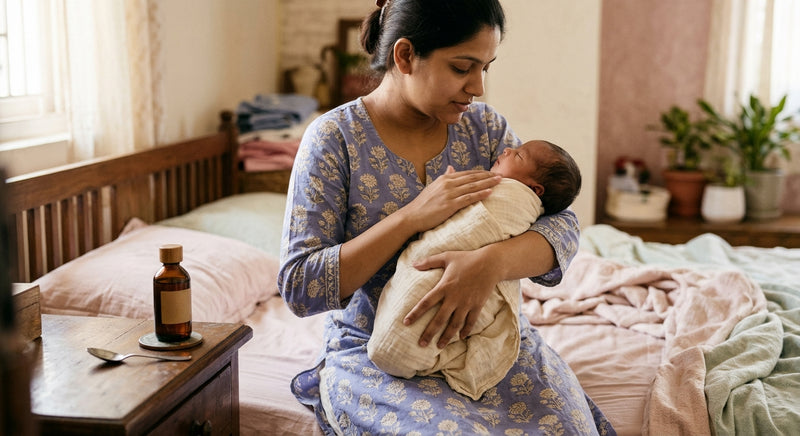
It's 2am on day four at home. Your baby latches, and it feels like glass going in. Someone has handed you a small tube that says lanolin, and you're standing in the bathroom at the end of the feed wondering whether you're meant to wipe it off before the next one.
You don't. That's the short version. The longer one: lanolin nipple cream is purified wool wax — a thick, slightly tacky balm that sits on the surface of the skin and slows water loss, so a sore or cracked nipple stays soft instead of drying into a scab that splits open again at the next feed. A pea-sized amount per side, after a feed, is the entire dose. The purified grades sold for nursing are made so that you don't have to wipe them off before your baby feeds again.
And the part nobody puts on the tube: lanolin does not fix why you're sore. That is almost always the latch.
At a glance
- Lanolin is purified wool wax — an occlusive, meaning it forms a layer that holds moisture in rather than soaking in like a lotion.
- Dose is tiny: pea-sized per nipple, warmed between your fingertips, dabbed on — never rubbed in.
- Nursing-grade purified lanolin is designed not to need wiping off before a feed.
- It comforts; it doesn't correct a shallow latch. If feeding still hurts after 48 hours, get the latch watched by a doctor or lactation consultant.
- Indian weather changes the routine: thin layers and air-drying in humid summer and monsoon, a proper layer in dry winter and AC rooms.
This sits inside our complete guide to skincare for mothers, because nipple care in the first fortnight rarely arrives alone. It usually comes bundled with dry hands, a tight scar line, and skin that behaves nothing like it did before.
What is lanolin, exactly?
Lanolin is the waxy substance sheep produce to waterproof their own fleece. It's collected when wool is cleaned, then refined. The grade sold for nursing is usually labelled ultra-purified or hypoallergenic anhydrous lanolin — "anhydrous" meaning no water, which is why it needs no preservative and why it feels like soft candle wax rather than cream.
Chemically it behaves a lot like the lipids in human skin, which is why it spreads thin and clings. It is an occlusive, not a humectant. A lotion pulls water into the skin; lanolin stops the water that's already there from evaporating. That sounds like a technicality until you picture what a nipple actually goes through — soaked, stretched and air-dried a dozen times a day. Skin that stays pliable bends at the next latch. Skin that has dried stiff tears along the same line it tore along yesterday. The older advice of letting a cracked nipple "dry out and harden" is the opposite of what current lactation support teaches.
Does lanolin need to be washed off before a feed?
No. That one misunderstanding is the commonest reason parents abandon the tube. Purified nursing lanolin is sold specifically so it can stay on. Wiping it off with a tissue before every feed costs you twice: it removes the layer you just applied, and the friction of wiping is itself part of why the skin is raw.
Dab, don't rub. Rubbing a balm into a nipple that already has a fissure hurts, properly, and it pushes the edges of the split apart. Warm the dose between two fingertips first so it goes on as a film instead of a drag.
How do you actually use it? A routine for tonight
This is the version I give friends over the phone. Ninety seconds per feed, give or take.
- Feed on the less sore side first, when the baby is calmest and sucking hardest.
- At the end of the feed, break the latch gently with a clean finger in the corner of the baby's mouth rather than pulling off.
- If a drop of milk comes easily, spread that on the nipple first and let it dry — it costs nothing and it's already there.
- Take a pea-sized blob of lanolin, warm it between your index finger and thumb for five seconds until it turns glossy.
- Dab it over the nipple and the areola, especially the base where cracks sit. No rubbing.
- Sit with your bra open for five minutes before covering up. In summer and monsoon this step is not optional.
- Use a cotton nursing pad, not a plastic-backed one, and change it when it feels damp — not on a schedule.
- Do not soap the nipple in the shower. Plain water, patted dry with a soft towel.

How does Indian weather change the way you use lanolin?
Most of the instructions printed on these tubes were written for temperate countries. An occlusive balm behaves very differently at 38°C with 80% humidity in Chennai than it does in a dry Delhi January. The adjustment comes down to two things: how much you use, and how long you stay covered.
| Season | What goes wrong | How to adjust |
|---|---|---|
| Peak summer (Apr–Jun) | Sweat under the breast plus a thick occlusive layer leaves skin soggy and tender; pads stick and pull on removal | Halve the amount. Air-dry 5 minutes. Change pads more often than you think you need to. Wipe the fold under the breast with plain water and pat dry. |
| Monsoon (Jul–Sep) | Nothing dries — bras, pads, towels. Trapped damp around the areola is the setup for itchiness and fungal trouble, not just soreness | Thin film only. Cotton pads, changed the moment they're damp. Dry bras indoors near a fan, and keep a spare set so you're never reusing a half-dry one. |
| Dry winter (Nov–Feb) | This is when lanolin earns its keep. Cold, dry air plus a room heater pulls moisture out of everything, and cracks heal slowly | Use the full pea-sized layer after each feed. Keep the room humid — a bucket of water near the heater helps more than it sounds like it should. Warm the tube in your palm first; cold lanolin is impossible to spread. |
| Year-round AC | Sitting under a vent during long night feeds dries the skin exactly where you least want it dry | Angle the vent away from the feeding chair. Reapply after the night feeds, which are the longest gaps between applications. |
And hard water, which quietly makes all of it worse
If you're in Delhi, Hyderabad, Jaipur or large parts of Maharashtra, your bath water is hard. Hard water plus soap leaves a residue that is drying in its own right, and nipple skin in week two has no spare capacity for that. The fix costs nothing: no soap, no body wash, no ubtan on the nipple and areola. Plain water is enough. Those glands produce their own lubricant, and scrubbing it off every morning is a quiet cause of soreness nobody tells you about.
When lanolin is the wrong answer
Honestly, most cracked nipples I've come across are a latch problem wearing a skincare disguise. A balm will take the edge off while the skin surface recovers. But if the baby is taking only the nipple tip instead of a good mouthful of areola, you re-injure the same spot at the next feed and conclude that the cream doesn't work. Get someone experienced to watch one full feed. That single appointment is worth more than any tube.
Lanolin is also the wrong tool when:
- You're sensitive to wool. Purified grades greatly reduce the wool-alcohol fraction that people react to, but they don't eliminate the possibility. If wool clothing makes you itch, patch test on your inner forearm for 24 hours first.
- The pain is burning or shooting, after the feed rather than during it, and your nipples look shiny or flaky — or your baby has white patches inside the cheeks. That combination needs a doctor to look at both you and your baby rather than another balm; don't try to work out the cause yourself.
- There's a wedge of red, hot, painful breast tissue and you feel flu-ish. That's a breast, not a skin, problem. Same day medical advice.
- Your nipple blanches white and then throbs in cold weather — warmth helps, balm doesn't. Mention it to your doctor.

What to look for on the label in India
Tubes here range from single-ingredient lanolin to "nipple butters" blended with shea, cocoa butter and beeswax. Both can work. What I'd check, in order:
- A short ingredient list. For something staying on skin your baby will mouth, five ingredients beats twenty-five.
- The words purified, ultra-purified or hypoallergenic before "lanolin" — pharmaceutical-grade refining is the whole point.
- No fragrance, no added flavour, no menthol or camphor.
- No "wipe off before feeding" instruction. If the pack says to remove it, believe the pack — it isn't a nursing-grade product.
- A sealed tube, not a tub. You'll be using this with one hand at 3am.
- Storage sense. Keep it out of direct sun. Anhydrous balms soften in a Nagpur May and turn stiff in a January night — both are normal, neither is spoilage.
Two other options are worth knowing about. Hydrogel pads feel wonderful on a hot afternoon, though they need careful hygiene in monsoon humidity. And expressed breastmilk is free and already to hand — spread a drop after a feed and let it air-dry before you cover up.
When to see a doctor
Book an appointment with your doctor, obstetrician or a lactation consultant — don't wait it out — if any of these are true:
- Feeding still hurts sharply after 48 hours of trying to correct the latch.
- A crack is bleeding, widening, oozing yellow fluid, or has a crust that keeps rebuilding.
- You have fever, chills, or a hot red area on the breast.
- Burning or stabbing pain between feeds, or white patches in your baby's mouth.
- Your baby isn't gaining weight or seems unsettled at every feed, however the nipple looks.
- You get itchy, bumpy redness spreading beyond where you applied the balm — stop it and ask about a lanolin sensitivity.
Nipple pain in the first week is common. Nipple pain that is still this bad in week three is a signal, and it deserves someone's eyes on it rather than another tube.
The rest of your skin, while you're at it
The nipples get all the attention, and meanwhile your knuckles are splitting from washing bottles, your shins are ashy, and there's a dry patch on your forearm from the hospital tape. If you've had a caesarean, the scar line has its own timeline — we've written separately about what actually helps a C-section scar and what to avoid. Night-time is usually the only window you get for your own skin, and the choices change while you're nursing — that's covered in our guide to a postpartum night routine that's melasma-aware and nursing-safe. And if the itching started in pregnancy and never quite left, read when itchy skin in pregnancy needs a doctor before you treat it as ordinary dryness.
For hands, arms and legs, what you want is a short ingredient list, no fragrance, and real barrier support rather than a thin lotion that disappears in an hour — our Hydra Healing Moisturizing Balm is made for exactly that job (it's been shown in a lab study to help support the skin barrier, with increased Keratin-10 and Filaggrin expression), and it's gentle enough for the whole family's dry skin — just not a stand-in for a nursing-grade nipple cream.
In summary
- Lanolin nipple cream is purified wool wax that forms a layer on the skin, keeping a sore or cracked nipple soft instead of letting it dry and split again at the next feed.
- Use a pea-sized amount per nipple after each feed, warmed between your fingertips and dabbed on — nursing-grade lanolin is made so you don't have to wipe it off.
- Thin the layer and air-dry for five minutes in summer and monsoon humidity; use the full layer in dry winter and AC rooms, and keep soap and hard water off the nipple entirely.
- Lanolin comforts the skin surface but doesn't correct a shallow latch — if feeding still hurts after 48 hours, get a full feed watched by a doctor or lactation consultant.
- See a doctor for fever, a hot red area on the breast, burning pain between feeds, white patches in your baby's mouth, or a crack that bleeds or keeps crusting over.
Frequently asked questions
Do I need to wash lanolin off before breastfeeding?
No. Purified nursing-grade lanolin is sold precisely so it can stay on between feeds. Wiping it away removes the layer you just applied, and the friction of wiping is itself part of why the skin is raw. Dab it on at the end of a feed and leave it. If a pack instructs you to remove it before feeding, it isn't a nursing-grade product.
Is it okay if my baby swallows a little lanolin?
The amount transferred is very small, which is why the purified grades are formulated to be left on. Use a pea-sized dose, not a thick smear, and keep to products made for nursing. If your baby is preterm, has a feeding issue, or you're simply unsure, ask your paediatrician to look at the tube by name before you start.
Can I use coconut oil or ghee instead of lanolin?
They're kinder than most kitchen improvisations, but they soak in and evaporate rather than forming a lasting layer, so they do less for a crack that keeps re-opening. Coconut oil also goes rancid fast in Indian heat. Expressed breastmilk is the better free option: spread a drop after a feed and let it air-dry before you cover up.
Will lanolin make things worse in Mumbai or Chennai humidity?
It can, if you use too much. A thick occlusive layer under a damp nursing pad in 80% humidity leaves the skin soggy and tender. Halve the amount, sit with your bra open for five minutes before covering, use cotton pads rather than plastic-backed ones, and change them whenever they feel damp instead of on a schedule.
How long before cracked nipples feel better?
Comfort often shifts within a day or two once the latch changes, while a visible crack takes longer to close. The honest test is direction, not speed: if nothing at all has improved after 48 hours of latch correction and consistent balm use, stop troubleshooting alone and get a full feed watched by your doctor or a lactation consultant.
Can I use lanolin if I'm allergic to wool?
Be cautious. Ultra-purified grades remove most of the wool-alcohol fraction people react to, but not all of it. Patch test a small amount on your inner forearm and leave it 24 hours before putting it anywhere near a feeding area. If you get itchy, bumpy redness there — or spreading beyond where you applied it — stop and ask your doctor for an alternative.