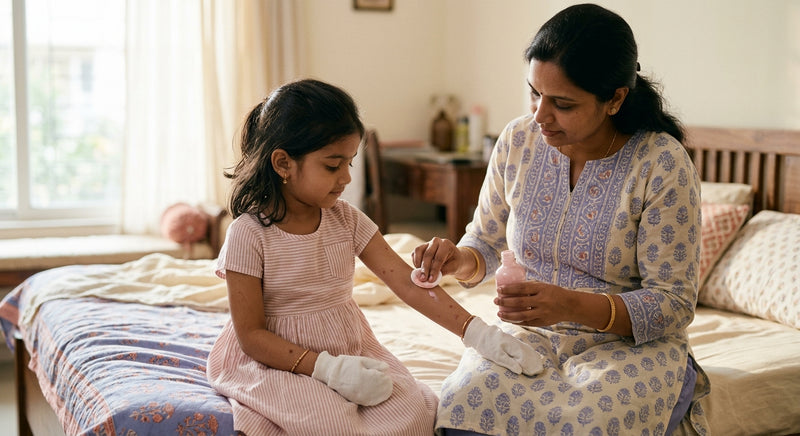
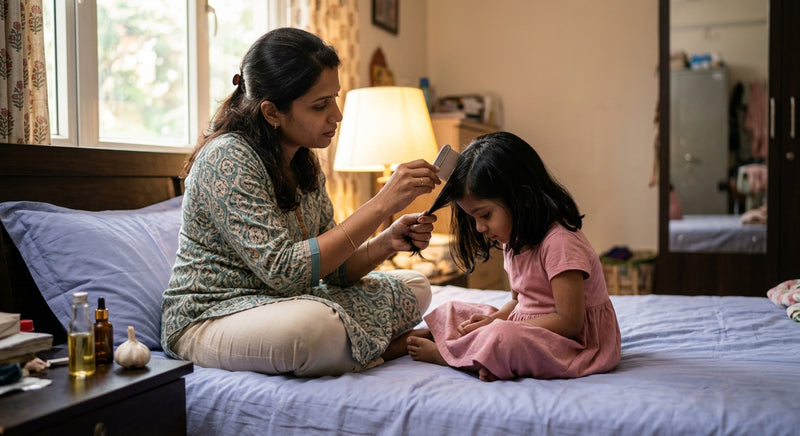
It is a question we hear often from parents of eleven- and twelve-year-olds. The skin under a daughter's arms has darkened over the past year, and a grandmother has a plan: a wedge of lemon and a pinch of haldi, rubbed in every night before the bath. It's natural. What's the harm?
The honest answer is: please don't. Neat lemon juice on skin that later meets sunlight can cause a genuine chemical burn, called phytophotodermatitis. Turmeric paste triggers contact rashes in a small but real number of children, and it stains uniform sleeves yellow. Irritation itself also deposits more pigment, which means the remedy usually darkens the very patch it was meant to fix. In a tween, underarm colour is almost always friction, sweat and irritation. It is not dirt. It will not scrub off.
At a glance
- Lemon juice contains psoralens, compounds that make skin react badly to sunlight. The burn can appear a day or two later and leave a dark mark for months.
- Turmeric is generally well tolerated in a diluted ubtan. Neat paste on thin underarm skin is the highest-risk way to use it.
- Darkening in a fold is usually friction, sweat, hair and irritation. Scrubbing adds inflammation, and inflammation adds pigment.
- Stop every home remedy for a week. Wash gently, dry properly, and give it eight weeks before you judge.
- Velvety, thickened darkening across the neck and underarms together needs a paediatrician, not a scrub.
Why do Indian families reach for lemon and haldi in the first place?
Because both have earned their place. Haldi has been part of ubtan for generations, and turmeric's role in traditional skin preparations isn't nonsense; it has been studied for its anti-inflammatory activity. Lemon turns up in kitchen remedies because acid does, technically, loosen dead surface cells. Neither ingredient is stupid. What goes wrong is the dose, the dilution and the site.
Ubtan is besan, a little haldi, milk or curd, patted on the body and rinsed within minutes. Neat lemon juice rubbed into an armpit nightly for six weeks is a different thing altogether. The old preparations carried their own safety rails: dilution, a short contact time, a rinse at the end. Strip a remedy down to "just rub the lemon on" and those rails come off. This article sits inside our complete guide to tween body changes, where most of the questions follow the same shape. Something new is happening to a child's body, and the family remedy is stronger than the situation calls for.
What goes wrong when lemon meets an Indian afternoon
Citrus juice, whether lemon, lime or bergamot, contains furocoumarins, better known as psoralens. On skin that is later exposed to UV, psoralens amplify the sun's effect dramatically. What follows is phytophotodermatitis: redness, sometimes blistering, in odd streaky shapes wherever the juice ran. It typically shows up 24 hours or more after the exposure, which is why parents rarely connect the two. The mark it leaves behind is a deep brown that can take months to settle.
Now picture the actual week of an Indian eleven-year-old. Sports period in a half-sleeve PT shirt. Sleeveless kurta at a cousin's wedding. Annual day rehearsals in the school ground. A swim on Sunday. Arms go up all day, and underarm skin sees far more sunlight than we assume. That is the collision: lemon at night, sun by eleven the next morning.
Underarm skin is thin, folded, and in a tween it is often micro-irritated already. New hair. A razor tried in secret. A deodorant that stings. A school bag strap rubbing all the way home on the bus. Neat lemon on skin like that hurts. Children rarely say so, because they think the sting means it is working.
Turmeric: gentler, but not harmless
Turmeric is the friendlier of the two, and I want to be fair to it. Most children tolerate a diluted ubtan on the body without a whisper of trouble. But turmeric is also a recognised plant contact allergen for a small number of people, and an underarm is the worst possible place to find that out. It is occluded, warm, and rubbed all day. A reaction there is itchy, weepy and miserable.
Turmeric also stains, and not only the skin. The school shirt, the sports vest, the good kurta. More than one family has given up on the remedy purely because of yellow rings on white sleeves.
| What you've been told | What actually holds up |
|---|---|
| Lemon lightens dark underarms | Lemon juice is acidic and carries psoralens. On skin that later meets sunlight it can burn, and that burn leaves its own dark mark for months. |
| Haldi is natural, so it's safe anywhere | Fine for most children in a diluted ubtan that gets rinsed off. Neat paste, left on thin underarm skin overnight, is the riskiest way to use it. |
| Dark underarms mean the area isn't being washed properly | Colour in a fold comes from rubbing, sweat, hair and irritation. It isn't grime, and it doesn't come off. |
| Daily scrubbing will sort it out | Friction is a cause, not a cure. Every scrub adds inflammation, and inflammation is exactly what deposits extra pigment. |
| It's purely cosmetic, so we can experiment | Usually it is cosmetic. But velvety, thickened darkening across the neck and underarms together deserves a paediatrician's opinion. |
So why has my child's underarm skin actually darkened?
Somewhere between eight and thirteen, the adrenal glands wake up. That one shift explains a lot of what changes in this period: the new body odour, and the way a child's hair suddenly goes greasy overnight. Underarms get the same memo. More sweat, more oil, and the first hair.
On top of that sit the mechanical causes, and in Indian school life they stack up fast:
- Friction. Tight sleeve seams, a school bag strap, a synthetic PT shirt, the cycle ride to tuition, dance class. Skin that is rubbed repeatedly thickens and darkens. This is the most common cause in this age group.
- Damp. A sweaty fold that never fully dries stays inflamed, and inflamed skin pigments. From peak summer through the end of the monsoon, that fold barely gets a dry hour.
- Product irritation. Strong deodorants and body sprays borrowed from an older sibling are a common trigger. If you're weighing this up, we've gone through it properly in deodorant at 10 — or just a better bath routine.
- Early hair removal. Razors, threading and especially hair-removal creams on a nine- or ten-year-old's underarm cause repeat micro-irritation. The darkening often begins the month the removal begins.
- Post-inflammatory pigment. Whatever irritated the skin, a rash or a remedy or a scrub, leaves colour behind as it heals. That is why aggressive treatment backfires.
In most tweens it is the first three, together. Which is convenient, because all three answer to the same thing: less friction, less product, more drying time.
What to do tonight instead
- Stop everything on that skin tonight. Lemon, haldi paste, toothpaste, baking soda, ubtan on the underarm, adult de-tan creams. For one week, water and a gentle wash, nothing else.
- Wash with lukewarm water and a mild, soap-free cleanser. Twenty seconds, with fingertips. No loofah, no scrub, no rubbing the area "clean".
- Dry it properly. Lift the arm, pat with a soft towel, then give it 30 seconds of air before the shirt goes on. This one step changes more than any cream.
- Move to cotton sleeves for school and sport, and check where the seam sits. A seam cutting into the armpit rubs all day.
- At night, a thin layer of a plain barrier cream on the fold, for comfort while the skin settles.
- If she's using a deodorant or a body spray, park it for two weeks and watch what settles.
- Give it eight full weeks before you judge anything. Friction marks fade slowly, if they fade.
About that night cream: keep the ingredient list short, keep the fragrance low, and skip anything with actives in it. This is an already-irritated fold, and it needs far less than a face does. A simple, barrier-supporting balm is enough. Our Hydra Healing Moisturizing Balm is one option — dermatologically tested, and formulated to help support the skin's natural barrier and comfort dry, sensitive skin. A pea-sized amount does the job. Any more just sits there in a fold that needs to breathe.
When to see a doctor
Book a paediatrician appointment if you notice any of these:
- Darkening that looks velvety and thickened, especially if it appears on the back of the neck and the underarms together. This pattern needs medical assessment, not skincare.
- The darkening arrives alongside rapid weight gain, skin tags, or a family history of diabetes or PCOS.
- Itching, blistering, weeping or pain, particularly after a home remedy has been used.
- Recurring painful lumps or boils in the fold.
- Colour on one side only, or a patch that is spreading quickly.
- Any darkening in a child under seven, where puberty-related change wouldn't be the expected explanation.
None of this is something you or I can diagnose at home, and there's no need to worry your way through a weekend. A fifteen-minute consult settles it.
The promise nobody should make you
No product should promise to lighten your daughter's skin, and ours never will. That includes the ones marketed at adults with confident language and a before-and-after. The claim doesn't hold up, and it teaches an eleven-year-old that a normal part of her body is a defect to be corrected.
What I can tell you truthfully is this. When the rubbing stops, when the fold stays dry, when the harsh products go away and the skin is left alone, the area usually looks calmer and more even over a couple of months. Nothing bleached it. You stopped injuring it. That takes longer than a wedge of lemon, and it is the version that works.
If you're rebuilding the daily wash around this, start with a mild, soap-free cleanser made for school-age skin. Our Kids Gentle Body Cleanser is formulated for exactly that job.
In summary
- Stop lemon, turmeric paste, toothpaste, baking soda and adult de-tan creams on your child's underarms tonight — they irritate, and irritation adds pigment.
- Lemon juice plus sunlight can cause a real burn (phytophotodermatitis) that shows up a day later and leaves a mark for months.
- In tweens, underarm darkening is usually friction, sweat and product irritation — not dirt, so scrubbing makes it worse.
- Wash gently with fingertips, dry the fold fully with 30 seconds of air, switch to cotton sleeves, and use a thin layer of a plain barrier cream at night.
- See a paediatrician if the darkening is velvety and thickened, appears on the neck too, or comes with itching, blistering or rapid weight gain.
Frequently asked questions
Is lemon juice safe for a child's underarms?
No. Lemon juice contains psoralens, which make skin far more reactive to sunlight. Applied to underarms and followed by sun exposure — a sports period, a swim, a sleeveless outfit — it can cause phytophotodermatitis, a burn that appears a day or two later and leaves a dark mark lasting months. On thin, already-irritated tween skin it also stings badly.
Can I use turmeric on my child's underarms instead?
Diluted turmeric in a rinse-off ubtan on the body is usually fine. Neat turmeric paste left on the underarm overnight is not a good idea — the fold is warm, occluded and constantly rubbed, which is the worst place to discover a contact allergy. Turmeric is also a well-known plant allergen for a small number of people, and it stains uniform sleeves.
Why do my 11-year-old's underarms look darker than the rest of her skin?
Most often it's friction, sweat and irritation rather than pigment gone wrong. Tight sleeve seams, bag straps, synthetic PT shirts and early hair removal all rub the same fold daily, and repeatedly rubbed skin thickens and darkens. Puberty adds more sweat and oil. Damp folds that never fully dry stay inflamed, and inflammation deposits extra colour.
Will scrubbing the area help lighten it?
No — it usually makes it worse. Friction is one of the causes, so adding a loofah, a scrub or daily vigorous rubbing adds inflammation, and inflammation is exactly what leaves pigment behind. Wash with fingertips for about twenty seconds using a mild cleanser, rinse, and dry the fold properly. Gentleness is the treatment here, not effort.
When should dark underarms in a child be checked by a doctor?
See a paediatrician if the darkening looks velvety and thickened, especially when it appears on the back of the neck and the underarms together, or if it comes with rapid weight gain or skin tags. Also check any itching, blistering, weeping, recurring painful lumps, one-sided darkening, or darkening in a child under seven.
Should my tween start shaving or waxing her underarms?
There's no medical need, and starting early often begins the darkening rather than solving it. Razors, threading and hair-removal creams cause repeat micro-irritation in a fold that's already rubbed all day. If your child badly wants it done for her own comfort, wait as long as she's comfortable waiting, keep it infrequent, and avoid chemical hair-removal creams on that skin.