Her knuckles are the giveaway. Pale, slightly scaly, one fine split across a finger that stings under the tap. And a sanitiser bottle rattling around the bottom of the school bag — second refill since term began.
Here is what is actually happening. Ethanol dissolves the thin film of lipids that holds water inside the top layer of skin, then evaporates and takes some of that water with it. So don't stop sanitising. Put the lipids back instead: a moisturiser within about 60 seconds of every wash or rub, and a thicker layer at night. In my experience that one habit does more than switching brands ever has.
At a glance
- Sanitiser isn't the villain — unmoisturised sanitiser is. Keep the hygiene, add the repair step.
- Soap and water is gentler on the barrier than alcohol if the water is lukewarm and hands are patted, not rubbed, dry.
- The 60-second rule: moisturise while hands are still faintly damp. Dry skin absorbs less and loses more.
- Look for glycerin high on the list, plus an emollient and an occlusive. A watery "quick-dry" lotion won't hold up to ten washes a day.
- Cracks that bleed, weep or crust yellow, or a rash creeping onto the wrists, need a paediatrician — not a stronger cream.
Why does hand sanitiser dry out my child's hands so much?
The outer layer of skin is built like a brick wall. Flattened cells are the bricks; a mortar of ceramides, cholesterol and fatty acids fills the gaps, and that mortar is what stops water escaping. Ethanol is a very good solvent — precisely why it works on microbes — and it does not pick and choose. Every rub takes a little mortar with it, along with the sebum your child's skin was using as a top coat.
Children come off worse than you do, and for three reasons that stack.
- Less sebum. Oil glands stay fairly quiet until puberty. A seven-year-old has a thinner natural top coat to lose in the first place.
- More frequency. Dispenser at the school gate. Again before tiffin. Again after games, again on the bus. Six to ten exposures a day is ordinary now.
- Nobody moisturises a hand. We do legs and cheeks diligently, then forget the one body part getting chemically degreased all day.
Then add dry-season air. Delhi, Jaipur and Lucknow in December sit at humidity levels where skin loses water to the room itself, so the wall never gets a quiet night to rebuild. If you want the full picture of how a child's barrier works and why it behaves differently from yours, we've laid it out in our complete guide to kids' dry skin and the skin barrier.
Sanitiser or soap and water — which is gentler?
Soap and water, usually. Surfactants lift grime and leave; alcohol has to degrease to work at all. But a scalding wash with a perfumed bar and a rough towel afterwards will beat up the barrier more than a quick rub of a well-formulated gel ever does. Technique is doing more here than the product is.
| Soap & water | Alcohol sanitiser | |
|---|---|---|
| What it does to the barrier | Removes some surface lipid; the water itself swells and then dries the skin | Dissolves surface lipid and some intercellular lipid, then evaporates |
| Best used when | Hands are visibly dirty, greasy, post-toilet, before eating | No sink available — bus, car, playground, canteen queue |
| Stings cracked skin? | Mildly | Sharply — alcohol on a split is genuinely painful |
| Aftercare needed | Pat dry, moisturise | Let it fully evaporate, then moisturise |
| Hard-water penalty | Yes — mineral-rich water needs more product and leaves a film | None |

The routine: four steps, done tonight
Step 1 — Fix the bottle in the bag
Read the label properly. At least 60% alcohol (ethanol or isopropyl) so it actually works, glycerin in there, and ideally no added fragrance. Perfume on cracked skin is one of the commonest avoidable irritants in school-age hands. Buy a 50ml refillable bottle rather than a 500ml pump — the gel in use stays fresh, and a small nozzle stops a child emptying half of it into one palm.
Step 2 — Change how they wash and dry
Lukewarm water, never hot. Hot water strips lipid faster and feels wonderful on itchy skin, which is exactly the trap. Twenty seconds of lathering is plenty; past that they're sanding the barrier. Then pat with a soft towel and stop while the hands are still slightly damp, instead of the vigorous scrub most kids do. And skip the hot-air dryer at the mall if there's a towel — it's a drying machine pointed at the worst-affected skin on the body.
Step 3 — Moisturise inside 60 seconds (this is the step that works)
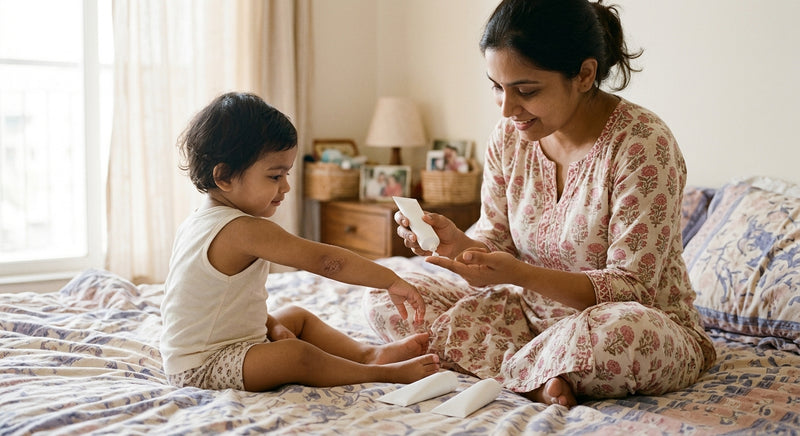
Cream on damp hands traps the water where you want it. Cream on dry hands is a film sitting on a wall that is already thirsty. Same tube, two completely different outcomes, and that is usually why one family swears by a cream while another says it did nothing at all. One pea-sized blob for both hands. Work it over the backs of the fingers and across the knuckles, where cracks start — that skin flexes a thousand times a day and has almost no oil glands to help it.
Put a small tube in the bag with their name on it, and give them the order out loud: sanitise, count to ten, cream. A sequence sticks. An instruction doesn't.
Step 4 — The night layer
Night is where you make up the deficit. After the evening bath, on damp hands, use something distinctly thicker than the daytime lotion — a balm or a butter-textured cream. If there are open cracks, put thin cotton mittens or old socks over the hands for an hour before bed. Even 30-60 minutes of that cover slows evaporation and keeps the layer on the skin rather than on the bedsheet. Keeping the night step up through the dry season is what gives dry, tight-looking knuckles the best chance to look and feel more comfortable — the daytime layer alone gets far less time to do anything.
- Swap the school bottle for a ≥60% alcohol gel with glycerin and no added fragrance.
- Lukewarm water only — tell them hot water makes the itch worse tomorrow.
- Pat dry, leave hands faintly damp.
- Moisturise within 60 seconds, every single time, knuckles first.
- Keep a named tube in the school bag and one by the kitchen sink at home.
- Thick balm on damp hands after the evening bath; cotton mittens if there are cracks.
- Trim nails short while skin is sore — scratching a dry patch is what turns it into a wound.
- Run a bucket of water or a humidifier in the bedroom through dry-season nights.
What should I look for in a hand cream for a child?
A hand cream has three jobs to do. Most cheap lotions only do the first one.
- Humectants pull water in. Glycerin is the workhorse — sitting in the first four or five ingredients is a good sign. Panthenol and sodium PCA belong here too.
- Emollients fill the gaps between cells and make skin feel smooth: squalane, almond oil, oat lipids, shea and kokum butter.
- Occlusives slow water loss — beeswax, dimethicone, petrolatum, the heavier butters. This is the part a "light, fast-absorbing" lotion leaves out, and it's why that lotion fails on hands.
Things to skip while skin is compromised: added fragrance, essential oils sold as "natural perfume", anything with alcohol denat. high in the list. Skip "antibacterial" hand creams as well. Your child's problem is a damaged barrier, not insufficient disinfection.
For daytime reapplication you need something that sinks in fast enough that a nine-year-old will actually use it before picking up a pencil. A lotion with real emollient content — our Hydrating & Soothing Moisturizing Lotion does this — manages that without the greasy film kids object to. At night, go heavier. In lab testing, Janma's barrier formulations increased expression of Keratin-10 and Filaggrin, two proteins the skin uses to build and knit that outer wall. That's the mechanism behind "helps support the skin barrier": the wall being handed its materials back.
Four things that make it worse:
- Antiseptic liquid diluted in a mug as handwash. Common in Indian homes and far harsher than hand soap — it was made for surfaces and wounds, not ten washes a day.
- Sanitiser on broken skin. If it stings, the barrier is already open. Soap and water there; sanitise the unbroken skin.
- Surface disinfectant wipes on hands. Check what's in the car and the school bag. Quaternary-ammonium wipes are not hand products.
- Waiting for it to settle. Hand skin that cracks in November keeps cracking until something in the routine changes.

Is this just dryness, or something else?
Plain irritation from washing looks like tightness, fine scale and shallow splits over the knuckles, and it answers to the routine above inside a week or two. Round, well-defined pale patches are a different thing, and we've covered why in white patches on kids: not worms, not calcium, with the daily sequence that helps in our three-step routine for dry white patches. And if everyone's skin got worse the week the room heater came on, start with room heaters and cracked winter skin. The air in the room is often doing more damage than the sanitiser.
When to see a doctor
Book a paediatrician if any of these are true: cracks that bleed or weep clear fluid; yellow crusting, pus or swelling (possible infection); a rash spreading from the hands onto the wrists and forearms; itching that wakes your child at night; pain that stops them writing or playing; or no clear improvement after two weeks of consistent moisturising. Hand rashes in children that keep coming back sometimes need a short prescription treatment and a proper diagnosis. That's a doctor's call, not a cream's, and no cosmetic product should be used in place of one.
If the skin is simply dry and tight rather than split or bleeding, start tonight with the thick layer on damp hands — our Hydra Healing Moisturizing Balm is the texture I'd reach for, to comfort dry, sensitive skin and support the skin's natural barrier. Skin that is broken belongs in the paragraph above first.
In summary
- Alcohol sanitiser dissolves the lipids holding water in skin — keep the hygiene and add a repair step rather than stopping.
- Moisturise within 60 seconds of drying, while hands are still faintly damp, working over the knuckles first.
- Lukewarm water, 20 seconds of lathering, pat dry — and skip hot-air hand dryers.
- Choose a formula with glycerin plus an emollient and an occlusive; avoid added fragrance and alcohol denat. on cracked skin.
- See a paediatrician for cracks that bleed or weep, yellow crusting, a rash spreading to the wrists, or no improvement in two weeks.
Frequently asked questions
Should I stop my child using hand sanitiser if their hands are dry?
No. Hygiene at school matters, and stopping isn't the fix. Keep the sanitiser for times there's no sink, choose a gel with at least 60% alcohol plus glycerin and no added fragrance, and pair every use with a moisturiser once the alcohol has evaporated. The dryness comes from the missing repair step, not from sanitising itself.
Is hand sanitiser or soap and water better for dry hands in kids?
Soap and water is generally gentler on the barrier, provided the water is lukewarm and hands are patted dry rather than rubbed. Use soap when hands are visibly dirty, before eating and after the toilet; use sanitiser when there's no sink. Technique and moisturising afterwards matter more than which one you pick.
How often should my child moisturise their hands?
Ideally after every wash, which means a small tube in the school bag and one by the kitchen sink. If that's unrealistic, set a floor of twice daily plus a thicker layer at night on damp hands. The night application does the most repair work, so protect that one even on busy days.
Can I use my own hand cream on my child?
Usually yes if it's fragrance-free and free of actives like retinol, strong acids or urea at high percentages. Children's skin is thinner and reacts more, and a baby's skin is 20-30% thinner than an adult's, so fragrance and potent actives are the main things to avoid. Patch test on the inner forearm for two days first.
Why do the knuckles crack first?
Knuckle skin flexes constantly, has very few oil glands and takes the brunt of both sanitiser and towel friction. It also sits on top of a joint, so every bend pulls at skin that's already low on lipid and water. That's why you work moisturiser over the backs of the fingers first, not into the palms.
Do mittens at night actually help?
Yes, for cracked skin. Covering a thick layer of balm with thin cotton mittens or socks for 30-60 minutes before bed slows evaporation and keeps the product on the skin instead of on the bedsheet. Use clean cotton, keep it loose, and skip it if your child finds it uncomfortable enough to disturb sleep.