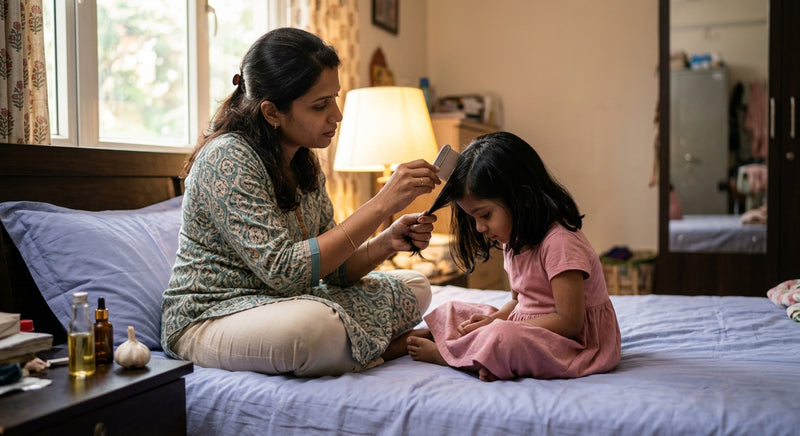
Ten weeks pregnant, phone torch on, reading the back of a face wash at 2am. That is usually when this question reaches me. Short answer: most of your shelf stays. Open a typical Indian bathroom cabinet and one or two products need to pause — usually a retinol night cream and a strong acid exfoliant. Two or three are worth swapping: a stripping face wash, a heavily fragranced body lotion. The rest is fine as it is. The one category that should get bigger is moisturiser.
At a glance
- The pause list is short. Retinoids, high-strength acid peels, prescription pigment creams. Anything a doctor prescribed goes back to that doctor.
- Cleanser: keep a mild, pH-balanced wash. Swap anything that leaves your face tight or squeaky.
- Moisturiser: this is where the money goes now. Fragrance-free, humectant plus occlusive, face and belly.
- Sunscreen: keep it, daily. A mineral SPF 30+ with PA+++ is the simplest low-irritation option for pregnant skin.
- Stretch-mark oil: no oil prevents stretch marks. It does make a stretching, itchy belly far more comfortable — reason enough to use it.
- Turn the bottle over. "Pregnancy-safe" is not a regulated phrase in India. The ingredient list is the only honest label.
Below is the category-by-category version of our complete guide to pregnancy-safe skincare. Four shelves, three piles, and an audit you can finish tonight before bed.
Why is the "pause" list shorter than the internet suggests?
Because fear and evidence are looking at different things. A cleanser sits on your face for about forty seconds and then goes down the drain. A moisturiser does its work in the outermost few layers of skin. The ingredients that carry real caution flags in pregnancy are the ones with known activity in the body at drug-level doses — vitamin A derivatives are the clearest example — plus a handful of prescription actives your obstetrician or dermatologist will want to review.
Everything else is a tolerance question, not a safety one. Skin gets more reactive. Your nose gets sharper, so a perfume you loved in January can turn your stomach by March. Pigment arrives easily and leaves slowly. None of that calls for fear. It calls for gentler versions of what you already own. If you'd rather see this laid out week by week instead of shelf by shelf, the Journal's trimester-wise AM/PM routine plan does that.
The three piles, category by category
Every product goes into one of three piles. Keep — use it, no change. Swap — same job, gentler formula. Pause — into a drawer until your doctor says otherwise. This is how the four categories usually land.
| Category | Keep | Swap | Pause (ask your doctor) |
|---|---|---|---|
| Cleanser | Mild, low-foam, pH around 5-5.5; gentle micellar water; plain water rinses | SLS-heavy foaming washes, scrubs with granules, daily clay masks, strongly perfumed bars | Prescription-strength acid washes; anything your dermatologist gave you for acne |
| Moisturiser (face & body) | Glycerin, hyaluronic acid, ceramides, shea and kokum butter, colloidal oatmeal, niacinamide | Fragranced body lotions, essential-oil-rich creams, thin summer lotions once your belly starts stretching | Retinol, retinaldehyde, retinyl palmitate; "firming" or "anti-ageing" creams without a readable list |
| Sunscreen | Mineral (zinc oxide, titanium dioxide) SPF 30+, PA+++, fragrance-free | Alcohol-heavy mattifying gels that sting; tinted sticks used as your only cover | Nothing routinely — pausing sunscreen is the one mistake that costs you |
| Stretch-mark oil | Cold-pressed almond, sesame, coconut; a butter-based balm for a stretching belly | Essential-oil "belly blends", camphor or menthol warming oils, anything with retinyl palmitate | Any oil that stings, tingles or leaves your skin red — your skin is telling you something, so stop |
Cleanser: what actually needs to change?
For most women, nothing at all. The one swap I push for is any wash that leaves your face squeaky. That squeak is your barrier being stripped, and pregnant skin has far less patience for it.
The lever is the surfactant, and you can read it off the back. Sodium lauryl sulphate and its cousins high on the list mean aggressive cleansing and a lot of foam. Gentler builds use milder syndets: sodium cocoyl isethionate, coco-glucoside, decyl glucoside, sodium lauroyl sarcosinate. How much foam a wash makes is a formulation decision, largely independent of how well it cleans. Big lather is a habit the market trained us into. A low-foam wash is not a weaker one.
One India-specific note. If your tap water is hard — Delhi, Hyderabad, Chennai, most of Bengaluru — a foaming cleanser leaves a film of soap scum that your skin reads as dryness. Low-foam, pH-balanced, once a day at night, plain water in the morning. That fixes more "pregnancy dryness" than any serum.
Salicylic acid, since someone always asks. A 2% rinse-off wash and a leave-on 20% peel are not the same exposure question, and I won't pretend they are. Show the bottle to your obstetrician. In the meantime, use something plain. Skipping acids for nine months costs you very little.
Moisturiser: the one category that should get bigger
Almost every woman I speak to arrives expecting to subtract products. Moisturiser is where you add. Skin over a growing belly is being stretched further than it has ever been stretched, the AC runs all night from March onwards, and hormones shift how much water skin holds.
A moisturiser has three jobs to cover. Humectants (glycerin, hyaluronic acid, sodium PCA) pull water in. Emollients (squalane, almond oil, avocado oil, oats) smooth the gaps between cells. Occlusives (shea butter, kokum butter, beeswax, dimethicone) slow the water leaving. A plain oil does one of those three. Which is why oil alone on a dry belly feels lovely for an hour and tight by morning.
On the label, I look for ceramides or a barrier-support claim with actual testing behind it. Barrier support is the part of formulating I enjoy most, because you can measure it instead of arguing about it — a lab study showing increased Keratin-10 and Filaggrin expression is the technical way of saying a formula helps support the skin barrier. Then fragrance-free. Not "lightly fragranced". Properly unscented, because a first-trimester nose turns on you without warning, and because fragrance is the most common avoidable irritant in any cream.
Retinol is the clear pause. Check your night cream, your "brightening" serum and any body firming lotion for retinol, retinaldehyde, retinyl palmitate or tretinoin. Drawer, all of them. For the face specifically, we've written a longer piece on how to choose a pregnancy-safe face moisturiser in India.
Sunscreen: keep it, and make it mineral
This is the category where stopping does real harm. Pregnancy makes pigment settle in more readily. The cheeks, the upper lip, the line down the middle of the belly. Daily UVA protection is the single most useful habit for keeping those changes from deepening, and dermatologists agree on that in a way they rarely agree on anything.
Mineral filters, zinc oxide and titanium dioxide, sit on the surface and scatter light rather than absorbing it, which makes them the low-irritation default for skin that has turned touchy. Look for SPF 30 or higher and PA+++. SPF is the UVB number, the one that drives burning. The PA rating is UVA, and UVA is the wavelength that matters most for pigment. A high SPF with no PA rating on the pack is half a sunscreen.
Non-nano zinc is what you want if you'd rather the particles stay on the surface. And use two fingers' worth for face and neck. The honest reason most sunscreens "don't work" is that people apply a third of the tested amount. A mineral formula built for children's skin is designed to be low-irritation, which is a sensible thing to look for when your own skin has turned touchy. Our Daily Defender mineral sunscreen at SPF 40 PA++++ is formulated to that standard.
Stretch-mark oil: the honest version
This category sells a lot of hope, so let me be straight. No oil, butter or cream prevents stretch marks. They form in the dermis, driven mostly by genetics, how fast the skin stretches, and how much. If your mother and sister got them, you very likely will, and a ₹2,000 bottle will not change that.
What a good oil or balm does is make the third trimester more bearable. A stretching belly itches, and it itches most at night. Three to five minutes of slow massage with a warm oil, morning and night, settles that itch and keeps the surface supple. It also gives you ten quiet minutes with your baby, which is the part nobody puts on a label. Worth doing for that alone. We've written more on what helps an itchy, stretching belly and where the myths creep in.
Look for a single cold-pressed oil — almond, sesame, coconut — or a butter-based balm. Plain, unscented. In a dry Nagpur April, or a north-Indian winter, a balm outlasts a thin oil by hours, because it holds the water in as well as feeding the surface. Skip the "belly blend" loaded with essential oils. Some of those, bergamot among them, are phototoxic on sun-exposed skin, dosing is unregulated in cosmetics, and the therapeutic claims on the label are not ones any formulator can stand behind.
The 10-minute shelf audit you can do tonight
Take everything off the shelf and onto the bed. Phone torch, reading glasses if you need them, and work through this.
- Scan every label for retinol, retinaldehyde, retinyl palmitate, tretinoin, adapalene. Into the drawer, all of them.
- Set aside anything a doctor prescribed — acne creams, pigment creams, medicated washes. One photo of all of them, one message to your doctor.
- Squeeze-test your cleanser: if your face feels tight or squeaky after, replace it with a mild low-foam wash.
- Check your body lotion for "fragrance" or "parfum". If you're queasy, move to an unscented balm or cream.
- Confirm your sunscreen says SPF 30+ and PA+++. If there's no PA rating, upgrade it.
- Pick one oil or balm for the belly, keep it on the bedside table, and use it after your bath and again before sleep.
- Cut back scrubs and exfoliating pads to nothing for now, and see how your skin behaves after two weeks.
- Check who made it. A brand should be able to tell you where a product is manufactured and whether it was dermatologically tested. Ours are made in our own GMP-certified facility — we own our formulations — so that answer is a short one.
Four categories, ten minutes, done. Anything you're unsure about goes into an "ask at the next visit" bag, not the bin. Most of it will come straight back out.
When to see a doctor
Skincare choices are cosmetic decisions. The four below are not. These deserve a phone call:
- Itching that is intense, keeps you awake, or is worst on the palms and soles — especially in the third trimester. This needs same-week medical review.
- A rash that is spreading, blistering, weeping or coming with fever.
- Any prescription cream you were using before pregnancy, including for acne or pigmentation — confirm with your obstetrician or dermatologist before you continue or stop.
- Sudden swelling with headache or vision changes, which is an obstetric matter, not a skin one.
Your paediatrician takes over soon enough. Until then your obstetrician is the right person to ask, and asking early is cheaper than guessing. Once the baby arrives the shelf shifts again, and we've mapped what settles on its own and what needs attention in our guide to postpartum skin changes.
If you keep only one new thing through these nine months, make it a fragrance-free barrier balm for your face, belly and hands. Our Hydra Healing Moisturizing Balm was built for exactly that job — a lab study on it showed increased Keratin-10 and Filaggrin expression, which is to say it helps support the skin barrier — and it carries on working for the baby afterwards.
In summary
- Pause the short list — retinol, retinaldehyde, retinyl palmitate and high-strength acid peels — and take any prescription cream back to your doctor.
- Swap any cleanser that leaves your face tight or squeaky for a mild, low-foam, pH-balanced wash, especially if your tap water is hard.
- Add moisturiser rather than subtracting it: fragrance-free, with a humectant, an emollient and an occlusive, used on face and belly.
- Keep sunscreen daily and check it says SPF 30+ with PA+++; a mineral formula is the gentlest option for reactive pregnancy skin.
- Use a plain cold-pressed oil or butter balm on the belly for comfort and itch, and skip essential-oil belly blends and warming oils.
Frequently asked questions
Is it safe to keep using my regular face wash during pregnancy?
Usually yes. A mild, pH-balanced cleanser needs no change at all. Swap it only if your face feels tight or squeaky afterwards, which suggests a harsh surfactant like sodium lauryl sulphate high in the list. Park prescription-strength acid washes until your doctor reviews them, and cut daily scrubs to nothing while your skin is more reactive than usual.
Which skincare ingredients should I actually pause in pregnancy?
The short, clear list is vitamin A derivatives: retinol, retinaldehyde, retinyl palmitate, tretinoin and adapalene. Check night creams, brightening serums and firming body lotions, since retinyl palmitate hides in all three. High-strength acid peels and prescription pigment creams should go back to the doctor who prescribed them rather than being stopped or continued on your own judgement.
Is mineral sunscreen better than chemical sunscreen during pregnancy?
For most women, yes — not because chemical filters are proven risky, but because mineral filters like zinc oxide and titanium dioxide sit on the surface and tend to irritate touchy pregnancy skin less. Look for SPF 30 or higher with PA+++, since PA is the UVA rating and UVA is what drives pigment changes. Apply two fingers' worth for face and neck.
Can any oil actually prevent stretch marks?
No, and any product promising that is overselling. Stretch marks form deep in the dermis and are driven mainly by genetics and how fast and how far the skin stretches. What a plain cold-pressed oil or butter-based balm does well is ease the itch of a stretching belly, keep the surface supple and comfortable, and give you a few calm minutes each night.
Do I need special pregnancy-labelled products, or can I use my baby's?
"Pregnancy-safe" is not a regulated claim in India, so the label tells you less than the ingredient list does. Products formulated for babies and children are built to be low-irritation by design — fragrance-free, mild surfactants, mineral sunscreen — which makes them a sensible shortcut for pregnant skin. Read the back of the pack and check who manufactures it.
Is fragranced skincare unsafe in pregnancy?
Fragrance is not a safety problem so much as a tolerance one. It is the most common avoidable irritant in any cream, and a sharper first-trimester nose can turn a scent you loved into something you cannot stand. Buying the unscented version of your cleanser, moisturiser and belly oil means nausea never forces you to stop using them.