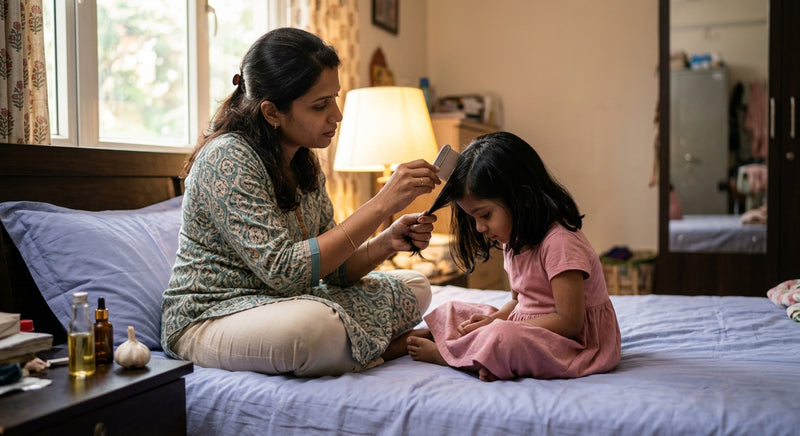
Open your daughter's school bag. Somewhere at the bottom there is a black stationery rubber band, stretched out of shape, three of her hairs still twisted into it. That one thing does more damage than everything else in the drawer put together.
You came for the short answer, so here it is. Stiff stationery rubber bands are the worst thing you can put in a child's hair. Thin elastics with a metal crimp are next. A wide fabric scrunchie or a claw clip is the gentlest. The accessory is only half of it, though. How hard you pull, and whether the hair was damp when you tied it, count for just as much as what the tie is made of.
At a glance
- Rubber grips the hair cuticle and cannot slide, so it tears hair instead of releasing it. Keep those bands for files.
- Any elastic with a metal join saws at one fixed point every single time. Seamless ties cost the same and do not.
- Damp hair stretches much further before it breaks, and does not spring back. Tie dry, or nearly dry.
- Two fingers of slack under every tie. If you cannot slide two fingers under it, it is too tight.
- Move the parting and the ponytail position each day so the same follicles are not pulled every morning.
Two different kinds of damage are going on here, and most of us only think about one. Fibre damage is the shaft snapping. You see it as short broken hairs standing up around the ponytail. Follicle damage is tension at the root, and that is what thins a hairline. Rubber bands manage both. A good scrunchie tied too tight does only the second. Work out which one you are looking at and you know what to change. The tension side gets a longer treatment in our complete guide to styling damage in kids' hair.
Which accessory actually damages hair the most?
Ranked, more or less as I find them in an Indian school-morning drawer.
| Accessory | How it grips | Damage risk | My verdict |
|---|---|---|---|
| Stationery rubber band (the ₹10 black packet) | High-friction rubber locks onto the cuticle; it cannot slide off, so hair snaps | Highest | Never in hair. Nothing else on this list is this easy to fix. |
| Thin elastic with a metal crimp | Tension plus a hard metal edge cutting at one fixed spot | High | Only if you cut the metal out. Or just buy seamless. |
| Seamless fabric-covered elastic | Fabric spreads the load, no metal edge | Low to moderate | Fine for sport and school. Replace it when it goes slack. |
| Scrunchie (satin or soft cotton) | Wide surface, low tension, fabric slides over the cuticle | Lowest | Best daily choice, and the best thing to sleep in. |
| Snap clips, tic-tacs, bobby pins | Small jaw closing on a few strands | Moderate | Fine for a few hours. Check the ends for kinks. |
| Claw clip | Load spread over a big section | Low | Excellent at home, especially for thick hair. |
| Plastic hairband with teeth | Teeth press into the same scalp line all day | Moderate | Shift it forward or back daily; avoid the sharp-toothed ones. |
Why a rubber band snaps hair but a scrunchie doesn't
A hair is keratin protein under a cuticle: flat overlapping scales lying down the shaft like roof tiles, all pointing towards the ends. Almost everything an accessory does, good or bad, happens to those scales.
Rubber has a very high coefficient of friction against keratin. Which is what makes it a good stationery band and a terrible hair tie. It does not glide. Your child yanks the ponytail out at 4pm, the band grips the scales, lifts them the wrong way, and the fibre either loses its cuticle at that spot or snaps outright. Underneath is the cortex, now exposed. That is your frizzy halo of short broken hairs, and the split ends that only ever show up in the ponytail zone. Satin is low-friction, and a scrunchie spreads its grip wide, so the same yank lets the hair slip out instead of catching.
Bath time is where this quietly gets worse. Wet hair is the real culprit, not the accessory. Water breaks the hydrogen bonds inside keratin, and those bonds are what give a dry fibre its snap-back. Wet, the same pull stretches it much further. Past its elastic limit it does not recover; it dries locked into that stressed shape. So a post-bath ponytail with a soft scrunchie can still do more damage than a dry ponytail with a mediocre elastic. Tie dry hair. In a rush: towel-blot, comb, wait five minutes, then tie.
Oil cuts both ways here. A malish or a light coconut oiling lowers surface friction, so oiled hair does slide out of a tie more easily. It does nothing about tension at the root. Pull oiled hair into a tight braid and the follicle feels exactly the same force. Friction is a shaft problem. Tension is a root problem. Oil only solves the first.
The routine that saves your child's hair (5 minutes, twice a day)
In order, this is what I actually do. It survives a real school morning, which is the only test that counts.
- Detangle before you tie, never after. Wide-tooth comb, ends first, then the mid-lengths, then from the roots down. Tie over a knot and the tie has to hold a weak point. That is where it breaks.
- Check the hair is dry. Cool to the touch, not cold and heavy. Straight out of the bath? Comb now, tie in five minutes.
- Pick the tie for the job. Satin or soft cotton scrunchie for school and for sleep. Seamless elastic for kabaddi, dance class and PE, where a scrunchie will slide out. Claw clip for homework hour at home.
- Two fingers. Tie it, then slide two fingers underneath. No room means undo and redo. If your child's eyebrows lift when you finish, it is too tight, and that pull is landing on the follicle.
- Move the position daily. High pony Monday, side parting Tuesday, low loose braid Wednesday. Same spot every single day is what pulls the hairline back at the temples, and it is completely avoidable.
- Take it down at 5pm, not at 10pm. Evening take-down, while everyone is still calm. Hold the length in one hand, slide the tie off with the other.
- Cut a stuck band. Never pull it. Blunt-nosed kids' scissors live in that drawer. Snipping a tangled tie costs you one band. Pulling it costs a chunk of hair.
What about clips, pins and plastic hairbands?
Snap clips and bobby pins are easier on hair than elastics, for one reason: a small section, a short time, no sustained tension on the root. Their risk is a different one. A metal jaw closing on a few strands leaves a kink, and kinking the same point over and over weakens the fibre. Look for rolled or coated edges. Check that the bobby pins still have their little plastic tips, because a bare metal end is a cuticle scraper.
Claw clips deserve far more use than they get, especially on thick hair. The load spreads across a whole section instead of sitting on one ring. After school, a claw clip beats a second tight ponytail every time.
Plastic hairbands with teeth are the sneaky ones. They sit in exactly the same place all day, and the teeth press into one line of scalp for eight hours. If your child wears one daily, shift it a centimetre forward or back each morning, and skip the aggressively toothed styles.
The Indian-school reality: hard water, oil and non-negotiable braids
Most schools here still want two tight braids or a high ponytail with black bands, and that rule is not going anywhere. Everything around it is yours to control.
Start with hard water, which does more than it gets credit for. Across much of central and north India, calcium and magnesium deposit on the hair shaft and leave it rough and grabby, so the cuticle is already lifted before any accessory touches it. Rough hair plus a rubber band is a much worse combination than smooth hair plus the same band. Which makes the cleanser matter more than it sounds: a gentle tear-free kids shampoo that clears oil and sweat without stripping the hair keeps that surface smoother through the week.
Then sweat. A Nagpur afternoon plus a synthetic uniform collar leaves the nape damp by lunch, and damp hair inside a tight braid all afternoon is the wet-hair problem again, running in slow motion. A slightly looser braid and a scrunchie instead of a band buy you a lot.
Conditioner is the step most Indian parents skip for children. It is doing mechanical work, not cosmetic work. Cationic conditioning agents carry a positive charge, damaged hair carries a negative one, so they deposit exactly where the cuticle is roughest and lay those scales back down. That is measurable slip. The comb passes through with less force, and the tie slides out instead of catching. Two more pieces if you want the fuller picture: whether tight braiding actually helps hair grow, and what tight school braids cost your child's hairline. Worth ten minutes if your child wears the same style five days a week.
When to see a doctor
Book a paediatrician or a dermatologist for a widening parting, a hairline visibly receding at the temples, small bumps or pustules around the follicles at the edge of the scalp, tenderness or scaling where the tie sits, or a distinct patch of loss rather than general thinning. Sudden shedding after an illness or fever deserves a look as well. That is a different mechanism entirely and nothing to do with accessories. Traction-type thinning caught early usually improves once the pulling stops. Left for a year or two, it may not. Never treat scalp bumps or bald patches at home; get them looked at.
Back to everyday care, which is separate from anything above that needs a doctor: most routine breakage happens at the daily comb-out, so it is worth looking for a light kids' conditioner that gives the comb some slip and lets it pass with less force. Our Rejuvenating & Detangling Conditioner is one option for that step.
In summary
- Throw out stationery rubber bands entirely — rubber grips the cuticle and snaps hair instead of releasing it.
- Choose seamless fabric elastics for sport and satin or soft-cotton scrunchies for school and sleep.
- Tie dry or nearly dry hair only; wet hair overstretches and dries locked in that stressed shape.
- Apply the two-finger rule to every tie, and move the parting and ponytail position each day.
- See a paediatrician or dermatologist for a widening parting, a receding temple hairline, or bumps and tenderness at the scalp.
Frequently asked questions
Are scrunchies really better for kids' hair than elastics?
Yes, for everyday wear. A scrunchie has a wide contact area and a low-friction fabric surface, so the load is spread and hair slides out instead of catching. A thin elastic concentrates the same holding force into a narrow ring. Keep seamless elastics for sport, where a scrunchie slips, and use scrunchies for school days and sleep.
Can my child sleep with her hair tied?
Yes, and it is usually better than leaving it loose. Long hair rubbing against a cotton pillowcase all night creates friction and morning tangles. Use a loose low braid or a soft satin scrunchie at the nape — nothing tight, nothing high on the crown, and never a rubber band. Two fingers should slide under it easily.
Do rubber bands cause hair fall or just breakage?
Both, by two different routes. The rubber grips the cuticle and snaps the shaft, which is breakage — you see short broken pieces around the ponytail. Separately, the tension of a tight band pulls at the follicle itself, and repeated pulling in the same spot over months can thin the hairline. The first regrows; the second is not always reversible.
Are spiral or telephone-cord hair ties good for children?
They are a reasonable middle option. The coil spreads tension over a wider area than a thin elastic and does not grip the cuticle the way rubber does, so hair slides out easily. The catch is that fine hair can slip right through them and they collect lint and hair inside the coil. Check them weekly and replace when they lose their spring.
My daughter's school insists on tight braids with black bands. What can I do?
Work around the rule rather than against it. Braid slightly looser at the crown where the tension is felt most, secure the ends with a seamless fabric-covered elastic in the required colour instead of a stationery rubber band, alternate the parting daily, and take everything down as soon as she gets home. Condition twice a week so the comb-out is gentler.
Do metal clips and bobby pins damage fine hair?
They can, but differently from elastics. A metal jaw closing on a few strands creates a kink, and kinking the same spot repeatedly weakens the fibre. There is no sustained root tension, so the hairline is not at risk. Choose clips with rolled or coated edges, discard bobby pins that have lost their plastic tips, and vary where you place them.