The fever broke five days ago. The mouth ulcers have stopped bothering her. Then this morning your five-year-old holds up a hand at breakfast and the skin on two fingertips is lifting off in one pale sheet, like old sellotape. Nobody mentioned this part.
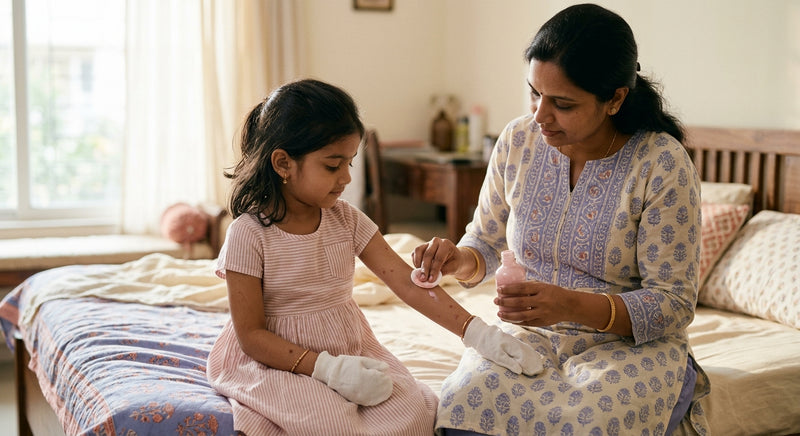
Peeling skin after hand, foot and mouth disease (HFMD) is normal, expected, and almost always nothing to worry about. It typically begins one to three weeks after the rash has faded. It shows up on fingertips, palms, soles and the skin around the nails, and it usually resolves on its own. In most children what you are looking at is simply the outer layer of skin shedding above where the blisters sat, rather than a new infection or an allergy — and it is not something you caused. If what you are seeing does not match the picture below, your paediatrician is the one to say so.
The harder part is the fortnight that follows it: tightness, itching, cracking. That is barrier care, and in India the weather decides how hard it gets. We cover how children's skin recovers after bites, rashes and viral spots in our complete guide to kids' bites and skin recovery. This piece is only about the peeling.
At a glance
- Peeling on palms, fingertips and soles after HFMD usually starts 1–3 weeks after the rash settles and finishes on its own.
- It happens on hands and feet because that skin carries the body's thickest outer layer. It comes off as sheets, not invisible flakes.
- No cream shortens the shed. Moisturiser is for comfort and barrier support while it happens.
- Never pull, trim, scrub or pumice loose skin. The sheet protects the raw layer underneath until it is ready.
- Nails that lift or shed weeks later (onychomadesis) are a known, painless aftermath and regrow.
- See a paediatrician for spreading redness, pus, deep cracks that bleed, or a child who is unwell again.
Why does skin peel after hand, foot and mouth disease?
The blisters of HFMD form within the upper layers of skin, not deep under them. Once the body has dealt with the virus, the roof of each blister has nothing anchoring it any more, and neither does the sheet of dead, interlocked cells sitting above it. So it separates and lifts off. The replacement skin was already built underneath. What you are seeing is the old lid coming away late.
Palms and soles carry by far the thickest stratum corneum on the body: many more layers of flattened, keratin-packed cells than cheek or forearm skin. Thin skin sheds invisibly. You lose it in the bath every day and never notice. Thick skin sheds as a sheet. That is the whole reason this looks so dramatic on two fingertips at 7am and never on her tummy.
The shed was decided weeks ago, when the blisters formed. You cannot speed it up and you cannot stop it. What is genuinely in your hands is how uncomfortable the next two weeks are, because while that outer layer loosens, the skin leaks water faster than usual. Hence the tightness, the dull look, the itch at bedtime, the splits in the fingertip creases.
What's normal — and what isn't
Normal, in the weeks after HFMD:
- Pale sheets or flakes lifting from fingertips, palms, soles and toes.
- Skin underneath that looks slightly pink, shiny or newer than the rest.
- Mild itch, mostly at night and after a bath.
- Hands that look fine all day and crack at the creases by evening.
- Peeling that comes in waves over 10–20 days rather than all at once.
Not the usual script, and worth a doctor's eye: redness spreading outward from a crack, yellow crusting or pus, swelling, a child who flinches at light touch, deep fissures that bleed, or new fever. Peeling is the quiet end of this illness. It should not arrive alongside a child who seems unwell again.
What about nails that lift off weeks later?
This one surprises parents more than the peeling does. Four to eight weeks after HFMD, a thumbnail or big toenail may develop a ridge, lift at the base, or come off altogether. It has a name, onychomadesis, it is a recognised aftermath of this illness, it is usually painless, and the nail regrows over a few months. Keep it trimmed short and smooth so it does not catch on socks. Moisturise the skin fold around it. Otherwise leave it alone. A nail bed that is red, hot, swollen or oozing needs a doctor, not a nail file.
How Indian weather changes the next two weeks
HFMD moves through creches and playgroups in the warm, damp stretch of the year, so the peeling phase usually lands in heat, humidity, or the first cool weeks after. Each of those treats shedding skin quite differently.
| Condition | What it does to peeling skin | What to change |
|---|---|---|
| Hot, dry summer + AC all night | Air-conditioned air pulls moisture out; skin that is already leaking water gets tight and cracks at fingertip creases | Moisturise again at bedtime, not just after the bath. A bowl of water in the room, or the AC at 26°C instead of 20°C. |
| Monsoon humidity | Loose sheets stay soggy inside damp socks and closed school shoes; softened skin tears instead of flaking cleanly | Two pairs of cotton socks a day, shoes dried fully overnight, a lighter lotion on feet in the morning and something richer at night |
| Winter + room heaters | The driest combination of the year; peeling palms go from flaky to split | Thicker, more occlusive product on hands after every wash; heater off before bed |
| Hard water (Delhi, Bengaluru, Chennai, Hyderabad) | Calcium and magnesium salts leave a residue that makes cleansers harsher and skin feel squeaky-tight | Short lukewarm wash, mild non-soap cleanser only on the dirty parts, pat dry, moisturise on damp skin within three minutes |
Then there is the hand-washing. After HFMD in the house, everybody is at the basin twenty times a day. Sensible for the family. Brutal for a child whose palms are mid-shed. Every wash with a strong soap strips more of the lipid glue holding those loosening cells together. So: a mild cleanser for her, washes kept quick, moisturiser back on afterwards. And go easy with the alcohol sanitiser. On split fingertips it stings badly enough that a five-year-old will refuse hand hygiene altogether, which defeats the point of all of it.

The routine to start tonight
- Lukewarm bath, bucket or shower, under five minutes. No bubble soak. Water that feels pleasantly warm to your inner wrist, not your hand.
- A mild, non-soap cleanser on the armpits, groin and feet only. Plain water is enough for peeling palms.
- Pat dry with a soft towel. Don't rub the loose sheets off. They are a dressing.
- Moisturise within three minutes, while the skin is still slightly damp. That window matters more than the product.
- A generous blob on palms, fingertips, soles and the skin around each nail, which is where the shedding actually is.
- Cotton socks at night if feet are cracking. They keep the product on the skin instead of on the bedsheet.
- Trim fingernails short. Night-time itch plus long nails is how a clean shed turns into a scratched, broken one.
- Repeat the moisturiser at bedtime and after every hand wash, for about two weeks.
What the ingredients actually do here
This is my day job, so let me be specific. Humectants (glycerin, honey, sodium PCA) pull water into the outer layer. On their own, in dry AC air, they can draw water up and let it evaporate straight off. Emollients (almond oil, oat lipids, squalane) slot between the loosening cells and keep the skin smooth and flexible, which is what stops a fingertip crease from splitting. Occlusives (butters, waxes, petrolatum) sit on top and slow water loss.
A shedding palm is a compromised barrier, and on a compromised barrier the occlusive fraction is the part you feel. It is also why plain coconut or almond oil underperforms here: emollient, mildly occlusive, no humectant at all. If you prefer an oil, apply it on skin still damp from the bath so there is water underneath for it to hold on to.
What I would skip on a child mid-shed: anything with urea above about 10%, salicylic acid, glycolic or lactic acid "foot repair" formulas, and granular scrubs. They are keratolytics. Their entire job is to loosen the bonds between outer-layer cells, and those cells are already letting go. You do not need chemistry to help them, and you can easily strip past the ready layer into the tender one. Skip fragranced products and essential-oil blends too. A new surface is a more permeable surface, and this is the worst fortnight of the year to introduce a fragrance allergen.
On texture: in monsoon and peak summer most children do better with a light, fast-absorbing lotion on arms and legs. A hydrating lotion with almond oil, ghee and oats is what I reach for in humid weather. Keep something thicker for hands, feet and around the nails, where the shedding actually is. One rich balm everywhere in August will just sit on sweaty skin.

What not to do
Don't pull the sheet off, even when it is hanging by a thread. It tears into living skin at the attached edge, and that is how a tidy shed becomes a painful raw patch. If a flapping edge is catching on things, trim it flush with clean scissors and leave the rest.
Also avoid: pumice stones and foot files on peeling soles; salt or antiseptic liquids in the bath water (they sting, they strip, and they help nothing); antifungal or antibiotic creams unless a doctor has prescribed them for a specific reason; and strong de-tan or "brightening" products on skin that looks patchy while it recovers. That colour difference is new skin next to old. It evens out.
Night-time itch is the other trap. A child who scratches peeling fingers in her sleep can break the surface and let infection in, which is the same mechanism we go into in what actually stops a child scratching a healing bite. Short nails, a cool room, a moisturising layer at bedtime, and cotton socks on the hands for a toddler who cannot help herself.
If the itchy bumps keep returning in crops long after the peeling has finished, especially on exposed arms and legs, that is a different story and probably not HFMD at all. Papular urticaria from insect bites is the usual culprit in Indian homes, and it behaves quite differently.
When to see a doctor
Post-HFMD peeling does not normally need a visit. Book one if you see redness spreading out from a crack, warmth or swelling, yellow crusting or pus, deep fissures that bleed or stop your child walking or holding a pencil, a nail bed that looks red and angry rather than simply lifting, fever returning, or a child who is drinking very little. Check in too if the peeling is still actively progressing after about four weeks, or if it involves large areas beyond the hands and feet. That deserves a proper look rather than a guess from an article. Nothing here is a diagnosis. Your paediatrician examining the actual skin always wins.
For the fortnight of tight, splitting fingertips and soles, a rich occlusive layer is the single most useful thing in the cupboard. Our Hydra Healing Moisturizing Balm was formulated for exactly that job: comforting dry, sensitive skin and helping support the skin's natural barrier while it rebuilds.
In summary
- Peeling on palms, fingertips and soles one to three weeks after hand, foot and mouth is the expected end of the illness, not a new problem.
- Never pull, trim back, scrub or pumice loose skin — it is protecting the newer layer underneath until it is ready to let go.
- No cream shortens a shed; moisturise twice daily on slightly damp skin for comfort and barrier support instead.
- Adjust by season — a lighter lotion in monsoon and summer humidity, a richer occlusive layer on hands and feet in AC or winter air.
- Call a paediatrician for spreading redness, pus, bleeding cracks, an angry nail bed, returning fever, or peeling still spreading after four weeks.
Frequently asked questions
How long does skin peeling after hand, foot and mouth disease last?
Most children peel in waves over about 10 to 20 days once it starts, and it usually starts one to three weeks after the rash fades. Fingertips and palms often finish before soles, which carry thicker skin. If peeling is still actively spreading after around four weeks, or extends well beyond hands and feet, have a paediatrician look at it.
Should I peel off the loose skin or trim it?
Leave it. The loose sheet is acting as a dressing over skin that is not quite ready, and pulling it tears into the attached living edge, which hurts and can let infection in. If a flap is catching on clothes, trim it flush with clean scissors. No pumice stones, no foot files, no scrubs while shedding is underway.
Can I use a foot cream with urea or salicylic acid to speed it up?
I would not, and nothing speeds a shed up anyway. Urea above roughly 10 percent, salicylic acid and glycolic or lactic acid formulas are keratolytics designed to loosen outer-layer cells. Those bonds are already releasing on their own, so you risk stripping past the ready layer into tender skin. Use a plain, fragrance-free moisturiser instead.
Is my child still contagious while the skin is peeling?
Peeling itself is shedding dead outer skin, not active infection, and the illness is generally past its most infectious phase by then. But the virus can persist in stool for several weeks, so keep up nappy and toilet hand hygiene. For when your child can return to creche or school, follow your paediatrician's advice and your school's policy.
Why are my child's nails lifting weeks after hand, foot and mouth?
It is called onychomadesis and it is a recognised, well-documented aftermath, usually appearing four to eight weeks later on thumbs and big toes. It is typically painless and the nail regrows over a few months. Keep it trimmed short so it does not catch, moisturise the skin fold around it, and see a doctor if the nail bed looks red, hot or oozing.
Does monsoon humidity make peeling worse?
It changes it rather than worsening it. Humid air keeps skin less dry, but damp socks and closed school shoes keep loose sheets soggy, so skin tears instead of flaking cleanly and toe webs can macerate. Two pairs of cotton socks a day, shoes dried fully overnight, a light lotion in the morning and something richer at night handles it.