It's 11pm. You've bathed her, patted her dry, worked the moisturiser in, and by the time you reach the second leg the first one feels papery again. Somewhere on an eczema forum you read the phrase “soak and seal.” Now you're wondering whether any of it applies in Chennai in August, when the air outside feels like a wet towel.
Short version: soak and seal does work in India. The version that works here is lighter than the one written for American winters, and the number that decides it is your bedroom's humidity, not your city's. Air-conditioned room running all night? Seal like it's winter. Still, un-airconditioned monsoon bedroom? A thick all-over occlusive is the quickest route to prickly heat. A thin lotion and some moving air will do more.
This one sits inside our complete guide to sleep and skin, where we work through the whole 7pm-to-7am stretch: bath, dressing, room, and the 3am wake-ups.
At a glance
- Soak and seal = short lukewarm bath, pat until just damp, moisturise within about 3 minutes.
- The “seal” step earns its keep when the air is dry: winter, and any AC bedroom, which is drier than the city outside it.
- In a humid, non-AC room the risk flips. Sweat trapped under a heavy layer causes prickly heat, not hydration.
- Buy a ₹200–400 hygrometer and read your bedroom. Mumbai's 85% outdoors means nothing if your room sits at 50%.
- Same method, different vehicle: balm in dry air, lotion in wet air, balm reserved for rough patches only.
What is soak and seal, exactly?
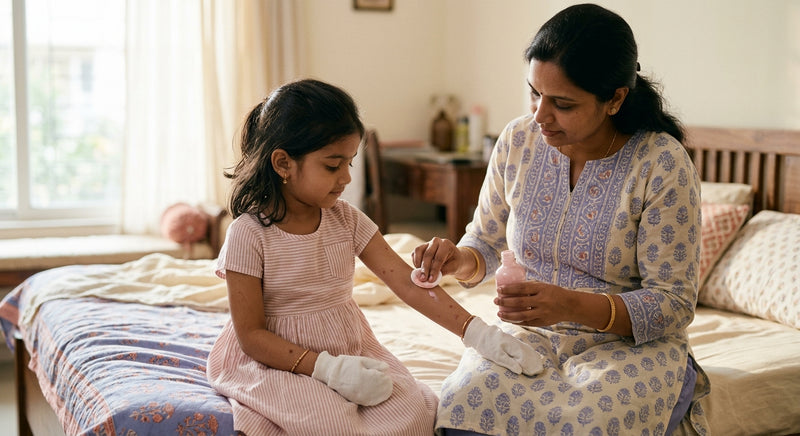
Nobody sells soak and seal in a bottle. It's a sequence. Bathe in lukewarm water for roughly 5–10 minutes with a gentle, low-irritant cleanser. Lift the child out and pat until the skin is still slightly damp, the way a mirror is damp rather than wet. No rubbing. Then moisturise within about three minutes, before that surface water goes. Dress, and off to bed.
The reason is plain physics. A short soak loads water into the stratum corneum, the top 15-odd layers of flat, dead cells that do most of the barrier work. That water is on loan. Left alone it evaporates in minutes and can leave the skin drier than it was before the bath. The moisturiser slows the exit.
Why the “seal” matters less in a humid room
Water leaves skin because of a gradient. Inside the body it's wet. In the air above it, usually drier. The steeper that difference, the faster water moves out. That's transepidermal water loss, and every moisturiser on the shelf is fighting it.
Now picture a Kochi bedroom in July, windows open, air sitting near saturation. The gradient is shallow. Skin isn't losing water quickly to that air, so the occlusive layer you're adding has less to do. That is why a rich balm can feel as though it simply sits on the skin through the monsoon — it isn't a bad balm, there is just far less water loss for it to hold back.
The second half of this catches people out. Humectants — glycerin, hyaluronic acid, honey-type sugars, urea — are hygroscopic. They pull water toward themselves. In humid air they can draw a little moisture from the room, which does help. In very dry air, meaning a bedroom under 40% relative humidity, a humectant with nothing occlusive over it can end up pulling water up from deeper skin and letting it evaporate. That is why formulators pair glycerin with an occlusive instead of selling glycerin on its own. In dry air the pairing is essential. In wet air the humectant carries more of the load by itself.
But your bedroom is not the same as your city
This is the mistake I see most. A parent in Mumbai reads “India is humid, skip the seal” — and their baby sleeps every night in a room with the AC at 22°C. An air conditioner is a dehumidifier with a fan attached. It condenses water out of the room, continuously, all night. A closed AC bedroom at 22–24°C can sit around 45–55% relative humidity and drop lower over a long night. That is closer to a Delhi winter afternoon than to the street outside the window.
So: measure. A basic digital hygrometer costs ₹200–400 and takes ten seconds to read. Put it on the cot-side table. Check it at bedtime and once during the night. That one number tells you more than any regional rule, and it's the same number that helps you judge whether your child is sweating at night for ordinary reasons or something worth a doctor's look.
Three night-time methods, side by side
| Method | What it actually does | Where it wins in India | Watch-out |
|---|---|---|---|
|
Full soak and seal Bath → damp skin → rich cream or balm, head to toe |
Loads water into the top layer, then slows its escape with a strong occlusive film | Dry winters (North and Central India, Nov–Feb), AC bedrooms year-round, eczema-prone skin in a flare | Too heavy for a hot, still room — occlusion over active sweat glands invites prickly heat |
|
Modified soak and seal Bath → damp skin → light lotion all over, balm only on rough patches |
Uses the bath water and a humectant base; occlusion is targeted rather than blanket | Most of the Indian year — humid summers, monsoon, coastal cities, fan-only rooms | Needs honest reapplication on the dry patches; one thin coat everywhere isn't enough for eczema-prone areas |
|
Seal without the soak No bath → moisturise dry skin before bed |
Adds lipids and humectants but no water reservoir, so it works slower | Nights you skip the bath, newborns on alternate-day bathing, winter when daily bathing is too stripping | Less effective on genuinely dehydrated skin; a damp cotton-cloth wipe-down first closes most of the gap |
What we'd actually do
Read the hygrometer, then pick.
Below ~50% (AC room, winter, hill station): full soak and seal. Short warm bath, pat to damp, rich cream or balm within three minutes, top to toe. This is the setting the method was built for and it performs exactly as advertised.
Roughly 50–70%: modified. Lotion all over on damp skin, then balm on the places that stay rough — outer arms, shins, cheeks, ankles, backs of the knees. Two textures, one routine.
Above ~70% in a still room: keep the soak, lighten the seal hard. Thin lotion on damp skin. Fan on low, aimed at the wall and not the child. Cotton nightwear. Balm only where the skin is visibly cracked or flaky. Do not blanket a sweating child in butter — you'll be dealing with ghamori by Thursday.
The formulation bit: what to seal with
“Lotion,” “cream” and “balm” are not marketing moods. They're water-to-oil ratios, and that ratio decides how the product behaves on a humid night.
- Lotion — mostly water, low oil phase, thin enough to pump. It spreads fast, absorbs fast, leaves a light film. On sticky nights this is usually the right vehicle: enough humectant to hold water, not enough occlusive load to block a sweat duct.
- Cream — a heavier emulsion, more oil phase, still water-based. The everyday middle option for 50–70% rooms.
- Balm or ointment — little to no water, mostly butters, waxes and oils. Strongest barrier film, slowest absorption. Superb on cracked shins in January, and on the rough, flaky patches of eczema-prone skin. Wrong choice as a full-body layer at 32°C.
On an ingredient list I look for a humectant near the top. Glycerin is the workhorse and it's cheap, so where it sits in the INCI list tells you a lot. Then emollient lipids to fill the gaps between skin cells, and one occlusive that isn't so heavy it turns tacky. Ceramides, cholesterol and free fatty acids sit in the emollient group and earn their place in eczema-prone skin. Skip strong fragrance and essential oils on skin that's already irritated, especially at night when scratching goes unsupervised. We go through that in detail in our piece on why a baby rubs their face raw at night.
If that's the checklist you're working from and your nights are dry ones — AC on, winter air, or skin that stays flaky after a lotion — our Hydra Healing Moisturizing Balm is the sealing step we'd reach for, on damp skin, right after the bath, to comfort dry, sensitive skin and support its natural barrier.
The nightly routine, step by step
- Check the hygrometer at bedtime. One glance decides your texture.
- Bath at lukewarm — around 37–38°C, the temperature your inner wrist calls “nothing.” Keep it to 5–10 minutes. For babies, a mild tear-free head-to-toe foam wash is enough; there's no need to soap the whole body every night.
- Lift out and pat with a soft cotton towel. Stop while the skin still looks slightly dewy. Do not rub dry.
- Warm the moisturiser between your palms for two seconds, then apply in downward strokes along the limbs. Cold product on warm damp skin makes babies flinch.
- Dry patches get a second, thicker pass — shins, outer arms, cheeks, behind the knees.
- Dress in loose cotton. Match the layers to the room and not the calendar; our notes on TOG ratings by Indian season and on swaddling safely in 35°C heat are the two things worth reading before you buy any sleep sack.
- Fan on low, pointed away. Moving air prevents the sweat film that undoes the whole routine.
Common ways this goes wrong
Bathing in hot water because it “relaxes them.” Hot water strips barrier lipids faster than any cleanser does, and you spend the rest of the night compensating. Rubbing dry with a rough towel: friction on skin that's 20–30% thinner than an adult's is an irritant in its own right. Moisturising bone-dry skin an hour after the bath and expecting soak-and-seal results. Using a thick balm head to toe because a relative in Canada swears by it, in a Kolkata bedroom with no AC.
Hard water is worth a mention. Across much of North and Western India the calcium and magnesium load raises the pH of the bath and leaves a fine soap-scum residue, and the skin feels tight afterwards however well you moisturise. If your bath water is hard, a low-lather, pH-appropriate cleanser and a final plain-water rinse help more than a richer cream will.
When to see a doctor
Book a paediatrician or paediatric dermatologist if dryness or itch is disturbing sleep most nights despite a consistent routine. Same if you see cracked or bleeding skin, oozing, yellow crusts or rapidly spreading redness. Same if a rash comes with fever or the child seems unwell, or if a new product triggers redness and swelling within hours. Persistent night itching in an infant deserves a proper diagnosis, not another cream. There are treatable causes that no moisturiser will touch.
In summary
- Keep the soak — a 5-10 minute lukewarm bath, patted to just-damp, then moisturiser within about three minutes.
- Judge the seal by your bedroom's hygrometer reading, not your city's weather, because an AC room is far drier than the street outside.
- Below roughly 50% humidity, go full soak and seal with a rich cream or balm head to toe.
- In a warm, humid, fan-only room, use a light lotion all over and reserve balm for cracked or flaky patches only.
- See a paediatrician if skin is weeping, crusting, spreading fast, or itching is disturbing sleep despite a consistent routine.
Frequently asked questions
Does soak and seal work in humid Indian weather?
Yes, with a lighter seal. The soak still loads water into the skin, but in a humid room the air isn't pulling that water out quickly, so a heavy occlusive has less to do and can trap sweat instead. Use a thin lotion on damp skin all over, and save the balm for genuinely rough patches like shins and outer arms.
Should I moisturise my baby at night or in the morning?
Both, if the skin is dry — but night matters more. Night-time moisturising follows the bath, which is when skin holds the most water and absorbs product best. It also reduces the tight, itchy feeling that wakes children at 2am. Morning application is lighter and mainly protective, especially before an air-conditioned car or classroom.
How long after a bath should I apply moisturiser?
Aim for within about three minutes, while the skin is still slightly damp. That's when the surface water from the bath is still present and a moisturiser can slow its evaporation. If you miss the window, still apply — a few minutes late is far better than skipping it. Pat rather than rub the towel, so some dampness remains.
Can moisturiser cause prickly heat in a baby?
A heavy, greasy layer over a hot, sweating body can contribute to it, because occlusion over active sweat ducts encourages the blockage behind miliaria. That's an argument for matching texture to room, not for skipping moisturiser. In a warm, non-AC bedroom use a light lotion, dress the child in loose cotton, and keep air moving.
What humidity should my baby's room be for good skin?
There's no single magic figure, and comfort and safe temperature matter more than chasing a number. What's useful is knowing the reading: below roughly 50% behaves like dry air and rewards a richer seal, while a warm room above 70% calls for lighter textures and better airflow. A ₹200–400 hygrometer answers it in seconds.
Is lotion or balm better for night-time moisturising in India?
It depends on the room. Balms are mostly oils and waxes with almost no water, giving the strongest barrier film — ideal for dry winter air, AC bedrooms and cracked patches. Lotions are water-rich and light, which suits humid, fan-only nights. Many families need both: lotion as the all-over layer, balm reserved for the rough spots.