The notice comes home in the school diary about three weeks early. Annual Sports Day — report at 7:30, house colours, full water bottle, no jewellery. Nobody writes down the part that matters for skin: your child will be standing on an open ground from half past seven until nearly one o'clock.
The routine that survives that morning is short. A full layer of mineral sunscreen fifteen minutes before you leave the house. A thin barrier layer on the spots that rub. Cotton wherever the uniform allows. A cool shower and moisturiser the same evening. Six hours of sun and sweat is not an emergency. It is a far bigger exposure than a normal school day, and it asks for more than apply-and-forget.
Sports day is one of the mornings our complete guide to heat, sweat and friction in active kids was written around. All three problems land at once, and what fixes one does nothing for the other two.
At a glance
- Put the sunscreen on at home, fifteen minutes before you leave. Not at the school gate. Not in the car.
- Burn shows up on ears, nape, hairline parting and the backs of hands, because that is where nobody applies.
- Most of what looks like a sports-day rash is sweat and friction, not sun: collar line, underarms, inner thighs.
- Pack a cap, a spare cotton vest, a small towel. A dry change of layer beats any cream.
- That evening: cool shower, pat dry, moisturise while the skin is still barely damp. Leave the tan alone.
What should I put on my child's skin before sports day?
Three layers, in this order, and all of it happens at home while they are still fresh and still standing still.
One: sunscreen, and more of it than you think. Broad-spectrum, SPF 30 or higher. For a child who will be on a ground all morning I reach for a mineral (zinc oxide) formula. It sits on the surface, it does not need to soak in before it works, and it tends to sting less when sweat carries it towards the eyes. The amount matters more than the number on the bottle. A rough working guide: about half a teaspoon for face, ears and neck together, and roughly a teaspoon for each arm. Most of us put on a quarter of that. That thin smear is the commonest reason a child burns "despite sunscreen".
Apply in a fixed order so nothing gets skipped: forehead and cheeks, then nose, then fold each ear forward and do the top rim and behind it, then the back of the neck, then along the hair parting, then arms, then the backs of the hands, then knees and shins if they are in shorts. Do it with them facing you, in front of a mirror, so you can see the bits you would otherwise guess at. Ninety seconds, start to finish.
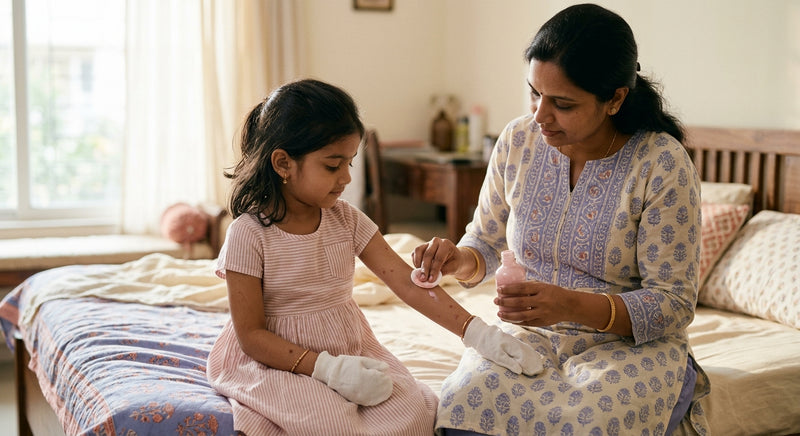
Two: the spots that rub. A thin layer of barrier balm on the inner thighs, the underarm crease and along the sock line before they leave. Thin is the word. You want the fabric gliding over skin, not a greasy wall on a 34°C morning.
Three: what they wear. A plain cotton banian under the house-colour t-shirt does more for a sweaty child than anything in a bottle. It wicks, it keeps polyester off the skin, and it can be swapped at lunch. Longer shorts if the uniform permits. Shoes that are already broken in — the white canvas pair bought yesterday will take skin off a heel by event four.
The sunscreen will sweat off by 10 am. What do we realistically do about that?
The standard advice is to reapply every two hours, and it quietly assumes an adult is standing there with the tube. On sports day nobody is. Bags are stacked by the house tent, your child is somewhere in a line for march-past, and no class teacher is going to sunscreen forty children between events.
So the plan has to work without you:
- Front-load it. A properly generous layer at 7:15 is worth more than a hopeful one at 7:28.
- Send a small tube or stick, named, in the front pocket. Not buried under the tiffin. Plenty of schools allow a quick top-up at the snack break if it is easy to reach.
- Teach one 20-second reapply: face, ears, nape, backs of hands. Four spots, not the whole body. A child will do four. No child does fourteen.
- Cap, always. It covers the scalp parting, which sunscreen rarely reaches and which burns badly.
- Ask where the shade is. Most Indian school grounds have one tree line, or a shamiana near the dais. That is where they sit between their events. That one habit removes more UV than any reapplication would.
- Water bottle out and visible. Refilled at least twice across the morning.
And let the tan happen. A child who comes home two shades darker with no burn, no blistering and no sting has had a successful day. Tanning is melanin doing its job. The burn is the thing you are there to prevent. The ordinary weekly version of all this is over in the Janma Journal: the five-minute freshen-up between games period and the next class.
Why does my child come back with rashes in the folds, not just a tan?
Parents brace for sunburn. What turns up at bath time is a raw underarm and a red band under the collar.
Sweat on its own is harmless. Sweat that cannot evaporate — trapped under a synthetic house t-shirt, inside a skin fold, in 70% humidity — blocks the sweat ducts and leaves the prickly pinprick rash most Indian families know as ghamori. Then add six hours of a seam sliding over damp skin. That is chafing: a friction injury, the top layer of skin worn thin.
| Where | What you'll see that evening | What helps |
|---|---|---|
| Collar line & back of neck | Red pinprick rash where the t-shirt sat wet | Cotton vest underneath, cool rinse, dry the crease fully before redressing |
| Underarms | Raw sting when they lift their arms or take off the shirt | Thin barrier layer before the event; a dry change of vest at lunch |
| Inner thighs | Shiny red patches that sting in the shower | Longer, softer shorts; balm applied at home, not after the damage |
| Ears, nape, hairline, hands | Genuine sunburn — hot, tender, sometimes peeling by day three | A fixed application order so these are never the spots you skip |
The polyester question comes up every year. House t-shirts are almost always synthetic, and synthetic really is worse at letting sweat evaporate than cotton. How wet it stays and how tightly it fits matter more than the fibre name, which we have unpacked in our piece on school uniforms and ghamori. On the friction side, each site has its own quirks, and both are worth reading before the next season: inner thigh chafing in active kids and underarm chafing from sports gear.
A barrier product for this job has to be thick enough to stay put through sweat, and plain enough — light on fragrance, short ingredient list — that you would happily put it on skin that is already sore. Our Hydra Healing Moisturizing Balm is one option that fits that description: a thin layer before a long outdoor day, and the same again on the sore spots that night to help soothe and support the skin's natural barrier.
One thing to skip: talc or powder over already-sweaty skin. It cakes into the crease and adds grit exactly where the skin is being rubbed.
What's the right routine that evening?
The hour they get home is where you undo most of the day. They will be tired, salty and probably hungry, so keep it to six minutes.
- Shower within an hour. Lukewarm. Not a cold shock on hot skin, and not hot, which stings chafed patches and pulls out more moisture.
- Gentle cleanser, bare hands. No loofah tonight, no scrubbing at the tan, no ubtan on raw skin.
- Pat dry, then check the creases. Neck, underarms, groin, behind the knees. A damp fold is how tomorrow's rash starts.
- Ten minutes in loose cotton, or nothing at all, so the folds properly air out before they dress.
- Moisturise while the skin is still barely damp, over the whole body, including the parts that caught the sun.
- Balm, thin, only on the raw patches. Inner thighs, underarm, heel.
- Cool compress on any hot, red, sun-exposed area. A clean cloth wrung out in tap-cool water, ten minutes.
- Look at the places they cannot see. Tops of the ears, back of the neck, under a light. Burn hides there.
- Keep the water going through the evening. They lost far more than they noticed.
A little redness should settle overnight, and chafed skin usually feels much better by day two or three. If the same three spots go raw after every single sports session, more cream will not fix it. Change what is touching the skin at that spot.
When to see a doctor
Call or visit your paediatrician the same day if your child, after hours in the sun, is confused or unusually drowsy, has stopped sweating, is vomiting, or has a bad headache. Heat illness needs medical attention, not a shower. Sunburn that blisters, or that covers a large area of the body, also needs a doctor.
Book an appointment if a rash develops yellow crusts or oozes, if redness spreads outward over a day, if there is fever, or if the pain seems out of proportion to how the skin looks. And if a chafed patch has not clearly improved after three to four days of rest and gentle care, have it looked at rather than layering more products on it.
Sports day is a good day. It asks for fifteen minutes of preparation the night before and six minutes when they get home. And for the sun part of it, a mineral layer a child can sweat in without their eyes stinging, which is what we built Daily Defender Kids Mineral Sunscreen SPF 40 PA++++ to do.
In summary
- Apply a genuinely generous mineral sunscreen layer at home, 15 minutes before leaving — not at the school gate.
- Use a fixed application order so ears, nape, hair parting and the backs of the hands never get skipped.
- Send a cap, a cotton vest to change into, a named tube in the front pocket, and agree where the shade is.
- Put a thin barrier balm on inner thighs and underarms before the event, not after the skin is already raw.
- That evening: lukewarm shower, pat the folds dry, moisturise on barely damp skin, and don't scrub the tan.
Frequently asked questions
What SPF does my child need for a full sports day outdoors?
Broad-spectrum SPF 30 or higher, with UVA protection marked as PA+++ or similar. For a full morning on an open ground, how much you apply matters more than the number — roughly half a teaspoon for face, ears and neck, and about a teaspoon per arm. Most children burn because the layer was too thin, not because the SPF was too low.
My child got tanned even with sunscreen. Did it not work?
Tanning isn't proof of failure. Sunscreen reduces how much UV reaches the skin; it doesn't block all of it, and on a six-hour day some darkening is expected. Judge it by burn instead: skin that is hot, tender, pink hours later or peeling by day three means the protection was too thin or reapplied too rarely. A deeper tan with no sting is a reasonable outcome.
How do I stop sunscreen stinging my child's eyes when they sweat?
Choose a mineral (zinc oxide) formula rather than a chemical one — they generally sting far less when sweat carries them downward. Apply nothing within a centimetre of the lash line, and use a cap so sweat from the forehead is intercepted. Send a small towel for them to blot, not rub, their face between events.
Should I use powder to control sweat before sports day?
No. Powder dusted over skin that is about to get sweaty cakes into the folds and adds grit exactly where fabric is already rubbing. A thin barrier balm on inner thighs and underarms before the event does the job better, and a dry cotton vest changed at the lunch break does more than either.
Can I use my own adult sunscreen on my child for one day?
For a one-off it's unlikely to cause harm, but adult formulas are often fragranced, more heavily perfumed or higher in alcohol, which can sting on sweaty, chafed skin. A child's sunscreen for sports day should be mineral, fragrance-light and comfortable enough that they don't rub it off. If you do use your own, patch-test on the inner forearm a couple of days ahead.