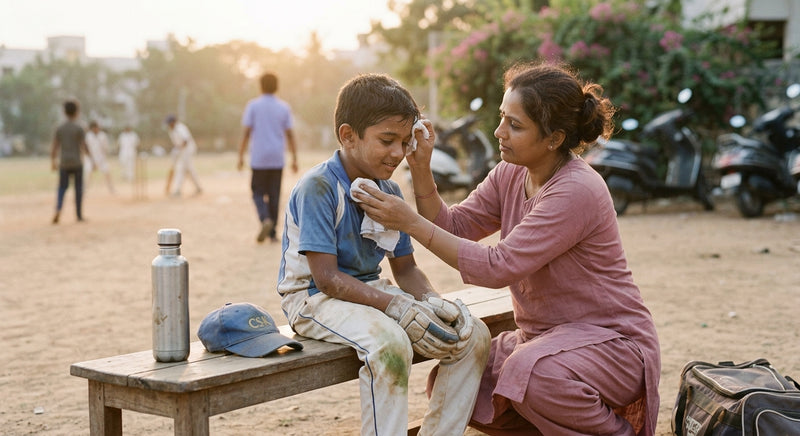
Sunday cricket, 11 to 3. No hat, no sunscreen. By dinner your eight-year-old's shoulders and the back of his neck are hot, tight and pink. His grandmother is already reaching for the malai. Someone else says put ice on it.
Here is the short answer. Get him out of the sun. Cool the skin with 10 to 15 minutes of cool — not cold — water, pat dry, and smooth on a plain fragrance-free lotion while the skin is still slightly damp. Fluids more often than usual. Loose cotton. A cool room. And expect the redness to look worse tonight and tomorrow morning than it did at 3pm. No ice, no ghee, no toothpaste, no de-tan pack, no sunscreen on top of burnt skin.
One belief starts most of these evenings: "Indian skin doesn't burn." More melanin raises the threshold. It does not remove it. Brown skin burns at a higher UV dose, and because the redness is harder to see on deeper tones, it usually gets noticed late — by which point it is already a full day old. The marks that come afterwards are a longer story, and we cover those in our complete guide to kids' tanning and pigmentation.
At a glance
- Sunburn redness peaks hours after the exposure ends — the skin at bedtime is not the final picture.
- Cool water for 10 to 15 minutes, then a light fragrance-free moisturiser on damp skin. That is the whole acute routine.
- Skip ice, ghee, malai, butter, mustard oil, toothpaste, vinegar, haldi paste and anything labelled de-tan or cooling-menthol.
- Extra fluids matter — a child loses water through burnt skin faster than you would guess.
- Blisters on a child, a burn over a large area, fever, vomiting, shivering or a drowsy child = paediatrician, today.
Why does the sunburn look worse at bedtime than it did at the ground?
Because sunburn isn't a heat burn. UVB damages DNA in the keratinocytes of the upper epidermis, and the skin answers with inflammation — blood vessels dilate, inflammatory mediators build, and the visible redness keeps climbing long after the sun has gone. The worst of it usually lands somewhere between 6 and 24 hours later. That is what changes your evening: you treat the burn you can see at 7pm, and you leave room for the one that hasn't arrived yet.
Children take the hit harder, and the reasons are structural. A baby's skin is 20 to 30% thinner than an adult's — less tissue sitting above the living layers. Young skin also has a less practised barrier and a much higher surface area relative to body weight, so water lost through an inflamed, leaky barrier costs a 4-year-old far more than it costs you. Parents watch the colour. The water is the part that gets missed.
Myths vs facts: what Indian households reach for first
| What you'll hear tonight | What's actually true |
|---|---|
| "She's brown, she can't get sunburnt." | Melanin raises the burn threshold. It doesn't abolish it. On deeper skin the redness reads as dusky, grey-brown, or simply "warm and tight" — easy to miss for a whole day. |
| "Put ghee / malai / butter / coconut oil on it." | A thick lipid layer over skin that is still radiating heat works like a blanket — it slows the cooling down. And dairy on skin that may be broken is an infection risk. Water first. Fats are not a cooling agent. |
| "Ice will bring the heat down fastest." | Ice and ice packs on already-injured skin can add a cold injury on top of the burn. Cool running water, or a cool compress. Never ice directly on the skin. |
| "Toothpaste, vinegar or haldi paste soothes a burn." | None of them were formulated for compromised skin. Toothpaste brings surfactants and flavour oils, vinegar is an acid, and turmeric paste on broken skin stings and stains. All three can push the inflammation further. |
| "Use a de-tan scrub so it doesn't go dark." | The worst possible timing. Scrubs and acid de-tan packs strip the stratum corneum you need intact right now, and friction on inflamed brown skin is exactly what sets up lasting dark marks. |
| "If there are no blisters, it's nothing." | A flat, non-blistered burn still means a real UV dose went in. It needs cooling, fluids, and a few days of staying covered. Read it as a prompt to fix the routine, not a free pass. |
The first 24 hours, step by step
Minutes 0 to 30: cool it
Indoors, out of the sun — even if the sun has gone behind cloud. Cool shower or cool bath, 10 to 15 minutes, comfortable-cool rather than shocking-cold. No loofah. No soap on the burnt area. No rubbing with the towel. If a shower is too much for a sore child, soak a cotton cloth in cool water, lay it across the shoulders and re-wet it every few minutes. Pat dry, and leave the skin faintly damp.
Minutes 30 to 60: moisturise light, not heavy
On that damp skin, a plain lotion — fragrance-free, alcohol-free. Light is deliberate. For the first few hours you want hydration without sealing the heat in, so a fluid lotion does more for him tonight than a thick butter or balm. Glycerin, panthenol, dimethicone, a simple oat-based emollient: all fine. Keep menthol, camphor, peppermint, eucalyptus, essential oils, salicylic acid, retinol and vitamin C well away. That "cooling" tingle on a child's burn is irritation, not relief.
Hour 1 onwards: fluids, clothes, room
Water or milk, little and often, more than he asks for. Loose cotton and nothing else — no bra straps on a tween, no tight waistband, no synthetic school tee. Keep the room cool, but don't park the fan or the AC vent blowing straight at the burn; moving dry air pulls water out of a barrier that is already leaking. Ask your paediatrician before you give any pain or fever medicine, including the bottle already sitting in your cupboard.
Overnight and the morning after
Look at the skin again at bedtime, and again when he wakes. That is when the true extent shows. Lotion morning and evening. If small blisters have come up, leave them completely alone — don't prick them, don't pull the roof off. Cover loosely with clean cotton and call your doctor.
- Cool water 10-15 minutes — no ice, no scrubbing
- Fragrance-free light lotion on damp skin, morning and night
- Extra fluids, offered often
- Loose cotton; nothing with a seam over the burn
- Re-check the skin at bedtime and on waking
- No sun at all for the next few days — hat, sleeves, shade

What about aloe vera?
It's the one home remedy with something real behind it, so it deserves a straight answer. Cool aloe gel does feel good, and it is mostly water — which is the whole of its value here. Two caveats from the formulation side. Fresh leaf carries a yellow latex layer near the rind that is itself an irritant, so if you're cutting from the plant on the balcony, scrape well clear of it. And a lot of bottled aloe is water plus alcohol plus fragrance plus a bright green dye; on a barrier that is already compromised, that combination stings and can sensitise. Use a plain one, patch it on a small area first, and treat it as comfort rather than care.
Day 2 to day 5: peeling, and the marks that follow
Peeling usually starts around day three or four, as the damaged cells are shed. Let it come away on its own — no picking, no helping it along with a towel. This is the window where a richer product finally has a job to do: the acute heat has gone, the barrier is dry and flaky, and an occlusive balm now helps rather than hinders. A thicker balm such as our Hydra Healing Moisturizing Balm suits that flaky stage on intact skin, to comfort dryness and help support the skin's natural barrier. Keep it, and everything else, off broken or blistered areas until your doctor says otherwise.

When to see a doctor
Call your paediatrician the same day if any of these apply: your child is under one year old and has any sunburn at all; there are blisters, or the burn covers a large area such as the whole back or both legs; there is fever, chills, shivering, vomiting, headache or dizziness; your child is unusually drowsy, floppy or hard to rouse; the skin is swollen, weeping, yellow-crusted or increasingly painful after day two; or your child has passed very little urine. Never apply a prescription cream on your own judgement, and never use a numbing spray on a child without medical advice. If something simply feels wrong to you, that is reason enough to get the skin looked at.
So the next one doesn't happen
Most sunburns on Indian children are collected between 10am and 4pm — at a cricket match, a pool, a sports day, a wedding lawn. Not on a beach holiday. Shade and clothing do more than any bottle: a wide-brimmed hat in place of a cap, a cotton full-sleeve over the tee, and sunscreen as the third layer on whatever stays exposed, reapplied every two hours and after swimming. Mineral filters sit on the surface rather than being absorbed, and that is how we formulate for children.
Once the burn has fully settled and the skin is intact again, a gentle mineral SPF like our Daily Defender Kids Mineral Sunscreen SPF 40 PA+++ is the habit worth building before next Sunday's match.
In summary
- Cool the skin with 10 to 15 minutes of cool water, then apply a light fragrance-free lotion while it is damp.
- Expect the redness to peak 6 to 24 hours later — judge the burn at bedtime and again in the morning, not at the beach.
- Keep ice, ghee, malai, toothpaste, vinegar, haldi paste, de-tan packs and numbing sprays off a child's sunburn.
- Offer fluids more often than usual, dress your child in loose cotton, and keep them out of the sun until the skin has healed.
- See your paediatrician the same day for blisters, a large burnt area, fever, vomiting, drowsiness or any sunburn in a baby under one.
Frequently asked questions
How long does a child's sunburn take to settle?
Mild redness usually peaks within 6 to 24 hours, fades over three to five days, and is often followed by peeling around day three or four. Deeper burns with blisters take longer and need a doctor's eye. Any pigment shadow left behind on brown skin can last weeks to months, which is why sun avoidance during healing matters as much as what you apply.
Can I put coconut oil or ghee on my child's sunburn?
Not in the first hours. A thick layer of fat acts as an occlusive film over skin that is still radiating heat, slowing cooling, and dairy on skin that may be broken adds an infection risk. Cool the area with water first, then use a light fragrance-free lotion. Richer balms and oils are better saved for the dry, flaky stage a few days later, on intact skin.
Should I put sunscreen on sunburnt skin?
No, not on skin that is broken, blistered or raw. Sunscreen is for prevention, not repair, and the surfactants and filters sting on a compromised barrier. For the next few days protect the area with clothing, a hat and shade instead. Once the skin has fully healed and looks normal again, go back to daily sunscreen on exposed areas.
Is aloe vera gel safe for a sunburnt child?
Plain aloe gel is mostly water and can feel soothing, but choose carefully. Fresh leaves carry an irritant latex layer near the rind, and many bottled gels contain alcohol, fragrance and dye, which sting damaged skin. Patch it on a small area first, keep it off blisters, and treat it as comfort rather than treatment. Cool water does most of the same work.
Why did my child's skin go darker after the sunburn?
Inflammation and pigment are linked, especially on brown skin. The cells that make melanin are stimulated both by the UV itself and by the inflammatory response that follows, so a healed burn can leave a shadow for weeks or months. Scrubbing, de-tan packs and bleach make it worse by adding fresh irritation. Sun protection and patience are what actually help it fade.
Can my child have a bath the next day?
Yes. Use cool to lukewarm water, keep it short, and skip soap, body scrubs and loofahs on the burnt area. Pat dry rather than rubbing, and moisturise while the skin is still slightly damp. If there are blisters, don't soak them or let water pressure hit them directly, and check with your paediatrician before covering anything.