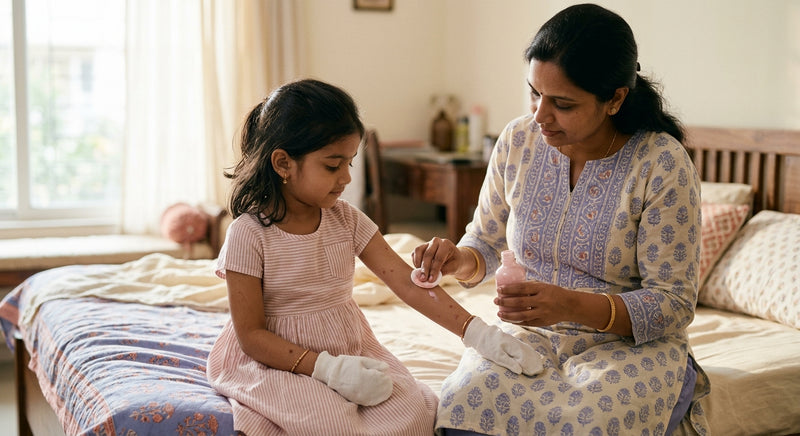
Ten days at camp near Panchgani, and she came home striped. A pale band where the sock ended. A hard line halfway down each arm, and a clean white ring under the watch strap. The bag hadn't hit the floor before she asked: will this go?
Mostly, yes. An ordinary camp tan is melanin the skin built as a shield, and it lifts on its own as the outer layer sheds. Four to twelve weeks is the usual span. The edges blur first; the middle takes its time to even out. A few other things get mistaken for tan every summer and don't clear on their own: colour left behind where a burn peeled, streaks or drip marks in odd shapes, and pale patches that only became noticeable once the skin around them darkened.
At a glance
- A plain sleeve or sock line fades by itself. Nothing you buy shifts pigment faster than the skin sheds it.
- Daily sunscreen for the next few weeks is what actually lets it fade. Fresh UV keeps topping the pigment back up.
- Darkening where skin peeled after a burn is the slowest to settle — think months rather than weeks.
- Sharp streaks, drips or a handprint shape often follow juice or fragrance plus sun rather than plain tanning. Worth showing a doctor.
- Pale patches appearing on tanned skin need a paediatrician's eye. Several look-alikes, treated very differently.
- Scrubs, lemon and “de-tan” packs don't lift melanin out of living skin. They inflame it, which can deepen the colour.
Why is the line so sharp?
Cloth turns UV into an on-off switch. Under the sleeve, near-zero dose. One millimetre outside it, ten days of high-altitude afternoon sun. There is no gradient to soften the join, so the skin draws you a straight edge.
Underneath that edge, two separate things were happening. Minutes after sun hits skin, the melanin already sitting there oxidises and darkens. That was the grey-brown of day one, and it had mostly gone by day three. What you're looking at now is the slow build. Over three to five days, melanocytes at the base of the epidermis manufacture fresh eumelanin, pack it into melanosomes and hand those parcels to the keratinocytes around them, which park each one like a tiny umbrella over the cell nucleus. A real, physical UV shield, put up after the exposure rather than before it. Children pigment fast and visibly, for reasons we went through in the Journal piece on why kids tan faster than adults. A camp tan is that machinery doing its job.
How long does a camp tan take to fade?
The pigment sits inside living cells, so it leaves when they do: pushed upward and shed. Epidermal turnover in a healthy child runs roughly a month. In practice, a ten-day camp tan softens noticeably by about week four and reads as “even” somewhere between six and twelve weeks.
Two things stretch that. The face, forearms and back of the neck get re-dosed every single day on the school run, so they hold colour longest. And anywhere that genuinely burned still has inflammation prodding the melanocytes, which is slower and more stubborn than a plain tan.
What fades on its own, and what doesn't
| What you're seeing | Fades by itself? | What it needs |
|---|---|---|
| Even sleeve, sock or watch-strap line | Yes — roughly 4–12 weeks | Daily SPF, moisturiser, patience |
| Deeper colour on face, neck, forearms | Yes, but slowest of all | These get re-dosed daily — hat plus sunscreen |
| Darkening where skin peeled after a burn | Slowly, often several months | Barrier care, strict sun cover, doctor if it spreads |
| Brown streaks, drips or a handprint shape | Very slowly | A doctor's look — usually juice or fragrance plus sun |
| Dark, slightly rough band under a bag strap or waistband | Only once the rubbing stops | Loosen straps, dry clothing, plain emollient |
| Pale or white patches on newly tanned skin | Depends entirely what it is | Paediatrician — don't scrub or self-treat |
Streaks and drips that aren't a tan
Nobody guesses this one. Lime squeezed for nimbu paani at the campsite. Mango skin. A bergamot-heavy body spray borrowed off a friend. The psoralens in them soak into skin, UVA switches them on, and out can come a sharply outlined brown streak shaped like a drip, a splash, or somebody's fingers. No itch. Painless by the time anyone notices it. And it can sit there for months. Whatever it turns out to be, it won't fade on the tan's timetable, so show it to a doctor rather than attacking it with a scrub.
Where the strap sat
A loaded backpack strap. A wet swimming costume waistband. A helmet chin strap, ten days running. Friction plus dampness is low-grade inflammation, and inflammation makes pigment. That band will not lighten while the rubbing continues, whatever you put on it. Loosen the strap first, then think about the skin.
The four-week post-camp routine
Here is the whole of it. It's a short list. The hard part is the daily part.
- Tonight, a lukewarm shower. Not hot. Hot water on sun-stressed skin makes it itch and flake more, and skin that flakes gets scrubbed, and scrubbing sets you back.
- Cleanse with your hands. No loofah, no besan, no body scrub. Thirty seconds is plenty. A mild surfactant that doesn't strip is the entire ask here.
- Moisturise within three minutes of patting dry, while the skin is still slightly damp. Glycerine holds that water in place; an emollient oil and a light occlusive slow the loss.
- Sunscreen every morning for six weeks — face, ears, back of the neck, hands. About half a teaspoon covers face, neck and ears on a school-age child.
- Reapply every two hours outdoors. A games period, a swim, one hard towel-down: each of those restarts the clock.
- Dress for the fade. Sleeves. A brimmed cap. A rash guard at the pool. That newly exposed strip must not go and earn a tan of its own.
- One photo a week, same window, same time of day. Skin moves too slowly to judge from memory, and parents underestimate their own progress.
- And nothing else. No lemon, no de-tan pack, no adult brightening serum borrowed off your shelf.
On step three: after a fortnight of sun, what you want on the label is a lotion rather than a heavy winter balm, because Indian August skin will not put up with a thick occlusive. Glycerine high in the list. A real emollient like almond or avocado oil. Oats for comfort. Skip added fragrance on skin that has just taken ten days of UV. Ours is the Hydrating & Soothing Moisturizing Lotion, built for daily post-bath use; it helps support the skin barrier — in our lab study the formulation increased Keratin-10 and Filaggrin expression, the proteins that hold that outer layer together.
What not to do
Never put an adult “de-tan” or brightening treatment on a child. Hydroquinone, strong AHA peels, high-percentage kojic or arbutin formulas were not designed for skin as thin and permeable as a child's, and the packs sold for this purpose are not formulated or tested for children. Keep lime juice off skin that's about to go out into the sun, too: lemon on the face plus an afternoon outdoors is the exact recipe for those brown streaks.
We don't make a lightening product for children and we won't. A tan is not a fault to be corrected. It is a record of sun exposure, and the useful response is better sun protection, not bleach.
When to see a doctor
Book a paediatrician or dermatologist if the sunburn blistered, or came with fever, chills or vomiting. Same if a tanned area is raised, itchy, scaly or has a defined round edge. Same again if pale or white patches have appeared and are spreading, or if you see sharply outlined brown streaks in shapes clothing can't explain. Darkening in the neck folds, armpits or over the knuckles with a slightly velvety feel needs a look, as does any single spot that is changing shape, changing colour or bleeding. Carry your weekly photos in. A dated series tells the doctor more than any description will.
If you keep one habit from this piece, make it the morning one. The tan fades when the sun stops re-dosing it, so park Daily Defender, our kids' mineral sunscreen SPF 40 PA++++, in the school bag for the rest of the season.
In summary
- A plain sleeve or sock tan line fades on its own — expect four to twelve weeks, edges softening first.
- Daily sunscreen after camp is the real lever: pigment can't fade while fresh UV keeps topping it up.
- Skip scrubs, lemon and de-tan packs — they inflame skin, and inflammation makes more pigment, not less.
- Streaks, drips, strap bands and colour left after a peeling burn follow different rules and deserve a doctor's look.
- Cleanse gently, moisturise on damp skin within three minutes, cover up, and take one photo a week to track it honestly.
Frequently asked questions
How long do tan lines take to fade in children?
An ordinary camp tan usually softens noticeably by about four weeks and evens out somewhere between six and twelve weeks, because the pigment sits in cells that take roughly a month to shed. The face, forearms and neck take longest since they keep getting fresh sun daily. Skin that actually burned and peeled can hold colour for several months.
Do de-tan packs, lemon juice or besan scrubs work on kids?
No. Melanin sits inside living skin cells, and a scrub only removes loose flakes from the surface, which looks brighter for a few hours. Worse, the abrasion and the acid create micro-inflammation, and inflammation is the exact signal that tells pigment cells to produce more. Lemon juice plus sunlight can also cause sharply outlined brown streaks that last months.
Can a tan line become permanent?
A plain tan line does not become permanent. What can linger is different: colour left behind where a sunburn peeled, darkening under a strap or waistband that keeps rubbing, or streaks from fruit juice or fragrance plus sun. Freckles across the nose also fade only partly each winter and return every summer, which is normal and not a tan.
Does sunscreen help a tan fade, or only prevent one?
Both, in effect. Sunscreen doesn't remove existing pigment, but continued UV keeps signalling for new melanin, so a tan that's re-dosed every day never appears to lift. Blocking that top-up lets normal skin shedding do its work. For a school-age child, about half a teaspoon covers face, neck and ears, reapplied every two hours outdoors.
My child has white patches now that the rest has tanned. What is it?
Usually those patches were always slightly paler and only became visible once the surrounding skin darkened. Several different things look like this in Indian children, and they are managed in completely different ways, so this is a paediatrician's call, not a guess from a photo. Don't scrub them, don't apply a steroid cream left over from something else, and keep the area sun-protected.
Should I stop sunscreen once camp is over?
No — the weeks right after camp are when it matters most. The skin is already carrying pigment and a slightly compromised barrier, and every additional hour of unprotected sun tops the colour up again. Keep the morning application going through the rest of the season for face, ears, back of the neck and hands, plus a brimmed cap for outdoor games.