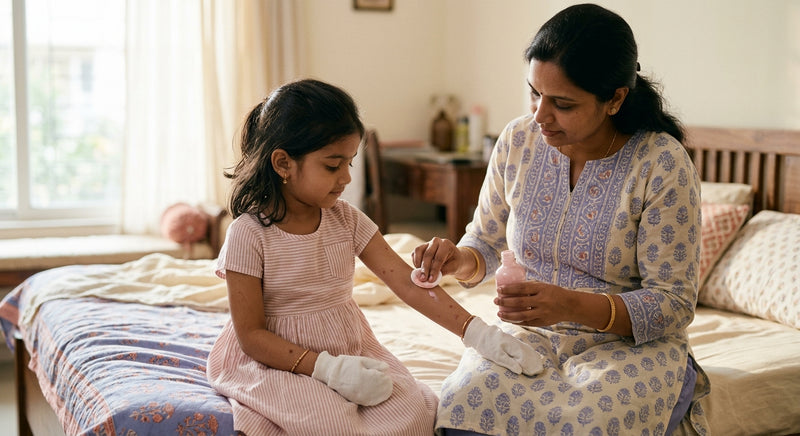
It starts with a photo on the phone. Four days at camp, and your daughter's forearms are two shades darker than her upper arms, with a clean line where the sleeve sat. By evening the suggestions arrive. An aunt, a neighbour, a reel forwarded at midnight. Use the de-tan cream in the bathroom cupboard. Or pick up a ten-rupee sachet of cream bleach from the shop downstairs.
Please don't. These are adult products at adult doses — hydrogen peroxide switched on by an alkaline activator, or fruit acids at 5-10%. A child's skin absorbs proportionally more, buffers less, inflames faster. And the tan isn't dirt sitting on the surface waiting to be lifted off. It's melanin your child's own skin manufactured to protect itself, and it clears on its own as the epidermis renews.
At a glance
- Cream bleach mostly lightens the fine vellus hair on skin, not the pigment inside it. On a child, what you actually get is stinging, redness and watering eyes.
- De-tan creams lean on glycolic or lactic acid, salicylic acid and gritty scrub particles. Every one of those disturbs a barrier that is thinner to begin with in children.
- On Indian skin tones, irritation is the fastest route to a darker patch. Post-inflammatory pigmentation can outlast the tan by months.
- Hydroquinone is a prescription medicine in India, not a cosmetic ingredient. It has no place in a child's routine without a dermatologist.
- Daily sunscreen and a plain moisturiser will do more for an uneven tan than any "removal" product, and they cost your child nothing.
If you're piecing this together for the first time, our complete guide to tanning and pigmentation in children is the place to begin. This piece is about one fork in that road: the products already sitting in your bathroom cupboard, none of which were designed for a seven-year-old.
What is actually inside an adult de-tan cream or bleach?
I read these labels for a living. Let me open both boxes.
Cream bleach: an oxidiser plus an activator
Household cream bleach comes in two parts. The tube is hydrogen peroxide suspended in a thick cream base. The little sachet is an alkaline activator powder, usually ammonia-based. You mix them, the pH shoots up, the peroxide turns reactive, and it oxidises melanin — mainly the melanin in the fine vellus hair lying on the skin. That's why bleached skin looks "brighter" in the mirror. The downy hair has gone golden. The skin's own pigment is barely touched.
So your child takes on every downside of an oxidising alkaline cream. The sting. The redness. The ammonia fumes in a bathroom with one small window and an exhaust fan nobody has cleaned since Diwali. All of that in exchange for what is, honestly, hair colouring. The pack tells you as much itself: patch test behind the ear, remove it the moment it burns. A child cannot reliably tell you "this is a warning sting" versus "this is a normal tingle." By the time they say it hurts, the barrier is already disrupted.
De-tan creams, packs and scrubs: acids, grit and lightening actives
The de-tan shelf is broader and messier. The actives I see most often, roughly in that order:
- Alpha hydroxy acids — glycolic or lactic acid, often 5-10%, in a formula sitting around pH 3.5-4. They loosen the bonds between surface corneocytes so pigmented cells shed faster. On an adult, that works. On a child, it's simply aggressive.
- Salicylic acid — oil-soluble, usually 1-2%, built for adult sebaceous skin.
- Physical scrub particles — walnut or apricot shell powder. Under a microscope they fracture into irregular shards with sharp edges. What they leave behind is micro-tears. Nobody is polishing anything.
- Lightening actives — kojic acid, arbutin, high-strength vitamin C at low pH, sometimes retinol.
- A heavy fragrance load, because acids and kojic acid smell unpleasant and something has to cover them.
Then there are the loose creams. Unlabelled tubs at the cosmetics stall in the weekly market, or a chemist's bottom shelf. No batch number, no manufacturer, no ingredient list. A product that promises a dramatic colour change in a week and won't tell you what's in it isn't a bargain. It's an unknown, and you're rubbing it into a child's skin.
Why does a child's skin react so differently?
Three reasons, and they stack on each other.
The barrier is genuinely thinner. A baby's skin is 20-30% thinner than an adult's, and although it thickens through childhood, the job isn't finished until well past puberty. The stratum corneum is the only thing standing between an acid and the living cells underneath. Less of it, more gets through.
Then there's dose, which is where most families are caught out. Children carry a much higher ratio of skin surface area to body weight than adults do. The same thumbnail of cream, spread over a forearm, delivers proportionally far more to a 20 kg child than to a 60 kg adult. It's ordinary paediatric pharmacology, and it's the reason paediatricians go carefully even with mild topicals on large areas.
The third one is the part I think about most as a formulator. Children's skin loses water faster once you disturb it. Strip the surface lipids with an acid or a scrub and transepidermal water loss climbs. What follows is the dry, tight, itchy skin that turns up after every "treatment" — and a child who scratches.
| What's in an adult de-tan product | Why it's wrong on a child |
|---|---|
| Hydrogen peroxide + alkaline activator (cream bleach) | Oxidises hair more than skin pigment; alkaline pH strips surface lipids; fumes irritate eyes and airways in a closed bathroom |
| Glycolic / lactic acid, 5-10%, pH ~3.5 | Thins an already-thin stratum corneum; sting and redness are the norm, not the exception |
| Salicylic acid 1-2% | Designed for adult oily skin; children's skin is drier and absorbs proportionally more |
| Walnut or apricot shell scrub grit | Sharp fractured particles cause micro-tears — the opposite of what a tanned, sun-stressed face needs |
| Hydroquinone | A prescription medicine in India, not a cosmetic. Never on a child without a dermatologist's instruction |
| Retinol, strong vitamin C at low pH | Photosensitising and irritating; the last thing skin heading back out into the sun needs |
The part that surprises parents: this can make skin darker
Irritation causes inflammation. Inflammation tells melanocytes to make more pigment. In skin types IV and V — which is most Indian children — that response is quick and stubborn. The name for it is post-inflammatory hyperpigmentation, and it can sit there for months after the original tan would have faded by itself.
So the child comes home with an even, temporary tan across both arms. Two weeks of scrubbing and bleaching later, there's a blotchy patch where the cream was rubbed in hardest, usually across the cheeks and the backs of the hands, and now it looks permanent. I've seen this often enough to say it plainly. The treatment creates the problem the family then spends a year trying to fix.
What to do tonight instead
Here's the whole protocol. It's boring, and it works.
- Bath in lukewarm water with a mild, pH-appropriate cleanser. Two minutes. No loofah, no scrubbing at the tanned areas.
- Pat dry rather than rub. Leave the skin very slightly damp.
- Within three minutes, a plain moisturiser over the whole body — our hydrating and soothing lotion for kids is the sort of thing I mean: humectant plus emollient, no actives, nothing that stings.
- Extra on the elbows, knees, shins and the backs of the hands. Those are the spots that go ashy and get read as "dirty tan" when they're only dry.
- Tomorrow morning, a proper layer of sunscreen on the face, ears, neck and the backs of the hands before school. Reapply if they're outdoors past two hours.
- Hat, or long sleeves, for anything between 11am and 4pm — the school ground, the walk back from the bus stop, colony cricket. This does more than every cream put together.
- Then leave it alone. Give it a month before you judge.
How long does a child's tan take to fade on its own?
Weeks rather than days, and quicker in children than in adults, because their epidermal turnover is faster. Melanin that's been transferred into keratinocytes rides those cells up to the surface and sheds along with them. Nothing you apply speeds that up meaningfully. The one lever that matters is stopping fresh UV exposure, so new pigment isn't being laid down while the old lot is still clearing.
The uneven bits take longest. It's why sharp tan lines after a summer camp look worse in week two than in week one — the covered skin lightens first, so the contrast sharpens before it softens. It's worth reading why children tan faster than adults do as well, because that mechanism is a defence the skin has built, not something gone wrong.
What about a salon de-tan facial before a wedding?
My honest position: not before the teens, and not on the face. Salon de-tan is usually the same acid-and-scrub chemistry at professional strength, and the exposure time is judged by feel by someone whose entire experience is adult clients. Children's skin doesn't give the same feedback. One wedding photograph is not worth a pigmented patch that lasts into the next school year.
If the occasion matters, do the boring version properly. Two weeks of consistent moisturising and daily sun protection beforehand. Skin that is well hydrated reflects light more evenly and simply looks better. No oxidiser required.
When to see a doctor
Book a paediatrician or dermatologist if your child's skin blisters, weeps, swells or stays painful after any product. Go too if a burning sensation hasn't settled within an hour of rinsing, or if the darkening is patchy, sharply bordered, spreading, or showing up on skin that never sees the sun. Pale or white patches, rather than dark ones, need the same attention. So does any pigment change that comes with itching, scaling or a rash — that one needs a look in person, not over a photo. And a doctor is the only person who should ever prescribe a lightening medicine for a child.
The most useful thing you can do about a child's tan is stop the next one. A broad-spectrum mineral sunscreen made for children's skin, used every morning, does more than any de-tan product ever will.
In summary
- Skip adult de-tan creams and cream bleach on children — the peroxide, 5-10% acids and scrub grit are dosed for adult skin.
- Irritation on Indian skin tones often leaves a darker, longer-lasting patch than the tan you started with.
- A child's tan is melanin their own skin made, and it clears over weeks as the epidermis renews.
- Tonight: lukewarm bath, mild cleanser, pat dry, and a plain moisturiser on slightly damp skin — no scrubbing.
- Tomorrow morning: broad-spectrum sunscreen on face, ears, neck and hands, plus a hat between 11am and 4pm.
Frequently asked questions
Can I use cream bleach on my child's face for a tan?
No. Cream bleach is hydrogen peroxide activated by an alkaline powder, and it mainly lightens the fine hair on skin rather than the pigment inside it. On a child it commonly causes stinging, redness and watering eyes, and the irritation can trigger post-inflammatory pigmentation that lasts far longer than the original tan. Keep it off children's faces entirely.
At what age can a child use a de-tan cream?
There's no age at which a child needs one. Most de-tan products rely on 5-10% fruit acids, salicylic acid or scrub grit, all formulated for adult skin. If an older teenager wants to address uneven tone, that's a conversation with a dermatologist, who can choose a strength and an ingredient that suits their skin rather than a general-purpose adult product.
Is a tan on a child permanent?
No. A tan is melanin made by the skin in response to UV, and it clears as the epidermis renews — usually over several weeks, and faster in children than adults. Uneven tan lines look worse before they look better, because covered skin lightens first and the contrast sharpens. Daily sun protection stops new pigment forming while the old fades.
My child's skin burned after a de-tan cream. What do I do now?
Rinse straight away with plain cool water, pat dry, and apply a bland fragrance-free moisturiser. Don't try to neutralise it with lemon, curd, toothpaste or another active product. Keep the area out of the sun completely for the next few days. If there's blistering, weeping, swelling, or pain that doesn't settle within an hour, see a doctor the same day.
Are ubtan or besan packs a safer de-tan option for kids?
Gentler than bleach, but not a tan remover. A besan or ubtan pack mildly exfoliates and makes skin feel smooth; it doesn't reach the melanin that gives a tan its colour. Used softly with no scrubbing pressure and rinsed off, it's usually fine on older children. Skip it on eczema-prone, broken or sunburnt skin, and never add lemon juice.
Does sunscreen actually help a tan fade faster?
Indirectly, and it's the most effective thing you have. Sunscreen doesn't remove existing melanin, but it stops fresh pigment being made every time your child steps out. That lets the natural shedding of pigmented surface cells get ahead. A broad-spectrum SPF applied every morning, plus a hat between 11am and 4pm, beats any cream marketed for tan removal.