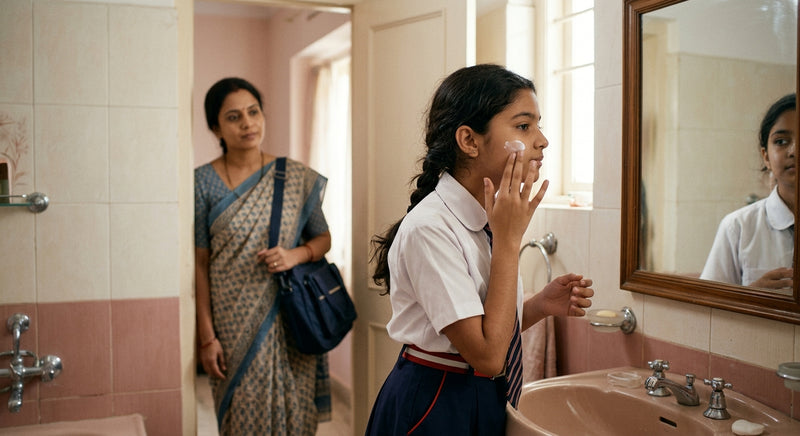
She hands you the phone. A girl barely older than her is patting something pearly onto her cheeks, the caption says glass skin in 7 days, and your nine-year-old wants it by Saturday. Say yes to the ritual, no to the actives. At nine, a retinol, a strong vitamin C or an exfoliating acid has no job to do on her skin, and a real chance of damaging the barrier she was born with. What she wants is the feeling in that video. You can give her that with three products. None of them is a serum.
I have some version of this conversation most weeks now. A flat no has never once held. So here's the script, the ingredient list, and what we'd do at home.
At a glance
- At nine, healthy skin already does what a hydrating serum promises. The serum is solving a problem she doesn't have.
- Hard no on retinol, retinal, glycolic and salicylic acids, and anything sold on making skin lighter.
- Fine in moderation: sheet masks as play, lip balm, a nice-smelling body wash she picked herself.
- The one product that earns a daily slot at nine is sunscreen. Not serum.
- Counter-offer the same day. Her own shelf, her own two products, her own 60-second routine.
Why is a nine-year-old asking for serum at all?
Because her feed is full of it. And because skincare has quietly become the currency of her friend group. Return gifts at birthday parties come with sheet masks in them now. An older cousin has a shelf. Two girls in her class compared bottles at tiffin break and she had nothing to show. The want is about belonging, dressed up as skincare, and it turns up alongside the other changes of this age — the ones we've mapped in our complete guide to tween body changes.
Which is why a ban backfires. Forbid the whole category and she'll borrow her friend's at a sleepover, or use whatever is standing in her aunt's bathroom, and you will never see that label. Better she experiments on your shelf, under your rules.
The script: what to say when she shows you the video
Four moves, in this order. The order does more work than the words.
1. Start with what she likes, not what she's wrong about. “That bottle is gorgeous. Play it again — tell me what she says it does.” The fight is now a shared review. You also find out what she's really after: a dewy face, a pretty dropper, or the girl holding it.
2. Then ask the question that does all the work. “What do you want your skin to do that it isn't doing right now?” Nine times out of ten the answer is “nothing, it just looks nice.” Sometimes it's specific. A dry patch on her cheek. An oily T-zone before the class photo. One spot on her chin. Whatever she says decides everything that comes after.
3. Give her the honest reason, at her level. Not “you're too young.” Try this instead: “Serums are strong on purpose. They're made for skin that has stopped doing a job by itself. Yours hasn't stopped. Putting that on your face now is like taking medicine for something you don't have.” A nine-year-old will accept a mechanism. She will not accept because-I-said-so.
4. Counter-offer the same day, with a date on it. Not someday. “Here's what you can have: your own shelf in the bathroom, your own face wash and your own sunscreen, and every time you want something new we turn the bottle over and read the ingredients together.” Then go and buy it that week. A promise you keep buys you two more years of trust on this subject.
Which viral ingredients are actually fine at nine?
These are the ones that keep turning up in the videos my daughter's friends watch. Sorted honestly.
| What she's asking for | What the video promises | Our call at 9 |
|---|---|---|
| Hyaluronic acid / glycerin serum | Plump, dewy, “glass” skin | Harmless, but pointless — a plain moisturiser does the same thing for a third of the price |
| Niacinamide | Smaller pores, glow | Not needed. There's nothing to shrink yet |
| Vitamin C (10%+) | Brightening | Skip. Stings on young skin, and there's no dullness to fix |
| Retinol or retinal | Smooth, anti-ageing | Hard no. Expect peeling, redness and a damaged barrier |
| Glycolic or salicylic acid | Clear, smooth skin | No — unless a dermatologist has specifically prescribed it for acne |
| Clay or charcoal mask | Deep clean | Occasional and brief. Not a weekly habit — it strips more than it cleans |
| Sheet mask | Spa night | Fine as play, 10 minutes, check for heavy fragrance first |
| Lip balm / lip oil | Shiny lips | Yes. The easiest yes on this list |
| Sunscreen | Protection | Yes — the only one that earns a daily slot |
| Anything sold on making skin lighter | “Even tone”, “fairness” | Never. Not at nine, not at nineteen |
That last row matters more than parents expect, because the kitchen versions travel the same way. A friend's older sister swears by lemon on her underarms, and by the weekend it's in your house too. We've written about why lemon and turmeric on kids' underarms causes more marks than it removes. The same logic holds on her face.
Hard no, free rein, or guided yes?
Parents land in one of three places. The three are not equally good.
| Approach | What she learns | What usually happens |
|---|---|---|
| Hard no — “You're a child, forget it” | That skincare is an adult secret and you're not part of it | She tries it anyway, at a friend's house, with no patch test and no label check |
| Free rein — “Fine, take the ₹1,200 one” | That a problem she doesn't have can be bought away | Irritation she didn't sign up for, often a dermatologist visit, then a new fear of products |
| Guided yes — her own shelf, your rules | How to read a label and tell marketing from mechanism | Excitement lands on a routine she'll still be doing at fourteen |
What we'd do: the guided yes, every time. Not because it's the polite middle option. Because it's the only one of the three that leaves her with a skill. Flip a bottle over, find the third ingredient, ask what it is supposed to do for her — that's the thing she keeps. She'll need it much more at fifteen, when the products on the shelf get properly strong.
The routine we'd give a nine-year-old instead
Three steps, about sixty seconds, at the same time every night so it feels like a ritual and not a chore. The fourth thing on this list lives in her school bag.
- Wash once, at night. Lukewarm water — not hot — about 20 seconds, fingertips only. No scrub, no face brush, no washcloth. Let her pick a gentle, low-fragrance cleanser meant for her age, like our Kids Gentle Body Cleanser, and let it live on her shelf. Mornings are water only, unless she's genuinely oily by breakfast.
- Moisturise within two minutes of towelling off. A pea-sized amount for the face, while the skin is still slightly damp. Keep it simple and fragrance-light: glycerin or a light emollient near the top of the list, no added actives. This is the step that delivers the “dewy” she saw in the video.
- Sunscreen on school mornings. Two fingers' worth for face, ears and neck, applied before the uniform goes on. Reapply every 2-3 hours on a sports day or a school trip.
- A lip balm in her bag. Small, satisfying, completely harmless. Let her choose it.
That's the whole shelf. If her hair has turned oily by the second day, that's a scalp story rather than a skin one, and why a child's hair goes greasy overnight covers it. If body odour arrived before the serum question did, deodorant at ten versus a better bath routine answers that one honestly.
When to see a doctor
Book a paediatrician or dermatologist if:
- Her skin is burning, peeling or staying red more than 48-72 hours after she used something — stop all products first, then call.
- Acne is more than the odd blocked pore, is painful, or is leaving marks — a doctor can guide it early, and self-treating it with a viral product is how scars happen.
- Any spot changes shape or colour, or a ring-shaped, scaly or spreading patch appears.
- Body odour, underarm hair or breast development has started before age eight — that's a growth question for a paediatrician, not a skincare one.
We're not a substitute for that appointment, and nothing on a label is either.
If you say yes to one real thing this week, make it the sunscreen. Look for a mineral filter, broad-spectrum cover and a texture light enough that she will actually wear it on a school morning — that is the shortlist, whichever brand you buy. Ours is the Daily Defender Kids Mineral Sunscreen SPF 40 PA++++, and it is what sits on our own shelf.
In summary
- Say yes to the ritual and no to the actives — a nine-year-old's skin already does what a hydrating serum promises.
- Use the four-line script: praise the bottle, ask what she wants her skin to do, explain the mechanism, then counter-offer the same day.
- Hard no on retinol, retinal, glycolic and salicylic acids, and anything sold on making skin lighter.
- Give her a three-step shelf instead — gentle night wash, a pea of simple moisturiser on damp skin, and sunscreen every school morning.
- See a doctor for stinging or peeling that lasts beyond 48-72 hours, painful acne, or any change before age eight.
Frequently asked questions
Is a hyaluronic acid serum safe for a 9-year-old?
It is unlikely to harm her, but it also has nothing to do. Hyaluronic acid pulls water into skin that has stopped holding it well — a nine-year-old's skin still does that on its own. A simple moisturiser gives the same dewy finish for far less money. If she wants the dropper experience, buy the ritual, not the active.
At what age can my child start using retinol or acids?
Not at nine, and not on a whim at any age. Retinoids and exfoliating acids are barrier-active ingredients that increase sun sensitivity, which works badly in Indian sun. If she develops acne, a dermatologist may prescribe something in that family and will supervise the strength and frequency. That's a very different thing from buying a viral bottle online.
What should I say when my daughter says all her friends use it?
Agree with the feeling before you disagree with the product. Try: “I believe you, and I get why you want it. Here's the deal — serums are made for skin that's stopped doing a job by itself, and yours hasn't. But you get your own shelf, your own face wash and your own sunscreen this week.” A same-week counter-offer works far better than a vague “when you're older”.
Are sheet masks and clay masks okay for a 9-year-old?
Sheet masks are usually fine as an occasional treat — ten minutes, low fragrance, patch-tested first. Clay and charcoal masks are the ones to limit, because they strip oil that young skin needs and can leave the face tight and flaky. Once in a while is fine. Weekly is not, and neither is leaving a clay mask on until it cracks.
My child already used a borrowed serum and her face is red. What now?
Stop every product immediately. Wash with plain lukewarm water, use only a bland, fragrance-free moisturiser twice a day, and keep her out of direct sun. Most simple irritation settles in a few days. If it's burning, swelling, blistering, or hasn't improved in 48-72 hours, see a doctor rather than layering anything else on top.
Does a 9-year-old need sunscreen every day in India?
On school days, yes — she's outdoors for assembly, games period and the walk home, which is where most of a childhood's sun exposure quietly accumulates. Two fingers' worth covers face, ears and neck. Reapply every two to three hours on sports days or trips. It is the one product in this whole conversation that genuinely earns a daily slot.