It's 11pm, the baby is finally down, and you're on your phone with the one question that won't let you sleep: was your mother-in-law right? Kajal in the eyes, a soap bath every single day, ubtan to keep body hair away, powder after every nappy change. The advice arrives fast, and always with love. Most of us have heard all of it.
The honest short answer: some of these habits are harmless, a couple are genuinely lovely, and a handful can quietly work against your baby's skin barrier. Below are the seven myths I get asked about most — what's true, what isn't, and exactly what to do instead tonight. This sits inside our complete guide to buying baby skincare by age, if you want the bigger picture after.
At a glance
- A baby doesn't need a soap bath every day — 2-3 gentle washes a week is plenty for most.
- Kajal in the eyes is a real lead-exposure risk, not eye protection. Skip it.
- "Chemical-free" and "100% natural" are marketing words, not safety guarantees.
- Peeling newborn skin is usually normal shedding, not a sign you need a stronger cream.
- No product lightens a baby's skin — and any that claims to should worry you.
Myth 1: "A soap bath every day keeps a newborn cleanest"
Babies don't get dirty the way we imagine. No Nagpur commute, no gym session — they milk-feed, sleep, and fill nappies. What genuinely needs cleaning several times a day is the nappy area and the folds of the neck. Not the whole body, and not with soap.
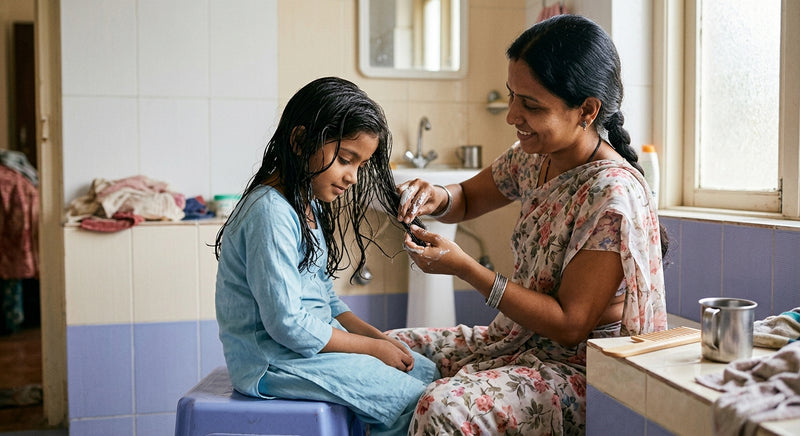
A baby's skin is 20-30% thinner than yours. A harsh daily soap strips the natural oils that hold the barrier together, and then you're chasing the dryness you just created. For most babies, a full wash 2-3 times a week is enough, with a quick top-and-tail — face, neck folds, nappy area — on the other days. When you do wash, reach for a tear-free, pH-appropriate gentle head-to-toe baby foam wash rather than a regular soap bar, which usually sits far too alkaline for infant skin.
Myth 2: "Kajal in the eyes protects a baby's eyesight"
This is the one I'd ask you to stop tonight, gently but firmly. Traditional kajal is loved and well-meant. But independent lead testing over the years has repeatedly found high lead levels in many homemade and unregulated kajals. A baby's system is tiny and still developing, and there's no safe level of lead exposure for a child.
Kajal does not strengthen the eyes, make them bigger, or ward off the evil eye's effect on vision — that's folklore, not physiology. If this is about protecting your baby, the protective act is not applying it. Especially not inside the waterline.
Myth 3: "Dusting powder after every nappy change prevents rash"
Powder feels like it's doing something — it looks dry, it smells clean. But talc-based powders can clump in damp skin folds, and, more importantly, the fine particles are easy for a baby to inhale during a wriggly nappy change. That's a genuine respiratory concern paediatricians warn about.
What actually prevents nappy rash is far less glamorous: change often, let the skin air-dry, use a thin protective barrier. If redness is already showing, a barrier balm is the right tool — in our in-vivo test we saw a visible improvement in the look of diaper-area redness in 7 days with twice-daily use. And if you want the numbers on quantities, our guide on how much product a baby actually needs by age saves you both money and over-application.
Myth 4: "Ubtan and besan will stop your baby's body hair growing"
Lots of newborns arrive with soft downy hair on the back, shoulders and forehead. It's called lanugo. The reassuring part: it falls away on its own over the first weeks and months, whether or not you rub anything on it.
Ubtan and besan don't remove hair follicles or slow growth. At best you're gently exfoliating fine hair that was going to shed anyway; at worst a coarse, dry paste scratches thin baby skin and tugs at it. If you love the ritual of a soft ubtan as part of malish, keep it gentle and well-moistened — but do it for the bonding and the tradition, not out of worry about hair that nature is already handling.
Myth 5: "'Chemical-free' and '100% natural' always mean safer"
This one's closest to my own work, so I won't dress it up. Water is a chemical. Nothing you put on skin is "chemical-free" — and under India's Cosmetics Rules, claims like "chemical-free", "100% natural" and "toxin-free" are considered misleading for exactly that reason.
| What the label says | What actually matters |
|---|---|
| "100% natural" | Some botanicals (undiluted essential oils, certain cold-pressed extracts) irritate infant skin. Natural is not the same as gentle. |
| "Chemical-free" | A marketing phrase, not a safety measure. Ask instead: is it pH-appropriate, fragrance-considered, and tested? |
| "No preservatives" | A water-based product with no preservative can grow mould and bacteria. A well-chosen preservative protects your baby. |
What I'd actually look for: who made it and where, whether the formula is dermatologically and in-vivo tested, and whether the brand can show its proof. We make ours in our own GMP-certified facility in Nagpur rather than white-labelling it, which means we own the formulation and can stand behind every ingredient decision. A label buzzword can't offer you that.
And if reading ingredient lists still feels like a foreign language, our season-by-season routine chart keeps the actual choices simple.
Myth 6: "Peeling newborn skin means my baby needs a heavy cream"
In the first week or two — especially with babies born a little late — the top layer of skin flakes and peels. Hands, feet, ankles, tummy. Parents panic and reach for the thickest cream in the house. Most of the time, though, it isn't dry skin at all. It's normal shedding: the outer layer that protected your baby in the womb coming away to reveal new skin underneath.
You don't need to scrub it, peel it, or slather on a heavy occlusive to "fix" it. A thin layer of a simple, barrier-supporting moisturiser after a bath is plenty. Look for something that helps support the skin barrier rather than just sitting on top — the Hydra Healing Moisturizing Balm was formulated with that in mind (in a lab study it supported increased Keratin-10 and Filaggrin expression, two proteins your baby's barrier is built from). If the peeling comes with redness, cracking or weeping, that's a different story — see the doctor section below.
Myth 7: "The right ubtan or cream can make my baby's skin fairer"
This is the biggest demand pool of all, and the one I most want to reframe — so I'll be plain about it. A newborn's skin tone often looks different at birth and shifts over the following weeks as melanin matures. That's biology on a schedule, not something a product corrects.
No cream, ubtan, oil or besan paste lightens a baby's skin, and any product that promises to should make you close the tab. Skin-lightening claims for infants are restricted by advertising rules for good reason — they're indefensible, and they prey on worry. Your baby's skin will settle into its own healthy tone. Spend your energy on keeping it soft, protected and comfortable, and let the colour be.
What to do tonight
- Skip the kajal in and around the eyes — starting now.
- Swap a daily soap bath for a warm sponge clean, with a proper wash 2-3 times a week.
- Retire the dusting powder; change nappies often and air-dry the skin instead.
- Read one label the new way: ignore "chemical-free", check who made it and whether it's tested.
- If newborn skin is peeling but calm, use a thin layer of a barrier balm — not a heavy remedy.
When to see a doctor
Most of what our elders pass down is rooted in care, and plenty of it — the warm malish, the calm bath ritual — is worth keeping. It's the handful of habits that can quietly harm a thin, still-developing barrier that are worth quietly retiring. For the gentle, barrier-supporting comfort a newborn's skin actually needs, look for a simple balm that helps support the barrier and use it sparingly — that's all most babies require.
In summary
- Bathe most babies 2-3 times a week with a gentle, tear-free wash — not a daily soap scrub.
- Skip kajal in the eyes entirely; it's a real lead-exposure risk, not eye protection.
- Retire dusting powder — change nappies often and air-dry instead of relying on talc.
- Judge products by who makes and tests them, not by "chemical-free" or "100% natural" labels.
- Treat peeling newborn skin as normal shedding, and never trust any product claiming to lighten a baby's skin.
Frequently asked questions
Is it safe to put kajal in a baby's eyes?
No. Independent lead testing has repeatedly found high lead levels in many homemade and unregulated kajals, and there is no safe level of lead exposure for a baby. Kajal does not protect or strengthen a baby's eyesight — that belief is folklore. The safest choice is to skip it entirely, especially inside the waterline, and speak to your paediatrician if you have concerns.
How often should I actually bathe my newborn?
For most babies, a full wash 2-3 times a week is enough, with a quick sponge clean of the face, neck folds and nappy area on other days. A baby's skin is 20-30% thinner than an adult's, so daily soap strips protective oils and causes dryness. When you do bathe, use a tear-free, pH-appropriate baby wash rather than a regular soap bar.
Does ubtan or besan stop a baby's body hair from growing?
No. The soft downy hair many newborns have is called lanugo, and it sheds naturally over the first weeks and months whether or not you apply anything. Ubtan and besan don't remove follicles or slow growth. A coarse, dry paste can actually scratch thin baby skin, so if you enjoy the ritual, keep it soft and well-moistened — and do it for the bonding, not the hair.
Does "chemical-free" or "100% natural" mean a baby product is safer?
Not necessarily. Everything, including water, is made of chemicals, and under India's Cosmetics Rules these phrases are considered misleading. Some natural botanicals irritate infant skin, and a product with no preservative can grow bacteria. What matters more is who made it, where, whether it's dermatologically and in-vivo tested, and whether it's pH-appropriate for a baby.
Is peeling newborn skin a sign my baby needs a heavy cream?
Usually not. In the first week or two, peeling on the hands, feet and tummy is normal shedding of the outer layer that protected your baby in the womb. You don't need to scrub it or use a thick occlusive. A thin layer of a simple, barrier-supporting moisturiser after a bath is plenty. See a doctor if the peeling comes with redness, cracking, weeping or fever.
Can any product make my baby's skin fairer?
No. A newborn's skin tone often shifts over the first weeks as melanin matures — that's normal biology, not something a cream corrects. No ubtan, oil or lightening product changes a baby's natural skin tone, and skin-lightening claims for infants are restricted by advertising rules. Focus on keeping the skin soft, comfortable and protected, and let the tone settle on its own.