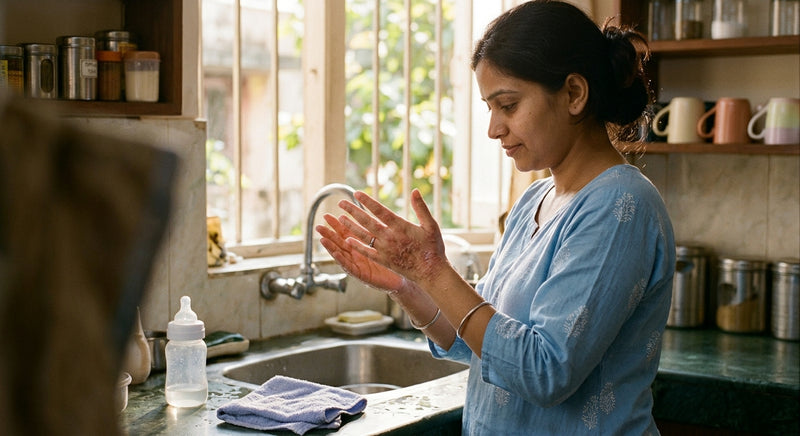
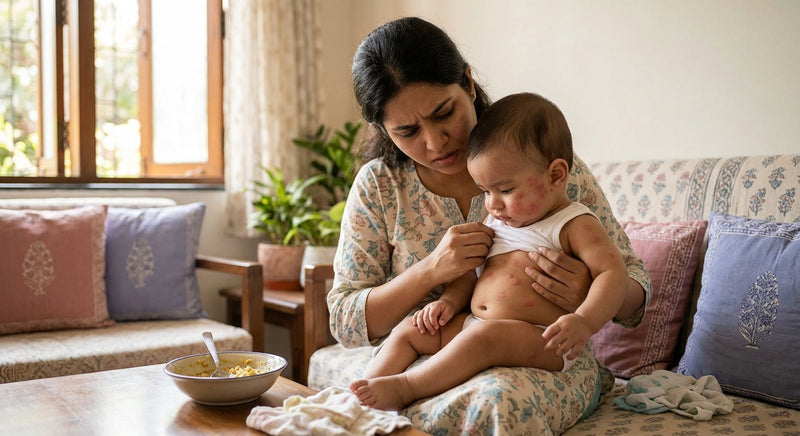
It's 2am, the nappy is heavy, and someone in the family has already said it: wipes nahi, cotton aur paani se saaf karo. Neither side is going to like this answer. For a newborn's first week or two — and any time the skin is sore, raw or broken — cotton with warm water is the gentler option. After that, a fragrance-free wipe buffered to the skin's own pH is not meaningfully harsher than tap water. What damages a baby's bottom is friction and leftover dampness. Not the wet tissue.
At a glance
- First 1–2 weeks, and any broken or weepy skin: cotton or muslin with lukewarm water, every time.
- From then on, a wipe with no fragrance, no alcohol high in the list and a pH near 5 is fine for daily use.
- Water alone doesn't lift the fatty part of breastfed stool, so parents rub more. Three dry passes do more harm than one wet pass.
- Indian tap water sits around pH 7–8.5. Skin's own surface is nearer 5. A buffered wipe can be closer to your baby's skin than your tap is.
- The step that prevents the most rash is free: pat the creases properly dry before the nappy goes on.
I formulate and test baby skincare for a living, so this lands on my desk as a formulation question, not a loyalty test. The wider set of these head-to-head calls sits in our complete guide to baby-care comparisons. This one earns a piece of its own. No other patch of skin on a newborn takes this much punishment: warm, humid, occluded, and opened eight to twelve times a day.
Newborn skin loses this argument either way
A baby's skin is 20–30% thinner than an adult's. The stratum corneum, the brick-and-mortar top layer that holds water in, is still organising itself through those first few weeks. Under a nappy it sits softened by moisture, and softened keratin is mechanically weaker. So whatever you drag across it, you are dragging across skin that scuffs more easily than it will at six months.
Which makes the variable that matters how many passes you make, and how hard. In the lab we'd call that mechanical insult. At 2am it's you rubbing a sticky bottom with a cotton ball for the fourth time.
What's in the liquid on a baby wipe
A wipe is two products: the nonwoven fabric, and the "liquor" it carries. The fabric matters less than parents assume (viscose/polyester blends, sometimes cotton). The liquor is where the skin science sits. Typically 95% or more of it is water. The rest has jobs to do.
The parts doing real work
- Humectants — glycerin, sometimes butylene glycol. They hold water against the skin so the wipe doesn't leave it tight.
- A very mild surfactant or solubiliser — coco-glucoside, decyl glucoside, polysorbate 20, usually well under 1%. This is the part water cannot replicate. Breastfed stool is high in fat and bilirubin, and without something to emulsify it you smear it around instead of lifting it off.
- A pH adjuster — citric acid, buffering the liquor to roughly 5.0–5.5, close to the skin's own acid mantle.
- A chelator — sodium phytate or EDTA. Boring ingredient. It keeps hard-water minerals and trace metals from destabilising the formula on a shelf through a Nagpur summer.
- A preservative system — sodium benzoate with potassium sorbate (these only work below about pH 5.5, which is why the pH and the preservative are one decision), or phenoxyethanol.
The parts that make me put the pack back
- Fragrance / parfum / "natural essence", and undeclared essential oils. On occluded, repeatedly wetted skin this is the most common avoidable sensitiser. There is nothing a nappy wipe needs to smell like.
- Alcohol denat. high in the list. A trace as a solubiliser is one thing. Alcohol doing the cleaning is another.
- Methylisothiazolinone (MI/MCI). A well-documented contact sensitiser that caused enough trouble in wipes specifically that it was pulled back hard in leave-on products. See it, skip it.
- "99% water" as the headline. Of course it's 99% water. So is most of a lotion. The 1% is the formulation. A pack that advertises the water is usually not keen to discuss the rest.

So what does cotton and water do?
Its advantage is an absence: no surfactant, no preservative, no fragrance, nothing to react to. For the first days of meconium, that sticky tar-like stool, and for any skin already red or weepy, I use nothing else.
It still isn't automatically the kinder choice, and two Indian realities explain why. Tap water in most of our cities runs around pH 7 to 8.5, mildly alkaline against a skin surface that likes to sit near 5. And hard water — Delhi, Jaipur, Hyderabad, much of Maharashtra — leaves calcium and magnesium salts on the skin as it dries. That's the squeaky, tight feeling. We've written separately about how water hardness changes which cleanser format suits your baby, and the same logic holds at the changing mat.
Then there's dry cotton wool. Pulled apart and rubbed on damp skin, it drags. Soak it properly and it glides. Most of the harm I see blamed on wipes is friction, and cotton delivers friction just as readily.
| What matters | Cotton + warm water | A well-formulated wipe |
|---|---|---|
| pH left on skin | 7–8.5, mildly alkaline | Usually buffered to ~5, closer to skin |
| Lifting fatty stool | Poor — needs more passes | Good — mild surfactant does the work |
| Things to react to | Essentially none | Depends entirely on the label |
| Friction risk | High if cotton is dry or stool is sticky | Lower per pass; still real if you scrub |
| Broken or weepy skin | Best choice | Pause until skin is intact |
| Out of the house | Impractical | Clearly better |
| Cost and waste | Cheap, reusable if using muslin | Ongoing cost, single-use |
The gentler nappy change, step by step
This is what I talk a parent through on day three home from the hospital. Ninety seconds once your hands know it, and it buys the diaper area more than any product on the shelf.
- Set up before you open the nappy. Lukewarm water in a steel katori, 5–6 cotton balls or a soft muslin square, a second dry muslin for patting, clean nappy, barrier cream with the lid already off.
- Test the water on your inner wrist. It should feel like nothing. Neither warm nor cool. For the first week or two, boil it and let it come down to that.
- Soak the cotton properly. Squeeze out the drip, not the wetness. Dry-ish cotton is what scuffs.
- One pass per ball, front to back. A used ball never goes back into the water.
- For sticky, solid stool, use the muslin with a trace of your baby's usual wash — a smear of a mild, tear-free baby foam wash on a wet cloth, then a plain water pass to rinse. One gentle pass beats six dry ones.
- Open the thigh and buttock creases with a finger and clean inside them. Ammonia and moisture collect in there, and it's the spot almost everyone misses.
- External only. Don't clean inside the labia, and never retract a foreskin. Wipe what you can see.
- Pat dry with the second muslin, creases included. Ten seconds of patting prevents more rash than any cream. Pat, don't rub.
- Air for 30–60 seconds if the room is warm and you can spare it.
- Apply a thin, see-through layer of barrier balm. You should still see skin through it. A thick white mask is wasted product and harder to clean off next time.
- Change every 2–3 hours while awake, and immediately after a poo.

What should sit on your changing table
Both of them. Cotton and water at home, where you have a katori and ninety seconds to spare. A sensible wipe in the nappy bag for the car, the clinic waiting room, the second-class coach with no water in the basin. Picking one for life is a decision nobody is asking you to make.
And after cleaning, what you leave on the skin matters more than what you cleaned with. The barrier layer is what works between changes. We've compared powder against cream for the diaper area if you're deciding, and whether your baby needs oil massage or just a lotion for the rest of the body. For the nappy area, the occlusive-plus-emollient balance is what you're paying for: in our own in-vivo testing, twice-daily use showed visible improvement in the look of diaper-area redness in 7 days. We make our formulations in our own GMP-certified facility, which is the only reason I can tell you precisely what's in them and at what percentage.
When to see a doctor
Book a paediatrician — don't wait it out — if you see any of these:
- Redness that hasn't started improving after 2–3 days of diligent changing and a barrier layer.
- Bright red, shiny patches with small spots scattered at the edges, or redness sitting deep in the skin folds. This can point to a fungal cause, which needs a different treatment entirely.
- Blisters, open sores, pus, yellow crusting, or any bleeding.
- Fever, poor feeding, or a baby who seems unwell as well as sore.
- Rash spreading beyond the nappy area, or appearing on the face and body too.
Nothing in this article is a diagnosis, and no skincare product treats an infection. A paediatrician can tell in thirty seconds what you could spend a week guessing about.
Once the bottom is clean and properly patted dry, a thin layer of our Hydra Healing Moisturizing Balm is the simplest way to leave a barrier between your baby's skin and the next nappy.
In summary
- Use cotton or muslin with lukewarm water for a newborn's first week or two, and whenever skin is sore or broken.
- Choose a wipe with no fragrance, no alcohol high in the list, and a pH near 5 — then use it freely outside the house.
- Treat friction as the real culprit: soak the cotton properly, and never take more passes than you need.
- Clean inside the thigh and buttock creases, then pat every fold dry before the clean nappy goes on.
- Finish with a thin, see-through layer of barrier balm, and change every 2–3 hours while your baby is awake.
Frequently asked questions
Are baby wipes safe to use on a newborn from day one?
They can be, but I'd wait a week or two. The first days bring meconium, which is sticky enough that you'll rub harder than you mean to, and newborn skin is at its most fragile. Use cotton or muslin with lukewarm water at home, and keep a fragrance-free wipe in the nappy bag for outings. Both approaches have a place.
Which baby wipe ingredients should I avoid for the nappy area?
Fragrance or parfum, undeclared essential oils, alcohol denat. appearing high in the list, and methylisothiazolinone (MI/MCI). Nappy skin is warm, damp and covered, which increases how much of anything penetrates and how likely a reaction becomes. Look instead for a short list with glycerin, a glucoside-type mild surfactant, and a pH stated near 5.
Do I need to boil water for cotton-and-water cleaning?
For roughly the first two weeks, yes — boil it and let it cool to a neutral, wrist-test temperature. After that, clean tap water is generally fine for the nappy area. If your home has very hard water, the mineral residue can leave skin feeling tight, so patting dry thoroughly and following with a barrier layer matters more than the water source itself.
Can I use wipes if my baby already has nappy rash?
Pause them while the skin is sore. Rinse instead: a squeeze bottle or mug of lukewarm water poured over the area removes without any dragging, then pat dry with a soft muslin. Go back to wipes once the skin is intact and comfortable. If redness isn't improving within two to three days, see your paediatrician.
Do "99% water" wipes mean there are no preservatives?
No. Almost every wet wipe is mostly water, and a damp pack opened repeatedly in Indian heat needs protection against mould and bacteria. A low level of a well-chosen preservative is safer than relying on packaging alone. Read the full INCI list rather than the front-of-pack number — the remaining 1% is the entire formulation.
Can the same wipes be used on my baby's face and hands?
Prefer plain water on a soft cloth for the face, especially around the eyes and mouth, where anything left behind gets licked or rubbed in. Hands after a messy feed are fine with a fragrance-free wipe. If you use one product for everything, that's one more reason to pick the plainest formula you can find.