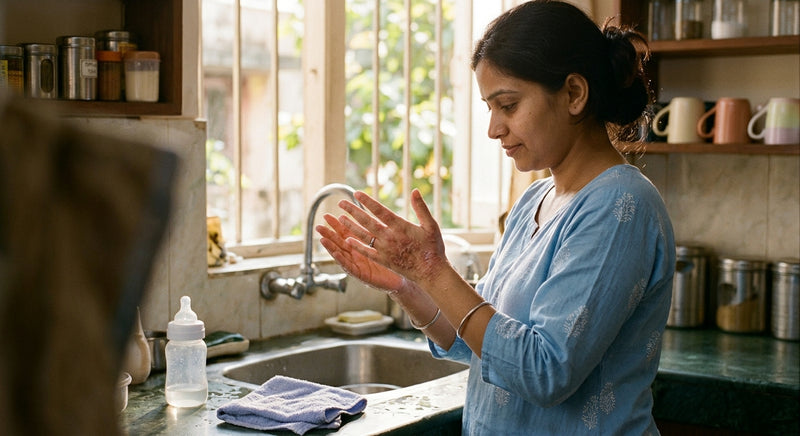
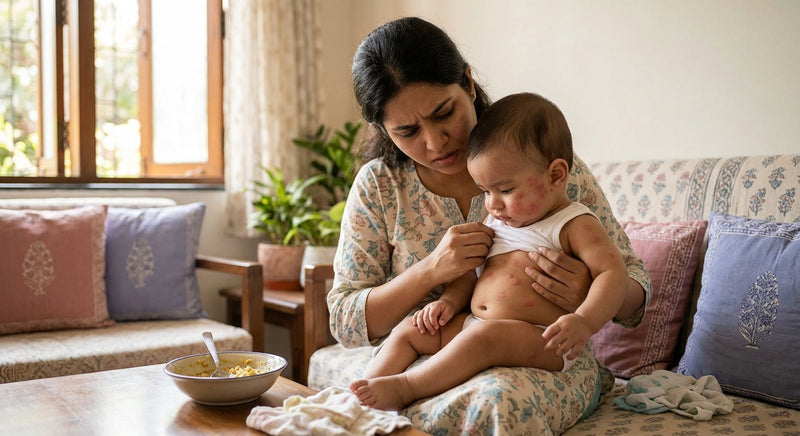
It's 11pm. The malish oil is on the floor next to a half-used pump of lotion, and you're wondering whether one of them has been pointless since the day you came home from hospital. Fair question. Most Indian babies need both, because they do two different jobs — but a lotion-only routine is the safer one to default to, and an oil-only routine is the one that most often leaves skin dry underneath the shine.
Oil seals. A lotion or cream delivers water. If your baby's skin is flaky, tight, eczema-prone or peeling, the water-based moisturiser is the half you can't skip, and oil is a bonus. If skin is comfortable and the air where you live is already wet, a short malish that gets washed off in the bath, then something light after, is plenty.
At a glance
- Massage oil = occlusive + emollient. It slows water loss and makes skin feel smooth. There's no water in it, so it cannot hydrate.
- Lotion, cream or balm = an emulsion. Water, humectants, lipids. It puts water into the top layer, then holds it there.
- Dry, flaky or eczema-prone skin: lead with the moisturiser. Oil alone is not enough.
- Humid coastal summer, sweat-prone or prickly-heat-prone baby: oil before the bath, washed off, then a light moisturiser.
- Keep malish for the touch, the calm, the bedtime rhythm. Just don't ask it to do a moisturiser's job.
Worth settling early, because this one call decides what sits on your shelf for the next three years. If you want the wider set, we keep a full guide to the head-to-head choices in baby skincare: wash formats, cream versus balm, powder versus barrier cream.
So which does my baby actually need?
Three checks, standing right where you already are.
- Press a fingertip on your baby's shin and lift it. Matte, papery, fine flakes lifting off? That's low water in the stratum corneum. Moisturiser, not more oil.
- Is the air in the room dry or wet? A heated Delhi bedroom in January and an AC room in Nagpur both pull water out of skin all night. A Chennai July does the opposite.
- Does your baby get prickly heat or sweat bumps in the folds? If yes, a thick layer of oil sitting there all day is working against you.
Why an oil can't do a lotion's job
Parents find this part surprising. It's formulation, not marketing.
A massage oil is one phase: lipids. Nothing else. Spread it on and it forms a film that slows transepidermal water loss, the water constantly evaporating out of the skin's surface. That film does real work. It just has nothing to give. If the top layer is already short of water, the oil seals in the shortage. Skin looks glossy at 11pm and still feels rough by morning. Shine is not hydration.
An emulsion is a different animal. Water held in oil, or oil in water, by an emulsifier, with humectants like glycerin to pull and bind water, lipids to seal it, and a preservative system, because anything containing water can grow microbes. Put it on damp skin and it does what oil structurally cannot. It raises the water content of the stratum corneum, then caps it.
Then there's what's inside the lipids. Baby barrier repair leans on ceramides, cholesterol and free fatty acids in the right ratio. A plant oil brings fatty acids. That's a real contribution, but it's one of the three. A well-built cream or balm can carry a fuller lipid set alongside the water phase. That matters more than usual in Indian homes, because up to ~48.6% of babies experience atopic-type skin issues, and those babies have measurably less of their own barrier lipid to work with.
Oil massage vs lotion only: what each one actually does
| Job | Massage oil | Lotion / cream / balm |
|---|---|---|
| Adds water to skin | No — contains none | Yes, that's the point |
| Slows water loss | Yes, well | Yes, depending on how rich it is |
| Supports barrier lipids | Partly — fatty acids only | Can carry a fuller lipid set |
| Slip for a proper malish | Yes — this is its real strength | No, it absorbs too fast |
| Behaviour in humidity | Can sit on skin, block follicles, trap sweat | Light versions absorb and don't occlude folds |
| Best time to apply | Before the bath, then washed off | Within 3 minutes of patting dry |
| Preservative needed | No (no water phase) | Yes — and that's a safety feature, not a flaw |

Which oils are fine, and which I'd skip
The oil's entire contribution is its fatty-acid profile. Which means the oil matters more than the brand on the bottle.
- Sunflower seed oil — high in linoleic acid, the fatty acid baby skin uses most. My first choice for a daily malish, and the one I'd reach for on dry or eczema-prone skin.
- Coconut oil — high lauric acid, well tolerated by most Indian babies, absorbs reasonably. Fine. A few babies with very occlusion-prone skin come up in tiny bumps on it. If that's yours, switch.
- Til (sesame) oil — the traditional winter and Sankranti choice, warming and well accepted. Cold-pressed and plain, not a medicated tail unless a doctor advised it.
- Olive oil — I'd skip it for a daily massage. Oleic acid dominates it, and oleic acid behaves as a penetration enhancer. It can loosen the very barrier it's meant to protect.
- Mustard oil — respected, widely used, and an irritant on thin newborn skin. If the family insists, keep it for an older child's arms and legs. Never a newborn's face, folds or broken skin.
Which routine suits which baby?
| Your baby | What I'd do |
|---|---|
| Newborn, first 4 weeks, no skin issues | Light oil massage 4-5 days a week, washed off. Moisturiser only where skin looks dry — shins, cheeks, hands. |
| Dry, flaky or eczema-prone skin, any age | Moisturiser twice daily, no exceptions. Oil optional, and only before the bath — not layered over a cream. |
| Humid coastal or monsoon weather | Oil before bath, washed off properly. A light lotion after. Don't leave oil on the skin all day. |
| Dry winter, heater or AC running | Both. Oil for the massage, then a richer cream or balm on damp skin after the bath. |
| Prickly heat or sweat bumps in folds | Lotion only, lightly. Pause the oil until the bumps settle. |
| Preterm or very low birth weight | Ask your neonatologist first. Massage and emollient choices for preterm skin are a medical decision, not a shelf decision. |
A correction I find myself making constantly: oil over cream does nothing useful. Moisturise, then seal it with oil, and all you've added is weight. The cream's own occlusive phase already did that job. Oil goes first, before the bath, or it goes alone.

Your routine tonight
- Warm a teaspoon of plain oil between your palms. Not on the stove, not in the microwave. Your hands are the thermometer.
- Massage 8-10 minutes on a towel on the floor. Long strokes down the limbs, flat palm on the back. Skip the face and the nappy area.
- Bathe within 15-20 minutes, while skin is still warm. Water at 37-38°C, 5 minutes maximum. The wash matters here, because you're taking oil off: if you're unsure which format suits your baby, we compare foam wash, gel and bar by age and season. For everyday bathing, a tear-free Head to Toe Baby Foam Wash keeps the oil-removal step from stripping skin.
- Pat dry, don't rub. Leave skin very slightly damp.
- Moisturise within 3 minutes. Two full fingertip lengths for a newborn body, four for a one-year-old. On the really dry patches, a balm instead of a lotion.
- Hard water, which is most of north and central India: add one plain-water rinse at the end, and be more generous with the moisturiser. Surfactant residue is what leaves skin feeling tight after a bath.
What to look for in the moisturiser half: glycerin fairly high in the list, a named lipid blend rather than just "oil", no fragrance if skin is reactive, and evidence the formula was tested on real children's skin rather than modelled. Janma's Hydra Healing Moisturizing Balm is what I reach for at the dry-patch end of this spectrum. It helps support the skin barrier, with increased Keratin-10 and Filaggrin expression in a lab study, and it's made in our own GMP-certified facility, so we can answer what's in it. Comparing it with another barrier cream? Our piece on how Mustela Stelatopia and Janma compare sets out the facts side by side and lets you decide.
The nappy area is the last place oil gets misused. Oil is not a barrier against urine and stool, and it holds moisture against skin in exactly the wrong way. That area needs something built for it, and our guide to whether powder or cream is safer for the diaper area covers the reasoning.
When to see a doctor
Book a paediatrician if you see weeping, yellow crusting or a spreading red edge. Same if dryness or itch is disturbing your baby's sleep most nights, if a rash appears straight after a new oil or product, or if skin is cracking and bleeding anywhere. A baby under one month with any widespread rash should be seen rather than managed at home. None of this is something to fix with a different bottle.
If your baby's skin is comfortable, keep the malish for what it's good at — the contact, the calm, the fifteen minutes that are only yours — and let a barrier-supporting balm handle the hydration.
In summary
- Massage oil seals water in; a lotion, cream or balm is the only one of the two that can actually add water to skin.
- Dry, flaky or eczema-prone skin needs the moisturiser as the non-negotiable half — oil alone is not enough.
- Massage with oil before the bath, wash it off, then moisturise within three minutes of patting dry.
- Never layer oil over a cream, and keep oil out of the nappy area, nose and ears.
- Choose sunflower or coconut oil for daily malish, skip olive oil, and keep mustard oil off newborn skin.
Frequently asked questions
Can I use only oil and skip lotion completely?
You can, if your baby's skin is genuinely comfortable and the weather is humid. Oil slows water loss but adds none, so on dry, flaky or eczema-prone skin an oil-only routine leaves skin glossy on top and still short of water underneath. The simplest test: press and lift a fingertip on the shin. If skin looks matte or papery, add a moisturiser.
Should I apply oil before or after the bath?
Before, in almost every Indian home. Massage for 8-10 minutes, bathe within 15-20 minutes, then moisturise on damp skin. Leaving a full oil layer on all day works against you in humidity — it traps sweat in folds and can block follicles. Oil after the bath only makes sense in a very dry winter room, and even then a cream does the job better.
Is it fine to put oil on top of a baby lotion?
There's no benefit. A lotion or cream already contains its own occlusive lipids, so sealing it with oil adds weight and greasiness without adding hydration. Choose one sequence: oil first and washed off in the bath, or moisturiser alone on damp skin. Layering both in the same sitting is the most common routine mistake I see.
Which oil is best for a newborn massage in India?
Plain cold-pressed sunflower seed oil is my first choice — it's high in linoleic acid, which baby skin uses most. Coconut oil is well tolerated by most babies. Til oil suits winter. I'd skip olive oil as a daily massage oil, since its oleic acid can loosen the barrier, and avoid mustard oil on newborn skin entirely — it's genuinely irritant on skin that's 20-30% thinner than an adult's.
How much moisturiser does a baby actually need?
About two full fingertip lengths for a whole newborn body, and roughly four by one year — more than most parents use. Apply within three minutes of patting dry, while skin is still slightly damp, so you're sealing water in rather than smoothing product over dry skin. On stubborn dry patches like shins and cheeks, a balm holds longer than a lotion.
My baby gets prickly heat. Should I stop the massage?
Pause the oil, not the massage. Keep the touch and the strokes with clean dry hands or a very light lotion, and let the bumps settle for a week before reintroducing oil. A thick oil film over sweaty folds in humid weather keeps sweat against the skin, which is exactly the condition prickly heat needs. Resume with less oil, always washed off.