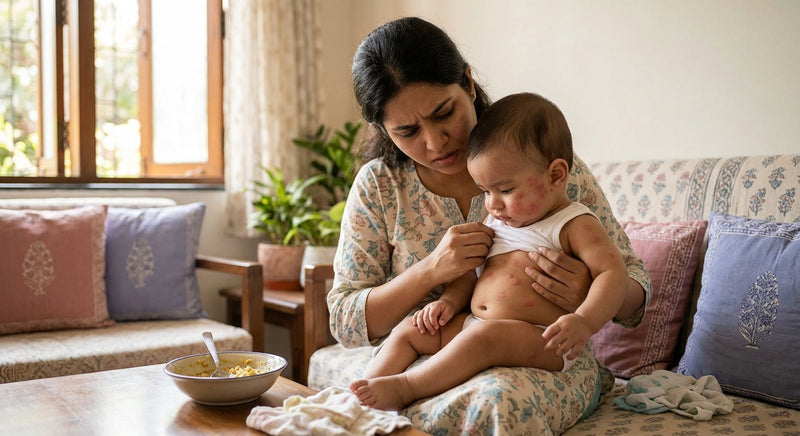
Red across the backs. Tight over the knuckles. Split at the fingertips, usually the right index finger first. If that started the week your baby came home, this is the pattern dermatologists usually describe as irritant hand dermatitis — a reaction to repeated wetting and washing rather than something you caught. Only a doctor who can see your hands can tell you what is actually going on.
The fix sounds backwards. Swap a good share of your soap-and-water washes for an alcohol gel, and seal your hands with a thick occlusive within a minute of drying them. Every time.
Gel feels like the harsher of the two. On unbroken skin, it isn't.
At a glance
- Cracked new-mum hands come from wet work — water plus surfactants, dozens of times a day. Not germs.
- Soap strips skin lipids. Alcohol gel largely doesn't. On intact skin, gel is the gentler top-up.
- Soap and water when hands are visibly soiled: nappies, spit-up, raw food. Gel for the other twenty times.
- The step that changes things is the boring one — an occlusive balm within 60 seconds of drying, and a thick layer at night.
- Weeping, bleeding, yellow crust or spreading redness? That is a doctor, not a better hand cream.
This piece sits inside our complete guide to skincare for mothers, where the postpartum things nobody warns you about get their own space.
Why do a new mother's hands crack in the first few weeks?
Count one ordinary day. Eight to twelve nappy changes. Six to ten feeds, a wash before each one. Bottle and pump parts rinsed and sterilised. Soiled vests soaking in a bucket. Relatives at the door all month — sanitiser on the way in, sanitiser again before anyone is allowed to hold her. That is thirty to fifty washes or gels between one sunrise and the next.
Dermatologists call it wet work, and it has been studied for decades in nurses, hairdressers and food handlers. A mother in month one does more of it than most of them.
I formulate skincare for a living, so: your barrier is a lipid mortar — ceramides, cholesterol and free fatty acids — holding the corneocyte bricks in place. Classic soap is an alkaline surfactant system, usually around pH 9 to 10. Healthy skin sits at about 4.7 to 5.5. A wash lifts out some of those lipids. It swells the keratin with water. It pushes surface pH up, which switches on the enzymes that loosen cells. Then your hands dry, the water leaves, the skin contracts — and it tears where there is least give. Hence the splits on fingertips, the sides of nails, the webs between fingers.
The surfactant matters. Sodium lauryl sulphate has the longest irritation record of the lot: cheap, foams beautifully, still common in economy handwashes and bar soaps. Sodium laureth sulphate is gentler. Amphoterics and glucosides — cocamidopropyl betaine, decyl glucoside, coco-glucoside — are gentler again, and usually sit alongside glycerin, so skin comes out less stripped.
Soap, sanitiser or antibacterial wash: which is actually kinder to your hands?
Most parents get this one backwards, and I understand why. Alcohol stings. Soap smells like clean.
| Option | What it does to your barrier | Use it when | Honest verdict |
|---|---|---|---|
| Plain soap bar or SLS handwash | Strips surface lipids, raises skin pH, swells keratin. The most drying of the lot with repetition. | Hands visibly soiled — after a nappy, after raw chicken, after mud from the balcony pots. | Necessary sometimes. Not thirty times a day. |
| Mild syndet handwash (glucosides, betaine, added glycerin) | Cleans with far less lipid stripping, and usually sits nearer skin pH. | Your default sink wash, if you are washing rather than gelling. | Best soap-type choice. Buy two bottles so one lives at the nappy station. |
| Alcohol gel, 60-80% | Kills microbes by denaturing their proteins, then evaporates. It does not emulsify your skin lipids away the way surfactants do, and most are built with glycerin as a humectant. | The twenty routine top-ups — before a feed, after a visitor, before you lift the baby. | Kinder than it feels, on intact skin. Better tolerated than repeated washing — the hand-hygiene literature in healthcare workers keeps pointing the same way. |
| "Antibacterial" or heavily fragranced wash | Adds fragrance and preservative load with no benefit for a healthy household. Methylisothiazolinone-type preservatives and fragrance are among the commonest hand-allergy culprits. | Only if a doctor has asked you to. | Skip. Highest irritation and sensitisation risk, least gain. |
| Wet wipes on your own hands | Leave surfactant and preservative sitting on skin with nothing rinsed off. | A car seat, a train, no sink anywhere. | Convenience only. Balm as soon as you reach one. |
What we actually did at home
In those first weeks the gel bottle lived next to the feeding chair and the mild wash lived at the sink. Nothing was agonised over. Geography decided it.
- Gel at the feeding chair and by the front door. Soap at the sink and the nappy station.
- Lukewarm water, never hot. Turn the geyser down — hot water pulls lipids out faster and feels wonderful for about four seconds.
- Twenty seconds of washing, not sixty. Longer is not cleaner on skin that is already raw.
- Pat dry, don't rub. Get between the fingers; damp skin inside a fold stays swollen and fragile.
- Balm within a minute. A jar at every place you wash.
- At night, a thick layer and thin cotton gloves. This one habit beats everything else on the list.
- Rubber gloves with a cotton liner for dishes and the vest bucket. Bare rubber traps sweat and makes its own problem.

What to look for in a hand product when your hands are cracking
A light lotion is the wrong tool here. You need all three mechanisms, in the right proportion.
Humectants, emollients, occlusives
Humectants (glycerin, hyaluronic acid, urea at low levels) pull water into the top layer. Emollients (shea butter, squalane, plant oils) slot between loose cells, so skin feels smooth instead of scaly. Occlusives (petrolatum, lanolin, beeswax, heavier butters) lay down a film that slows water escaping. On a hand that is washed forty times a day, the occlusive is the load-bearing ingredient. Humectants with nothing sealing them can even draw water up to a surface where it then evaporates.
Ceramides on the label are a sensible addition, not a marketing line — they are the same lipid class your washes are removing. We've written about whether ceramides are safe through pregnancy and nursing.
What to leave on the shelf
Fragrance, essential-oil blends and isothiazolinone preservatives, while your skin is broken. A compromised barrier lets more of everything through, which is exactly when a mild ingredient turns irritant and an allergen gets its chance.
If you are nursing and already own a tube of ultrapure lanolin for sore nipples, it works on fingertip cracks too — same occlusive logic, and our lanolin nipple cream guide covers how it behaves. Across a whole hand, though, a cream-balm spreads far better. Pure lanolin is stiff and tacky over that much skin.
Judge texture in the shop. Press a little between thumb and forefinger. If it vanishes instantly, it will not survive one nappy change. You want a slight cushion left behind. Our Hydra Healing Moisturizing Balm was built to that brief for dry, eczema-prone skin at any age — it helps support the skin's natural barrier (we measured increased Keratin-10 and Filaggrin expression in a lab study), and it is made in our own GMP-certified facility, so we know exactly what is in the jar.
Is it safe for the baby if your hands are coated in balm?
This worries mothers more than the dermatitis does.
With alcohol gel, the active evaporates. Rub until your hands are genuinely dry — not tacky — and there is nothing left to transfer. Lifting the baby with wet gel on your palms is the only real misstep.
With a fragrance-free balm, a thin film left on your hands is not a problem for a baby's skin. Do wipe your fingers before a feed if she is going to be mouthing them. Keep heavily fragranced hand creams away from the nipple area and her face — not because they are toxic, but because scent on skin that close to feeding is worth avoiding on principle. If you are rebuilding a whole evening routine around nursing, our guide to postpartum night skincare that works around breastfeeding goes further.

Do this tonight
- Move the sanitiser bottle to wherever you feed. That alone cuts ten soap washes out of tomorrow.
- Put a jar of balm at the sink, at the nappy station and by your bed. Hands get moisturised where the jar is, not where you meant to keep it.
- Before sleep, a layer thick enough to look slightly greasy, then thin cotton gloves — or a pair of clean socks, which is what I used. You will feel it in your fingertips by morning two.
When to see a doctor
Most parents find the day gets easier once the washing drops and the sealing becomes automatic — and if your hands are not settling, that is a conversation for your doctor rather than a stronger cream. If you want one jar that comforts dry, sensitive skin — your hands tonight, your baby's dry patches tomorrow — our Hydra Healing Moisturizing Balm is the one I keep by the bed.
In summary
- Treat cracked new-mum hands as wet-work irritation from repeated washing, not as an infection.
- Keep soap for visibly soiled hands and use alcohol gel for the many routine top-ups on intact skin.
- Switch harsh SLS handwash for a mild syndet with glycerin, and use lukewarm water for twenty seconds.
- Seal hands with an occlusive balm within a minute of patting dry, and wear thin cotton gloves over a thick layer at night.
- See a doctor if skin weeps, bleeds, crusts yellow, blisters or spreads — and mention it at your own six-week check.
Frequently asked questions
Is hand sanitiser or soap better for a new mother's dry hands?
On unbroken skin, alcohol gel is usually kinder. Soap and water work by stripping lipids with surfactants and raising skin pH, while alcohol evaporates and most gels include glycerin. Keep soap for visibly soiled hands — after a nappy, raw food, or the garden — and use gel for the many routine top-ups through the day.
Why are my fingertips cracking and splitting after having a baby?
Repeated washing swells the keratin with water, removes barrier lipids and raises surface pH. As hands dry out, the skin contracts and tears where it has least flexibility: fingertips, nail edges and finger webs. Thirty to fifty washes a day in the newborn weeks is enough to cause it in skin that was previously fine.
Can I use hand cream if I'm breastfeeding?
Yes. A fragrance-free hand balm is fine while nursing. Wipe your fingers before a feed if your baby mouths them, and avoid applying scented hand creams near the nipple area or the baby's face. Choose simple formulas built on glycerin, butters and occlusives rather than ones loaded with fragrance or essential oils.
How often should I moisturise my hands with a newborn at home?
After every wash, ideally within about sixty seconds of patting dry, plus a thick layer at bedtime. That sounds relentless, so make it geographic: keep a jar at the sink, at the nappy station and beside your bed. Hands get moisturised where the jar sits, not where you meant to go.
Should I use an antibacterial handwash around a newborn?
For a healthy household, no. Antibacterial and heavily fragranced washes add fragrance and preservative load without useful benefit, and preservatives of the isothiazolinone family plus fragrance are among the most common causes of hand allergy. A mild syndet handwash with glycerin, or an alcohol gel, does the hygiene job with far less irritation.
When does postpartum hand dermatitis need a doctor?
See a doctor if cracks weep or bleed and don't close within a week of consistent sealing, if there is yellow crust, spreading redness, swelling or pain, if itchy blisters appear on palms or finger sides, or if the rash spreads beyond your hands. A short prescribed topical treatment often settles an established flare quickly.