You lift the towel off your baby's head and there they are. Fine white flakes on the terry, a few more caught in the comb. One aunt says the shampoo is too strong. Another says the scalp needs more oil. They can't both be right.
The short version, in case you're reading this at 2am with a baby on your shoulder: for a dry, flaky scalp, look for a shampoo built on mild sugar-derived surfactants (coco-glucoside, decyl glucoside) or sodium cocoyl isethionate, with cocamidopropyl betaine as the co-surfactant. Add a humectant like glycerin or panthenol, a chelator to handle hard water, no added fragrance, and a stated mildly acidic pH. Then wash less often than you think. Two to three times a week suits most babies, even through an Indian summer. The flakes are rarely a cleaning problem. They're a lipid-and-water problem, and the wrong shampoo makes them worse every single wash.
At a glance
- Dry-scalp flakes are small, white and dry. Greasy yellow scale stuck to the skin is cradle cap, a different thing, handled differently.
- The surfactant system is the whole shampoo. Everything else is a small percentage.
- "Tear-free" describes eye comfort. Scalp gentleness is a separate test.
- Sulfate-free is a good starting filter, not a guarantee. Concentration and the full blend decide mildness.
- Hard water is the invisible variable in most Indian homes. Look for a chelator on the label.
- Oil before the wash for 20–30 minutes, not overnight under a cap.
First, is it actually dry scalp?
Thirty seconds here saves you a wasted bottle. Dry scalp gives you fine, loose, white flakes that fall off on their own: on the towel, on the shoulder of the vest, on your palm when you stroke the head. The skin underneath looks tight and dull, sometimes a little pink. Cradle cap looks nothing like that. It is yellowish, greasy, stuck-down scale in patches, usually on the crown or along the brow, and it doesn't shift when you brush it. In a hot room, sweat and a sticky pillow can also leave a crusty line at the hairline that has nothing to do with dryness.
The distinction decides the shampoo. Dry scalp needs less cleansing and more lipid. Cradle cap needs gentle loosening and regular, mild washing to lift the scale. If you can't tell which one you're looking at, ask your paediatrician rather than guessing — they can tell the two apart in a minute. The Janma Journal also has a full walk-through of the differences. Read this article as the dry-scalp half.
Flakes are not a sign of a dirty scalp
This belief does the most damage, because it sends parents towards more washing and stronger foam. What you're seeing is desquamation: the outer layer shedding faster and in bigger clumps than it should, because the water between the cells has gone and the lipid glue that held them flat has been washed away. More detergent takes away more of that lipid. The scalp flakes harder. I've watched families run that loop for weeks with a shampoo everyone in the house was sure was gentle.
On a scalp that is already dry, the wash is doing the damage. Cut the frequency first. Fix the formula second.
What to look for on a baby shampoo label
A shampoo is mostly water, and the cleansing system is only a small part of the bottle. That surfactant blend is the product. The front of the bottle tells you very little. The ingredient list tells you almost everything. Here's how I read one.
| On the label | What it actually is | On a dry, flaky scalp |
|---|---|---|
| Sodium Lauryl Sulfate (SLS) | Strong primary detergent, big fast foam | Skip. Cleans beautifully, removes more scalp lipid than a baby can spare. |
| Sodium Laureth Sulfate (SLES) | Ethoxylated, notably milder than SLS | Workable in a well-built formula. Not my first pick when the scalp is already flaking. |
| Coco-Glucoside, Decyl Glucoside, Lauryl Glucoside | Sugar-derived non-ionic surfactants | Look for these. Low irritation potential, softer foam, far kinder to the lipid layer. |
| Cocamidopropyl Betaine | Amphoteric co-surfactant | Good. It tames the whole system and improves foam quality without harshness. |
| Sodium Cocoyl Isethionate | Mild anionic, creamy lather | Good. Leaves the scalp feeling soft rather than squeaky. |
| Glycerin, Panthenol, Betaine | Humectants and conditioning agents | Helpful. They hold water at the surface after the rinse. |
| Sodium Phytate, Sodium Gluconate, Tetrasodium Glutamate Diacetate | Chelators — they bind calcium and magnesium | The line that matters most in an Indian bathroom, and nobody advertises it. See below. |
| Parfum / Fragrance / essential oils | Scent, and a common source of contact reactions | Skip while the scalp is dry or irritated. Tea tree and other neat essential oils have no place on a baby's head. |
One more judgement call. Squeaky is not clean. Squeaky is stripped. If your fingers drag on the scalp while you rinse, that shampoo has taken too much. A good baby shampoo leaves a slight slip behind. Parents read that slip as "not rinsed properly" and go back in for a second wash. Please don't.
"Tear-free" is an eye claim, not a scalp claim
Tear-free usually reflects a surfactant blend and pH chosen so the formula stings the eye less on contact. That is worth having. A baby who screams through hair-washing gets washed badly and quickly. But nothing in a tear-free result tells you how that formula treats scalp barrier lipids over twenty washes.
You want both, and they are separate questions. Eye claim on the front, surfactants on the back. If the back of the bottle reads like an adult clarifying shampoo, the front doesn't matter. We've written before about how to judge a baby shampoo without the marketing, and the same reading method works here, with dryness as the lens.
Sulfate-free doesn't automatically mean mild
I wish that shortcut worked. Sulfate-free is a useful first filter, and it takes the harshest options off your shortlist. Proof of mildness it is not. A poorly balanced glucoside-only system at high concentration can still leave a scalp tight, and some sulfate-free formulas make up for weak foam by pushing surfactant levels up, which defeats the whole point. Mildness comes from the blend: a mild primary, an amphoteric to buffer it, a sensible total concentration, and a pH that respects the skin.
So ignore the claim on the front and read the ingredient list in order. The first three or four names after water carry the weight.
How often should you wash a baby's hair with a dry scalp?
Two to three shampoo washes a week for most babies. Through a Nagpur summer, or coastal humidity, rinse the scalp with plain water daily if there's sweat. Water alone handles sweat perfectly well, and sweat is not what's causing the flakes. Save the shampoo for the days when there's real oil or grime to lift.
Toddlers who crawl through dust and get more dal in their hair than in their mouth may need three to four. Newborns, honestly, need very little. A mild wash over the scalp twice a week is enough in the first months.
Oiling: keep the tradition, change the timing
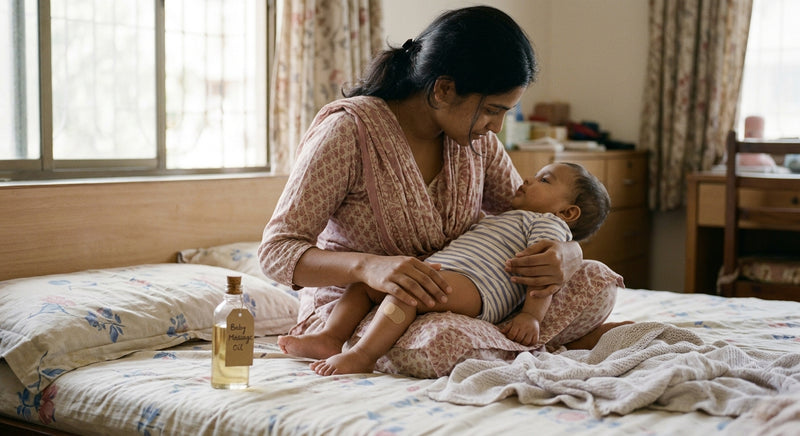
Malish stays. Oil on a dry scalp before the wash softens the flakes so they lift with gentle washing instead of scratching, and it leaves the surfactant less to do. What I'd change is how long it sits there. A generous overnight oiling under a cap, night after night, does two things you don't want. It traps warmth and moisture against the scalp, and it forces a bigger, longer shampoo the next morning to get all that oil out. You end up cleansing harder than if you had never oiled at all.
Twenty to thirty minutes before the bath is enough. Warm the oil to skin temperature, work it in with the pads of your fingers in small circles, and let it sit while you fill the bucket. Coconut, sesame and almond oil are all reasonable on a baby scalp. Pick one and stay with it instead of rotating.
If the dryness has crept past the scalp, so there's flaky skin at the hairline, behind the ears, along the eyebrows, that skin needs an occlusive rather than a shampoo. A thicker balm such as our Hydra Healing Moisturizing Balm helps comfort those dry patches and supports the skin's natural barrier, and it stays where you put it at the hairline better than a runny lotion does.
The wash-night routine (do this tonight)
- Warm a teaspoon of oil. Massage it over the scalp in slow circles for 3–4 minutes, then leave it 20–30 minutes.
- Lift the loosened flakes with a soft baby brush. Brushing only, no scraping or picking.
- Bath water at 37–38°C. Hot water dries a scalp out faster than most shampoos do.
- About half a teaspoon of shampoo, lathered in your own palms with a little water before it touches the head. Neat shampoo lands concentrated in one spot on a small scalp.
- Wash with fingertips for 30–45 seconds. One wash, not two.
- Rinse thoroughly. Most residue complaints turn out to be under-rinsing rather than the formula.
- Pat dry. Wet scalp skin is fragile, so no rubbing.
- Moisturise the body within 3 minutes of the towel, while the skin is still slightly damp.
When to see a doctor
Book a paediatrician if the flaking spreads onto the face, body or nappy area; if the scalp is weeping, crusting yellow, bleeding or smells off; if there's hair loss in defined round patches; if your baby is itchy enough to lose sleep over it; or if four weeks of gentler washing has changed nothing. Redness with warmth and swelling needs to be seen that same week. A doctor can tell scalp eczema, a fungal issue and stubborn seborrhoeic scale apart in about a minute. No shampoo label can do that for you.
So which shampoo, in the end?
One with a mild, well-buffered surfactant blend, a humectant, a chelator for our water, no added fragrance, and a pH that leaves the scalp soft instead of squeaky. Wash two or three times a week. Oil for half an hour before. Then give it three to four weeks, because skin turnover takes that long and judging a shampoo after two washes tells you nothing.
If you want one built exactly that way, made in our own GMP-certified facility, our Loving & Balancing Shampoo is the gentle, tear-free option we'd hand a parent with a flaky little scalp at home.
In summary
- Read the surfactant list first: coco-glucoside, decyl glucoside, sodium cocoyl isethionate and cocamidopropyl betaine over SLS.
- Drop shampoo washes to two or three a week and rinse with plain water on sweaty days.
- Treat tear-free and scalp-gentle as two separate checks — a formula needs to pass both.
- Look for a chelator on the label if your tap water is hard, and rinse with stored water where it's very hard.
- Oil the scalp 20-30 minutes before the bath, brush flakes loose gently, and never scrub or pick.
Frequently asked questions
Can I use an adult anti-dandruff shampoo on my baby's dry scalp?
No, not without a paediatrician's go-ahead. Anti-dandruff shampoos contain active ingredients dosed for adult scalps, and a baby's skin is 20-30% thinner than an adult's, so absorption and irritation risk are different. Persistent flaking in a baby also has several possible causes that need a doctor's eye. Start with a milder shampoo, fewer washes and a pre-wash oil soak instead.
Is dry scalp the same as cradle cap?
No. Dry scalp gives fine, loose, white flakes that fall away easily, with tight-looking skin underneath. Cradle cap is greasy, yellowish scale that sticks to the skin in patches, usually on the crown or brow, and doesn't brush off. Dry scalp needs less washing and more moisture; cradle cap needs gentle loosening with oil plus regular mild washing to lift the scale.
How often should I wash my baby's hair in Indian summer?
Two to three shampoo washes a week is enough for most babies. On hot, sweaty days, rinse the scalp with plain water daily instead — water clears sweat perfectly well and sweat isn't what causes the flakes. Extra shampooing removes scalp lipids and usually increases flaking. Toddlers who play in dust may need three to four washes a week.
Does sulfate-free always mean the shampoo is gentle?
It's a useful filter, not a guarantee. Mildness depends on the whole blend: which primary surfactant, whether an amphoteric like cocamidopropyl betaine buffers it, the total surfactant concentration, and the pH. Some sulfate-free formulas raise surfactant levels to recover foam, which cancels the benefit. Read the first three or four ingredients after water rather than trusting the front-of-pack claim.
Does hard water make a baby's scalp dry?
It contributes. Calcium and magnesium in hard water react with cleansing systems and leave a fine residue on the scalp, and they cut foam so parents tend to use more shampoo. Both add up on already-dry skin. Choose a formula containing a chelator such as sodium phytate, sodium gluconate or an EDTA-type ingredient, and do the final rinse with stored or filtered water if your supply is very hard.
Should I oil my baby's hair overnight for a dry scalp?
Twenty to thirty minutes before the bath works better than overnight. A short soak softens flakes so they lift with gentle washing. Leaving heavy oil on all night under a cap traps warmth and moisture, and forces a longer, harder shampoo the next day to remove it — so you end up cleansing more, not less. Warm the oil to skin temperature and massage with your fingertips.