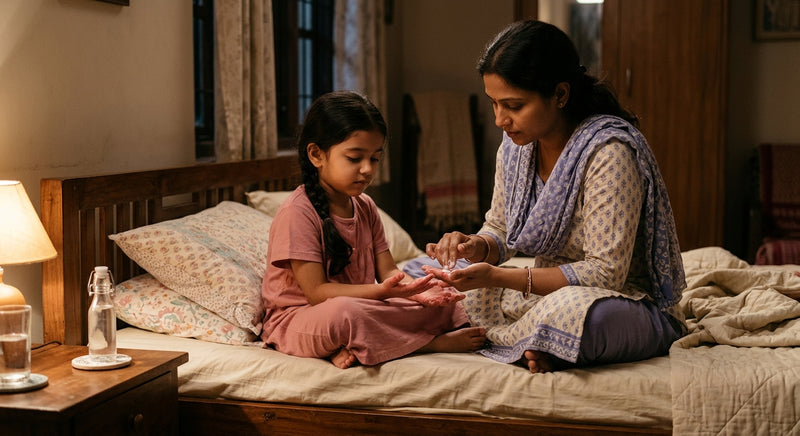
It's the collar you notice first. Fine white flakes on her school shirt, and she's going at the back of her head again while she does her homework. The anti-dandruff bottle is sitting in your bathroom. Tonight, you think — just a little of it on her.
Short answer: for most children under 12, that's the wrong tool. True dandruff is driven by scalp oil and the yeast that feeds on it, and both ramp up with puberty. Before that, flaking is far more often a scalp that is dry, irritated, or carrying a week of oil and product. Adult anti-dandruff shampoos are medicated products, formulated for adult scalps. On a child's dry scalp they frequently leave it drier — so you get more flaking a week later, not less. And if what you're looking at is nits, or a fungal patch, the shampoo does nothing for either.
At a glance
- Before puberty the scalp's oil glands are relatively quiet, so classic greasy dandruff is uncommon in young children.
- What you're usually dealing with instead: a dry scalp, oil and product buildup, an eczema-type scalp — or nits, which aren't flaking at all.
- Medicated anti-dandruff actives are medicines. Use one only if a paediatrician or dermatologist names it, at the age and frequency they specify.
- Indian weather does half the work: dry winter air and hot-water baths, damp tied hair through the monsoon, sweat and dust in summer.
- In this age group, a gentle, mild wash at the right frequency sorts out more scalps than any active ingredient.
This sits inside our complete guide to kids' scalp and lice care. If the itching has been running for more than a couple of weeks, read that one too.
Why it's usually not dandruff before 12
Dandruff, in the way a dermatologist means it, is a seborrhoeic process: sebum on the scalp, a yeast called Malassezia living happily on that sebum, and skin that sheds faster in response. Oil is the engine. A seven-year-old's scalp barely makes any.
Puberty changes that. A 12-year-old whose hair is greasy by the second day can develop real dandruff. An eight-year-old with flakes almost always has something else going on. From the doorway the two look identical — white bits, scratching, flakes showing up on a dark shirt — which is how everyone ends up reaching for the same bottle.
In this age group, a proper look under a bright light usually comes down to one of four things. The season it flares in is the biggest clue you have.
So what is flaking? Start with the season
| When it flares | What is usually driving it | The one change that helps most |
|---|---|---|
| Dry winter (Delhi, Punjab, Nagpur nights) | Dry indoor air, hot-water baths, a room heater running close to the bed. The scalp is simply dehydrated, and shedding in fine, loose white flakes. | Drop to 2-3 washes a week, lukewarm water instead of hot, and oil on for 30-45 minutes before the wash rather than overnight. |
| Monsoon | Hair tied or braided while still damp, sweat sitting under it, nothing fully drying for days. Here the itch arrives before the flakes. | Wash more often, not less. Never tie damp hair — towel it, then air or a cool dryer until the roots are dry. |
| Peak summer | Sweat, dust and sunscreen under a cap or cycle helmet; salt drying on the scalp after games period. | A plain water rinse after sport, and 3-4 gentle washes a week. |
| Hard water, all year | Mineral residue plus leftover oil and conditioner, reading as flakes. Classic in Delhi, Hyderabad, Chennai and most borewell-fed homes. | A final rinse from stored or filtered water. And comb before the wash, not after. |
There's a fifth possibility, and it's the one most parents miss: nothing is flaking at all. Nits sit glued to the hair shaft about a centimetre from the scalp and won't slide when you push them. A flake moves. We've written out the full 10-minute method for telling them apart — dry scalp, dandruff or lice: how to tell in 10 minutes — and do that before you buy anything.
What's inside an adult anti-dandruff bottle, and why it misses
Turn the bottle around. The active is usually ketoconazole, zinc pyrithione, selenium sulphide, coal tar or salicylic acid, at a strength meant to lift scale off an adult scalp. Some of those are licensed as drugs, not cosmetics. Three problems for a young child:
- The target may not be there. An antifungal active works on yeast overgrowth. If her scalp is flaking because it is dry, you're treating something that isn't the problem — while the detergent base strips what little oil the scalp had.
- The base is built for adult hair. Stronger surfactants, heavier fragrance, and no requirement to be tear-free. She tips her head back over the bucket and it runs straight into her eyes.
- Nobody set a dose for her. Most adult anti-dandruff labels carry an age restriction, or the line “consult a physician for children”. That line is not decoration. Twice-weekly use of a medicated shampoo on a 7-year-old is a prescribing decision, not a shopping decision.
And then a fourth problem, quieter than the other three. A medicated shampoo can bring the look of the scaling down just enough that you stop worrying, while the real cause carries on underneath. Scalp ringworm — tinea capitis — is the one that matters here. A coin-shaped patch, grey scale, hair broken off to stubble, sometimes a tender swelling. Shampoo alone does not clear it. It needs oral medicine from a doctor. Flaking plus a bald-ish patch is a clinic visit, not an aisle decision.
Don't improvise with a medicated shampoo. If a paediatrician or dermatologist has prescribed one for your child, follow their product, their strength, their frequency. Don't split an adult bottle “half-half with water”. Don't use it on a scalp that is weeping, crusted or bleeding from scratching. And don't keep going for months because it seemed to help once.

The 10-minute check to do tonight
Sit her in front of you under the brightest light in the house, phone torch in your free hand. Work in sections.
- Detangle first, gently, from the ends upwards. You can't see a scalp through knots — and tugging through tangles produces exactly the squirming that hides the real signal.
- Part the hair at the nape and behind both ears. Those two spots flare first, whatever the cause.
- Brush a few flakes onto a dark cloth. Loose, dry, white and moveable points to dryness or buildup. Stuck-on, yellowish, slightly greasy scale is a different picture — show that one to a doctor.
- Push at any white speck sitting near the shaft. If it won't slide, call it a nit and switch to proper nit-comb technique instead of a dandruff plan.
- Scan for a round patch with shortened or broken hair, or any tender, boggy swelling. That's a doctor, same week.
- Check the comb and the pillowcase. Heavy residue on the comb teeth is usually product and oil, not skin.
With long hair, a detangling step is what makes this a check rather than a fight. You want something light and rinse-out that slips the comb through without coating the scalp — that's what our rejuvenating and detangling conditioner is for. Mid-length down, and keep it off the roots.
The wash routine that sorts most of these scalps out
No active ingredient anywhere in this. It needs about three weeks of doing it the same way.
- Oil on a timer. Champi is good for a scalp and good for a child's evening. But oil left on for two days in Mumbai humidity is a sticky, dust-catching layer that flakes off later. 30-45 minutes before the wash is plenty.
- Lukewarm, every season. Test it on the inside of your wrist. Hot water feels wonderful for about four minutes and strips a dry winter scalp.
- One wash, two minutes of massage. Fingertips, not nails. Most “this shampoo doesn't work” cases are really “this shampoo was on for 15 seconds”.
- Rinse for longer than feels necessary. In hard-water homes, keep a mug of stored or filtered water for the last rinse. Leftover shampoo and minerals are a real cause of flaking.
- Dry the roots fully before any braid, clip or pillow. This one habit clears more monsoon itching than any product.
- Her own comb, pillowcase changed weekly, and nails kept short while the scratching settles.
On a label for this age group, here's what you're looking for: a mild, low-irritation cleansing base, a scalp-friendly pH, tear-free testing, no heavy fragrance load. Skip anything advertising an “anti-dandruff active” unless a doctor asked for it. And ignore “herbal” on its own — it tells you nothing about how harsh the detergent underneath is.

What to skip, honestly
Curd, lemon juice, vinegar rinses. Lemon stings a scratched scalp and does nothing for flaking; curd mostly leaves a smell and a mess. Neem decoctions are harmless enough, but they are no substitute for washing at the right frequency. The ones that actually do damage are the lice remedies that get repurposed for flaking, and we've set out why in kerosene, garlic and essential oils: lice remedies to skip. Kerosene on a child's scalp is a burn and a poisoning risk. Not a treatment.
And skip the daily wash. Flakes appear, frequency goes up — and in dry winter that speeds up the shedding you were trying to stop.
When to see a doctor
Book a paediatrician or paediatric dermatologist, rather than working through one more shampoo, if you see any of these:
- A round patch of scale with broken, stubbly or missing hair, or a tender, swollen area
- Scalp that is weeping, crusted, yellow-scabbed, or smells
- Flaking with swollen glands behind the ears or at the neck, or a fever
- Thick, greasy, stuck-on scale in a child under 12 that hasn't shifted in three to four weeks of gentle care
- Itching severe enough to disturb sleep, or scratching that has broken the skin
- Flaking alongside patches elsewhere, on the face, elbows or behind the knees, which may point to an eczema-type picture needing a proper plan
Take a photo in good light before the appointment. Scalps have a habit of looking fine the morning you finally get a slot.
For everyday washing while you work this out, that mild, tear-free profile is what our Loving & Balancing Shampoo is built around — a gentle everyday base for this age group, not a medicated anti-dandruff product.
In summary
- Before puberty, flaking is usually dry scalp, oil and product buildup, an eczema-type scalp, or nits rather than true dandruff.
- Adult anti-dandruff shampoos are medicated and dosed for adult scalps, so use one only if a doctor names the product and frequency.
- Match wash frequency to the season: 2-3 lukewarm washes a week in dry winter, 3-4 plus a post-sport rinse in summer and monsoon.
- Keep oil on for 30-45 minutes before the wash, never overnight, and dry the roots fully before tying or braiding hair.
- See a doctor for a scaly patch with broken hair, a weeping or crusted scalp, swollen glands, or flaking that hasn't shifted in three to four weeks.
Frequently asked questions
Can I use my adult anti-dandruff shampoo on my 8-year-old just once?
One cautious use is unlikely to harm a healthy scalp, but it rarely helps, because flaking at that age is usually dryness or buildup rather than yeast overgrowth. Most adult labels also carry an age restriction or tell you to consult a physician for children. Fix the wash frequency, water temperature and oil timing first, and see a doctor if nothing shifts in three weeks.
At what age can a child use an anti-dandruff shampoo?
There is no single age. Medicated anti-dandruff shampoos are drugs, and the right answer depends on the active, its strength and your child's scalp, which is a paediatrician's or dermatologist's call. Genuine seborrhoeic dandruff usually appears around puberty, so from roughly 12 onwards it becomes a realistic diagnosis. Before that, assume something else until a doctor says otherwise.
Why does my child's scalp flake more in winter?
Dry indoor air, hot-water baths and a room heater running near the bed all pull moisture out of the scalp, so it sheds in fine, loose white flakes. Washing more often makes it worse. Cut back to two or three lukewarm washes a week, oil for 30 to 45 minutes before the wash rather than overnight, and keep the heater away from the bed.
Does hair oiling cause dandruff in children?
Oiling itself doesn't, but leaving oil on for a day or two does create a sticky layer that traps dust and sweat, then flakes off later and looks exactly like dandruff. In humid or monsoon weather this happens fast. Keep oil on for 30 to 45 minutes before a proper wash, and make sure it is fully rinsed out.
How do I tell flakes from nits?
Push the white speck with your fingernail. A flake slides off or brushes away onto dark cloth. A nit is glued to the hair shaft, typically about a centimetre from the scalp, and will not move. Nits also cluster behind the ears and at the nape. If they don't shift, stop the dandruff plan and switch to a wet nit-comb routine.
Should I wash my child's hair every day if it's flaking?
No. Daily washing strips an already dry scalp and usually increases flaking within a week. Two to three washes a week suits dry winter air; three to four suits sweaty summer days and the monsoon, plus a plain water rinse after sport. What matters more than frequency is massaging for a full two minutes and rinsing completely.