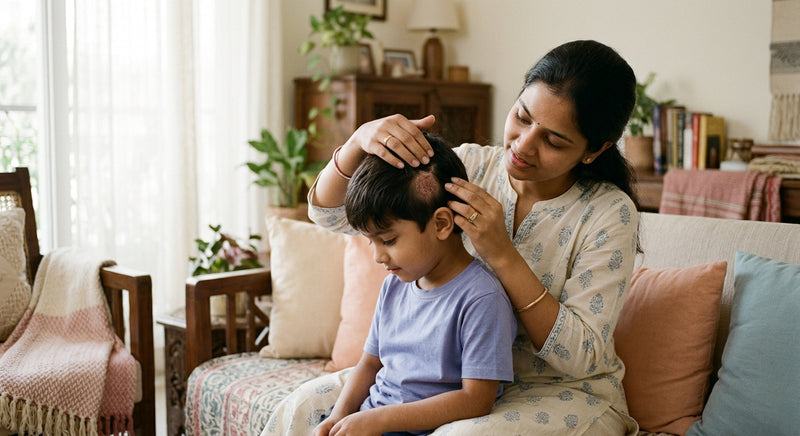
Nine at night. Your child has been digging at the same spot behind their right ear for twenty minutes. You're standing under the tube light with a phone torch, trying to work out whether this is dryness, dandruff, or the thing the class WhatsApp group warned about on Monday.
Here's the short version. Flakes that lift off easily and leave dry, tight-feeling skin are usually dry scalp. Yellowish, slightly greasy scale sitting in patches, on a scalp that feels oily underneath, reads more like dandruff. Lice behave differently: the itch concentrates at the nape and behind the ears, and you find tiny teardrop eggs glued to single hair shafts that will not flick off with a fingernail. Dry scalp and dandruff announce themselves. Lice you have to go looking for, with a comb and good light.
At a glance
- The fingernail test settles most arguments: flakes move, nits don't. A nit is cemented to the hair and slides only if you drag it along the shaft.
- Where it itches is your second clue. Lice itch sits at the nape, behind the ears and on the crown. Dry scalp and dandruff itch is spread all over.
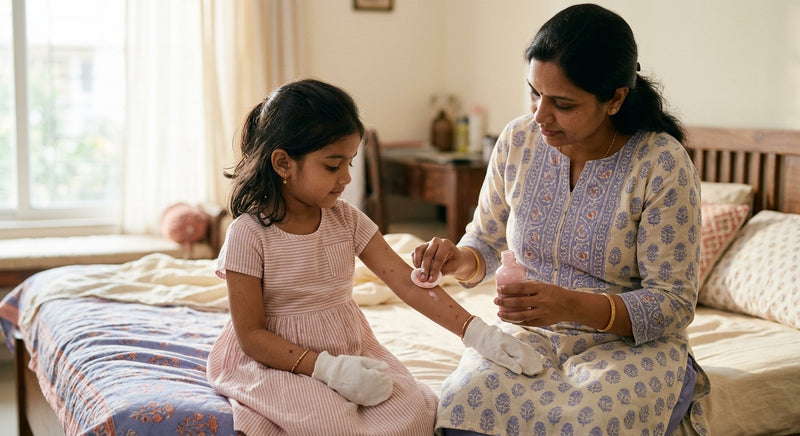
- A dry scalp rarely travels alone. Check shins, forearms and cheeks. If those are ashy too, you have a whole-skin dryness problem, not a scalp one.
- You cannot rule out lice by looking. Only wet-combing a detangled head, section by section, counts as a real check.
- Only lice spread. Dandruff and dry scalp are not contagious, so there's no need to strip every bed in the house for those.
This is the triage step. Once you know which of the three you're dealing with, our complete guide to kids' scalp and lice care goes deeper on each one.
What's the single fastest tell?
Hold the torch at a low angle, almost parallel to the scalp, and part the hair with the end of a comb. Then lift one flake with your fingernail.
If it comes away clean and crumbles, it's skin: dry scalp or dandruff. If it refuses to budge, feels like a hard little grain welded to the hair, and only travels when you pull it along the strand, that's a nit. Dandruff ends up on the collar by lunchtime. Nits stay put through a bath, a swim and a school day.
Dry scalp vs dandruff vs lice: the honest side-by-side
| What you're checking | Dry scalp | Dandruff | Head lice |
|---|---|---|---|
| The flakes | Fine, white, powdery. Loose. Often more visible right after oiling or washing | Larger, yellowish-white, slightly waxy. Clumps that sit in patches | Not flakes at all — oval eggs glued to the hair, cream-coloured when new, darker when hatched |
| Scalp underneath | Tight, dull, sometimes a little pink from scratching | Looks oily or shiny; may be mildly red in patches | Normal, except for scratch marks and the odd scab at the nape |
| Where it itches | All over, worse in dry weather and after a hot shower | All over, fairly constant, often worse when hair is left unwashed | Nape, behind both ears, crown. Children often scratch one patch repeatedly |
| Does it move? | Yes — brushes off | Yes — lifts off in sheets | No. Eggs are cemented. Live lice do move, fast, away from light |
| Typical trigger | Winter, room heaters, hard water, over-washing | Humidity, sweat, heavy oil left in for days, puberty's oilier scalp | Head-to-head contact. School, sleepovers, shared pillows at nani's house |
| Catches in the family? | No | No | Yes — check every head in the house the same night |
How to actually check: the torch-and-comb test
Looking at the top of your child's head tells you almost nothing. Lice avoid light and move to the far side of a parting within seconds. Combing is the only honest check, and detangling first is what makes it work. A nit comb's teeth sit close enough together to lift an egg, which also means they jam in the first knot they meet.
- Pick a bright spot and sit your child lower than you. A stool in front of the sofa works better than a chair.
- Dampen the hair and work some slip through it so the comb glides. A plain conditioner is fine. This is also the job a detangling conditioner is good at, because a jammed comb is the main reason parents give up halfway.
- Detangle fully with a wide-tooth comb first. Nape to crown, small sections, root to tip.
- Swap to the fine nit comb. Comb from scalp outward in overlapping rows. The step-by-step nit comb method explains the angle and the section size.
- Wipe the comb onto a white tissue after every stroke. Live lice are easier to see on white than in wet hair.
- Spend extra time on the nape, behind both ears and the crown. That's where you find things.
- Check every head in the house the same evening, not next weekend.

Why these three get mixed up so often in Indian homes
Three everyday habits muddy the picture at home, and none of them is hard to change.
Oil left in for days. A champi on Saturday that only gets washed out on Wednesday leaves a film that traps dead skin and dust. It looks exactly like dandruff: sticky, yellowish, flaky. It also clears within a couple of washes once the oil is actually being rinsed out. We've written separately on whether hair oiling causes dandruff in children. The honest version is that it's rarely the oil. It's the leaving it in.
Hard water. In Delhi, Chennai, Hyderabad and much of Nagpur, the mineral load leaves a dulling residue on hair and a tight, flaky feeling on the scalp. Parents read it as dandruff and reach for something stronger. That strips the scalp further, and the flaking gets worse.
Seasonal swing. A north Indian winter with a room heater running dries scalps out. A humid coastal summer does the opposite: sweat under a tight braid, scalp damp for hours, flaking turns greasy. The same child can have a dry scalp in January and classic dandruff-type flaking in July.
Honestly, a great many itchy scalps turn out to be build-up or plain dryness rather than either of the conditions parents feared. But lice is the one that genuinely spreads through a classroom, so it's the one to rule out first, even though on any given night it's the least likely of the three.
What we'd actually do, by what you found
You found loose, powdery flakes and dry skin elsewhere
Treat it as a dryness problem, not a scalp-product problem. Drop shampooing to two or three times a week. Keep the water warm, not hot. Rinse for a full extra minute to clear residue. Massage in a modest amount of oil 30-45 minutes before the wash instead of leaving it overnight. And if shins and forearms are ashy too, moisturise the body properly; the scalp usually settles alongside it.
You found greasy, yellowish patches on an oily scalp
Wash more often, not less, with something mild, and make sure the oil actually comes out. Two gentle rounds of shampoo beat one aggressive one. Give it two weeks. If the patches are thick, spreading, or sitting on visibly red skin, that's a paediatrician's call rather than a shelf-shopping exercise.
You found a live louse or eggs within 6 mm of the scalp
Then you have found what you were looking for, and the next step is combing rather than more inspecting. Comb out the heads where you have actually seen evidence. Wet-comb every 3-4 days for two weeks to catch anything that hatches after the first round. Tell the school quietly, without naming anyone. Our calm, step-by-step plan for a school lice outbreak has the full sequence, including what to do about pillows and hairbrushes (less than you'd think).

When to see a doctor
Book a paediatrician or dermatologist if you see a round, scaly patch where the hair looks broken off short or is missing. Go too if the scalp is weeping or crusted yellow, or if the glands behind the ears or at the neck are tender and swollen. Same answer if flaking is thick, spreading beyond the hairline onto the face or body, or hasn't budged after three to four weeks of gentle care; if your child is scratching badly enough to break the skin or lose sleep; or if lice persist after two properly completed comb-out cycles. A scalp problem that doesn't fit any of the three columns above needs an in-person look, not a longer internet search, and only a doctor should diagnose or prescribe for it.
One gentle thing for the meantime
While you're working out which of the three it is, the kindest thing for a scratched, irritated scalp is a mild wash that doesn't strip it: tear-free, lightly fragranced or unfragranced, and easy to rinse clean in hard water. Our Loving & Balancing Shampoo is the one we'd reach for. It is a gentle cleanser that comforts dry, sensitive skin — it is not a treatment for lice, dandruff or any scalp condition, and it is no substitute for the doctor's visit described above if any of those signs apply.
In summary
- Crush a flake between your fingernails — skin crumbles and falls, a nit stays cemented to the hair shaft.
- Lice itch concentrates at the nape, behind the ears and on the crown; dry scalp and dandruff itch all over.
- Check dry scalp against the rest of the body — ashy shins and forearms mean it's a whole-skin dryness problem.
- You cannot rule out lice by looking; detangle first, then wet-comb in sections and wipe the comb onto white tissue.
- Skip kerosene, garlic and neat essential oils entirely, and see a doctor for broken-off hair, weeping skin or flaking that won't shift in a month.
Frequently asked questions
Can my child have dandruff and lice at the same time?
Yes, and it happens more often than parents expect. Flaking makes nits harder to spot because both look like pale specks in the parting. Work out the flakes first by crushing one between your nails, then do a full wet-comb anyway. If a speck won't move off the hair shaft, assume it's a nit and comb properly regardless of what else is going on.
Do lice only go to dirty hair?
No. Lice spread by head-to-head contact and are completely indifferent to how clean or oiled the hair is. A freshly washed head is just as likely to pick them up during a school day. Equally, extra washing will not clear an infestation. Nothing about finding lice says anything about your hygiene or your child's.
Is dandruff normal in a seven-year-old?
Mild flaking is common at any age and is usually dryness or product build-up. True oil-related dandruff becomes more typical as puberty approaches and the scalp produces more sebum. In a younger child, flaking that is thick, patchy, red or spreading beyond the hairline deserves a paediatrician's look rather than a stronger shampoo.
How do I tell a nit from dried oil or hairspray?
Use your fingernails. Dried oil, hairspray and skin flakes crush, smear or fall away. A nit is a firm oval cemented to one side of the hair shaft and will only move if you slide it along the strand. Hold the hair up to a window — nits sit at a consistent small distance from the scalp, build-up sits anywhere.
Will changing shampoo fix my child's itchy scalp?
Sometimes, if the current one is stripping an already-dry scalp or isn't rinsing oil out properly. But change one thing and give it two weeks before judging. If the itch is concentrated at the nape and behind the ears, no shampoo change will help, because the cause is lice and the answer is a nit comb.
Should I keep my child home from school for lice?
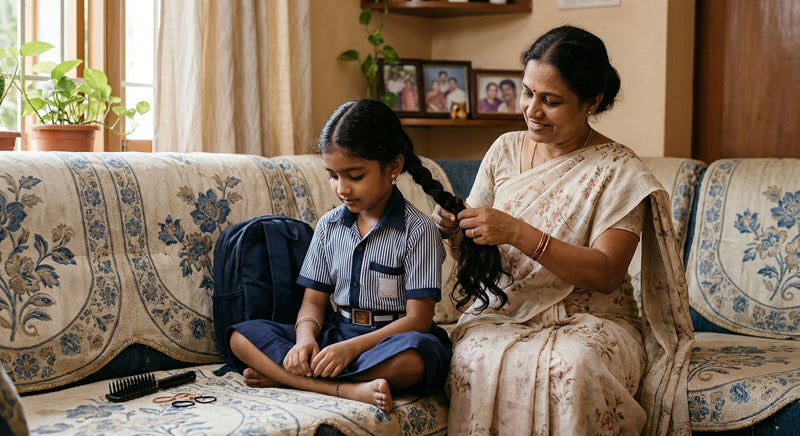
Most Indian schools don't require it, and current thinking favours treating promptly rather than excluding the child. Start the comb-out the evening you find them, tie long hair back tightly the next morning, and let the class teacher know so other families can check too. A plait or bun genuinely reduces head-to-head transfer.