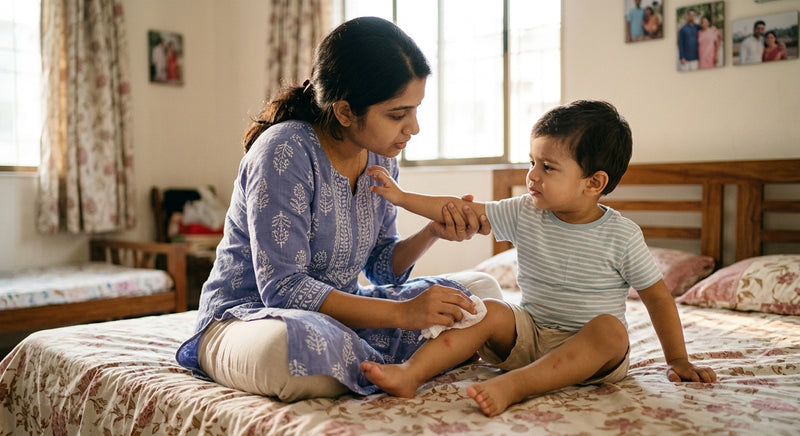
You spot it after a bath, nearly always. Towelling a five-year-old dry, and there they are — two or three pale, faintly powdery ovals on the cheeks, or one on the upper arm you're fairly sure wasn't there last month. You rub it. It doesn't come off. By 11pm you're typing the words into your phone.
The short answer: on an otherwise well child, dry pale patches are often the leftover mark of ordinary dryness, or of a mild itchy patch that has already calmed down — though several conditions look alike, so only a doctor can say what any individual patch is. Three unglamorous things done daily are the foundation of gentle care — a non-soap cleanse, moisturiser within three minutes of towel-off, and sun protection on any patch that's exposed. The colour comes back slowly, over weeks to months, and no cream speeds pigment up. What a good routine does is help reduce the scaling, soothe the itch, and keep the patch from standing out more than it already does.
If your child's skin has been rough or flaky all season, this sits inside a bigger story — read it alongside our complete guide to dry skin and the skin barrier in children.
At a glance
- Pale, slightly scaly patches on cheeks and upper arms are common in Indian children aged 3–10. Ordinary dryness is one common explanation, but the look-alikes are hard to tell apart by eye — that's a doctor's call.
- The patch looks whiter after summer because the skin around it tans and the patch doesn't. Contrast, not spreading.
- Cleanse with a syndet or mild surfactant wash, not soap. Soap plus hard water is the single biggest fixable cause.
- Moisturise within three minutes of towel-off, twice a day. Damp skin holds it; dry skin doesn't.
- Sunscreen matters most here — a pale patch has less pigment shielding it, so it burns first and the contrast widens.
- Repigmentation takes weeks to months and can't be rushed. Consistency beats intensity.
Why do dry white patches appear on a child's skin?
Skin colour is made in the melanocytes at the base of the epidermis, then handed over. Melanosomes — little parcels of pigment — get passed up into the keratinocytes that form the surface. It's a delicate, orderly handover. Inflame a patch of skin, even mildly, even if you never saw the redness, and that transfer stalls for a while. The skin heals. The pigment delivery takes longer to restart. What's left behind is a pale area.
Then there's the optical half of it. Dry, scaling skin doesn't sit flat — the loose corneocytes lift at the edges and scatter light in all directions instead of reflecting it evenly. Scattered light reads as white. That's why the same patch looks dramatically paler on a dry Tuesday and almost invisible ten minutes after a lotion goes on. Moisturiser adds no pigment. It flattens the scale so light stops bouncing. That flattening is often the entire visible improvement in week one — worth knowing, so you don't read it as the colour coming back.
Why the patch looks worse after a summer holiday
The surrounding skin tans and the patch can't keep up. A week in Goa or on a Konkan beach, and a barely-there mark becomes the thing every relative comments on. The patch didn't grow. The background moved.
One caveat before you commit to any routine: not every white patch is the same thing. Fungal patches, post-inflammatory pale spots and a few other look-alikes are genuinely hard to tell apart by eye, and the management differs. Spend five minutes with our guide to which white patch is which before you assume.
Step 1: How should you cleanse skin that has white patches?
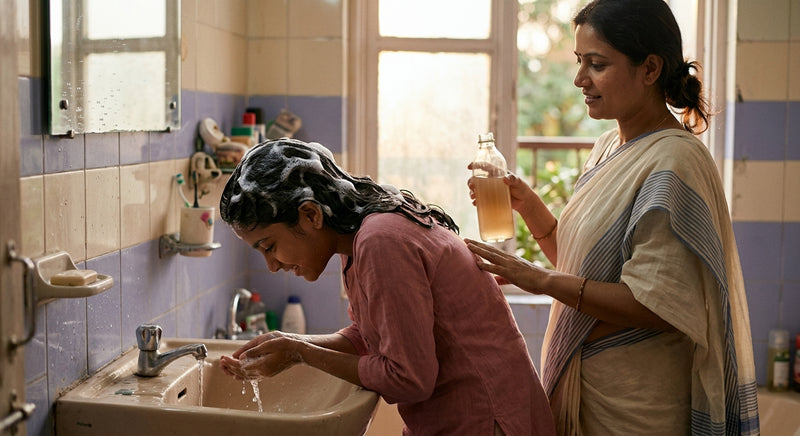
Stop using soap on these areas. I mean this literally — the bar, the "herbal" bar, the sandalwood one your mother swears by, all of it. Traditional soap is made by saponification and lands at pH 9–10. Healthy child skin sits closer to 5.5, and that acid mantle is what keeps the barrier enzymes working and the lipid layers stacked properly. A high-pH wash swings the surface alkaline for hours. The enzymes that shed old cells go into overdrive. More shedding, more scale, more white.
Now add Indian water. Across Nagpur, Delhi, Jaipur, most of Maharashtra and the Gangetic plain, tap water is hard — high in calcium and magnesium. Those ions react with soap to form an insoluble scum that settles on skin and stays there after rinsing. It's mildly irritant, and it is very good at turning a mild patch into a stubborn one. Stiff towels after drying, white crust on the taps: that's hard water.
Look for a syndet (synthetic detergent) cleanser instead, or a liquid wash built on gentler surfactants — sodium cocoyl isethionate, decyl glucoside, cocamidopropyl betaine, coco-glucoside. Skip anything led by sodium lauryl sulphate. A stated pH of around 5.5 on the label is a good sign. And prefer a short ingredient list without essential oils. On already-compromised skin, fragrance is the commonest avoidable irritant I see.
If the patches started or worsened after you switched washes, that's not a coincidence — read whether your child's body wash is causing their dry skin. That one change helps a lot of these settle.
- Warm water, not hot. If it fogs the mirror, it's too hot.
- Five minutes, no more. Long soaks strip lipids however mild the wash is.
- Cleanser on underarms, groin, feet and hands only. The patched arms and legs need water, not lather, most days.
- Never scrub a white patch — no besan ubtan, no loofah, no washcloth. Abrasion is inflammation, and inflammation is what caused this.
- Pat dry with a soft towel. Leave the skin slightly damp.
Step 2: How to moisturise so the patch actually settles
The three-minute rule isn't a marketing line. Straight after a bath the stratum corneum is swollen with water — put an emollient on then and you trap that water in. Wait fifteen minutes and it has already evaporated, taking a little extra with it, and now you're moisturising a drier surface than you started with. Same product. Much less benefit.
A moisturiser worth buying is doing three separate jobs. Humectants — glycerin, and it should sit high in the list — pull water into the corneum. Emollients like almond oil, avocado oil, ghee and fatty alcohols such as cetearyl alcohol slot into the gaps between cells, which is what makes skin feel smooth instead of rough. Occlusives slow water loss outward. On a child whose patches keep coming back, the barrier-repair ingredients earn their price: ceramides, cholesterol, colloidal oatmeal, niacinamide at low percentages.
At Janma, when we tested our formulation approach in the lab, we saw increased Keratin-10 and Filaggrin expression — the structural proteins the skin uses to build a working barrier. Our Hydrating & Soothing Moisturizing Lotion is built on almond oil, organic ghee, avocado and oats for exactly this daily, post-bath job, and it helps support the skin's natural barrier.
| Where the patch is | Texture that works | Why |
|---|---|---|
| Cheeks and face | Lotion, fragrance-free | Lighter feel, less likely to be rubbed off; heavy balms on a child's face collect dust |
| Upper arms, shoulders | Lotion, twice daily | Large surface area — you need something that spreads without dragging |
| Shins, elbows, knees | Thicker cream or balm at night | Fewer oil glands here; these areas lose water fastest |
| After a pool or beach day | Rinse first, then lotion within 3 min | Chlorine and salt both pull water out of the corneum |
Then there's how much you use, which is where most routines quietly fail. A full-body application on a school-age child is roughly two teaspoons. Most people use a quarter of that. If the skin still looks matte and chalky ten minutes later, you underapplied — go again. Ashy, greyish legs after a bath are the same underlying story, and we've written about why legs go ashy and what fixes it in detail.
Step 3: Why sun protection matters most for a white patch
This is the step families skip. Melanin is your child's built-in UV filter, and a hypopigmented patch has less of it, so it burns sooner than the skin beside it. There's a second cost too. Every unprotected hour deepens the tan around the patch while the patch stays exactly as it was — the contrast widens, and it looks like the mark is spreading when it isn't.
For children, use a mineral filter — zinc oxide, ideally non-nano — on skin that's already irritable. It sits on the surface and reflects rather than absorbing UV into the skin, and it's less likely to sting a compromised patch than some organic filters. SPF 30 or higher, with a PA+++ rating: UVA is what drives tanning and pigment change, and in India it's steady through the year, not just in May.
Put it on in the morning, two minutes after the moisturiser has settled — face, ears, neck, and any patched skin that will be uncovered. The back of the arms below a school shirt sleeve. The tops of the feet in sandals. Reapply every two to three hours during outdoor play or a sports period. For an ordinary school day, a good morning application plus a cap does most of the work.
What the whole day looks like
- Morning: quick warm rinse or a short wash with a mild cleanser; pat damp; lotion over the whole body within three minutes; sunscreen on face, ears, neck and exposed patches.
- After school: plain water rinse if it's been a sweaty day, then lotion again on face and arms. No second round of soap.
- Night: five-minute bath, cleanser only where it's needed, pat damp, lotion everywhere, thicker layer on shins and elbows.
- Weekly: cut the fingernails short. Night scratching keeps the inflammation cycle going, and it's often the real reason a patch won't settle.
- Ongoing: photograph the patch once a fortnight — same arm, same light, same spot in the house. Memory is unreliable. A photo isn't.
What to stop doing
No scrubbing. No exfoliating acids, no lemon, no home bleaching of any kind. And nothing borrowed off a parent's shelf — several adult anti-pigmentation creams are unsuitable for children and can make hypopigmentation harder to read. Skip strong steroid creams unless a doctor prescribed them for your child specifically; over-the-counter steroids used on a child's face without medical supervision can thin the skin and make the patch harder for a doctor to assess later. And be sceptical of anything sold as a fast cure for a white patch. There isn't one.
How long until the patches fade?
Texture first: the dryness and scale usually settle within one to two weeks of consistent care. Colour runs on a separate, slower clock — often several months, sometimes longer, and usually better once the strong-sun months pass and the surrounding skin loses its tan. So judge progress by texture and itch, not shade. If the patch is smooth, not itchy and not growing, the routine is working even though the colour hasn't caught up.
When to see a doctor
Take your fortnightly photos to the appointment. A dated series showing what the patch looked like a month ago tells a doctor more than any description you can manage in the room.
A pale patch has less of its own pigment to shield it. So if you add one thing to the school morning, make it a mineral SPF — ours is the Daily Defender Kids Mineral Sunscreen SPF 40 PA++++.
In summary
- Treat pale, scaly patches as a dryness problem first: gentle cleanse, moisturise, protect from sun, every day.
- Swap soap for a syndet or mild liquid cleanser at around pH 5.5 — soap plus hard Indian water is the commonest fixable trigger.
- Moisturise within three minutes of towel-off, twice daily, using roughly two teaspoons for a school-age child's full body.
- Apply a mineral sunscreen daily on exposed patches, since less pigment means faster burning and widening contrast.
- See a paediatrician for any chalk-white sharp-edged patch, loss of sensation, rapid spread, or no change in texture after four to six weeks.
Frequently asked questions
Are dry white patches on my child's face serious?
Usually not. On an otherwise healthy child, pale scaly patches on the cheeks or arms are most often the aftermath of ordinary dryness or a mild irritated patch, and they settle with gentle cleansing, daily moisturising and sun protection. That said, several conditions look similar, so any patch that is chalk-white with a sharp border, spreading fast, or losing sensation should be shown to a paediatrician rather than self-treated.
Will moisturiser bring the colour back?
Not directly. A moisturiser flattens the lifted scale so light stops scattering, which makes the patch look far less obvious within days — but it doesn't add pigment. Repigmentation happens on its own timeline as the skin's pigment transfer restarts, usually over several months. Consistent moisturising helps by keeping the skin calm so no fresh inflammation restarts the cycle.
How often should I apply moisturiser on a child with dry white patches?
Twice daily as a baseline — once within three minutes of the evening bath, once in the morning. Add a third application after school on hot, sweaty days or after swimming. Use roughly two teaspoons for a full-body application on a school-age child; most parents use far less than they think and then conclude the product isn't working.
Does my child need sunscreen if the patches are on covered areas?
Apply it on any patch that will be uncovered — face, ears, neck, forearms below a short sleeve, tops of the feet in sandals. Sun protection matters more here than on normal skin, because a pale patch has less melanin shielding it and burns sooner, and tanning of the surrounding skin widens the contrast so the patch looks like it is growing.
Can hard water make white patches worse?
Yes, indirectly. Hard water is high in calcium and magnesium, which react with soap to leave an insoluble scum on the skin that mildly irritates it. Switching from a soap bar to a syndet or mild liquid cleanser at around pH 5.5 removes that reaction entirely. If your towels dry stiff and taps have white crust, this is worth fixing first.
Should I scrub the white patch to remove the flakiness?
No. Scrubbing with besan ubtan, a loofah or a rough washcloth causes exactly the low-grade inflammation that led to the pale patch in the first place, and it usually makes both the scaling and the contrast worse. Let the moisturiser lift the scale gradually instead — it works better, and it doesn't risk restarting the cycle.