It's 11 pm. The tubelight is on, the house is finally quiet, and there's a pale oval on your child's cheek that wasn't there in May. You've already typed "white patch on child face" into your phone. Google led with vitiligo. Put the phone down for two minutes.
In Indian children, the overwhelming majority of pale patches are pityriasis alba. Dry, faintly scaly, lighter-but-not-white, with soft edges that blur into the normal skin around them. Cheeks, upper arms, outer thighs. It looks loudest after a sunny stretch. Vitiligo looks nothing like that: chalk- or milk-white, sharply outlined, smooth with no scale, and the skin inside has lost its colour entirely. Fungal patches (pityriasis versicolor and tinea) usually carry a fine, bran-like scale, sit on the chest, back, neck or armpit folds, and multiply through humid months. Border, surface, site. Those three do most of the sorting.
At a glance
- Fuzzy edge, dry powdery surface, face or arms = most likely pityriasis alba. A dry-skin pattern, not a pigment disease.
- Sharp edge, chalk-white, smooth surface = a doctor's eye, not a home guess.
- Fine scale that lifts when you scratch it lightly, on chest, back or neck folds, worse in humidity = points towards fungal. A paediatrician can confirm in minutes.
- Sun makes pale patches look worse because the skin around them tans. The patch itself hasn't changed.
- Never a leftover adult cream on a child's face while you're still guessing. Never a combination steroid cream at all.
A patch of pale skin is almost always a surface story before it is a pigment story, which is why this sits inside our complete guide to kids' dry skin and the skin barrier. Dry, disorganised surface cells scatter light. Scattered light reads as "white" to your eye long before any melanocyte is involved.
How do I tell pityriasis alba, vitiligo and fungal patches apart?
Take your child to a window in daylight. Not under the warm yellow bulb in the passage, which flattens everything into the same shade. Then work down the table, row by row.
| What you're checking | Pityriasis alba | Vitiligo | Fungal (versicolor / tinea) |
|---|---|---|---|
| Colour | Lighter than the skin around it, but still has colour — cream, dull, hazy | Chalk-white or milk-white; no colour left inside | Pale, pinkish or slightly darker-tan; can be either lighter or darker |
| Border | Soft, blurry, fades into normal skin — hard to draw around | Sharp, defined, often scalloped; you could trace it with a pencil | Fairly defined; tinea often has a raised, active outer ring |
| Surface | Dry, fine powdery scale; feels slightly rough | Smooth — same texture as the skin next to it | Fine bran-like flakes that lift when lightly scratched |
| Usual sites | Cheeks, chin, upper arms, outer thighs | Around mouth and eyes, hands, knees, elbows, over bony points | Chest, upper back, neck, armpits, groin, scalp margin |
| Itch | Rarely — occasionally mild | No | Often mildly itchy, worse with sweat |
| Season pattern | Noticed after sun exposure; worse look in dry winter | No season pattern; may enlarge slowly over months | Peaks in monsoon and humid summer; spreads to new spots |
Two things trip parents up here. One: a patch can be more than one story over time. A fungal patch that has cleared often leaves pale skin behind for weeks. Eczema does the same. So does a healed rash. That's post-inflammatory hypopigmentation — the pigment machinery paused while the skin was inflamed, and it takes its own time restarting. The other is the blacklight torch making the rounds on Instagram reels and family WhatsApp groups. It is not a home test. A Wood's lamp is used in a clinic, in a properly darkened room, by someone trained to read what it shows. A ₹200 UV torch under a ceiling fan will mislead you in both directions. Skip it.
Why the patch showed up right after summer
The patch didn't arrive in June. It became visible in June. Through the hot months the skin around it tanned — school runs, evening cricket, the walk back from the bus stop. The patch, being drier and slightly scaly, tans less evenly and reflects more light. Contrast rises. Suddenly something that was sitting there faintly in February looks alarming under the bathroom light.
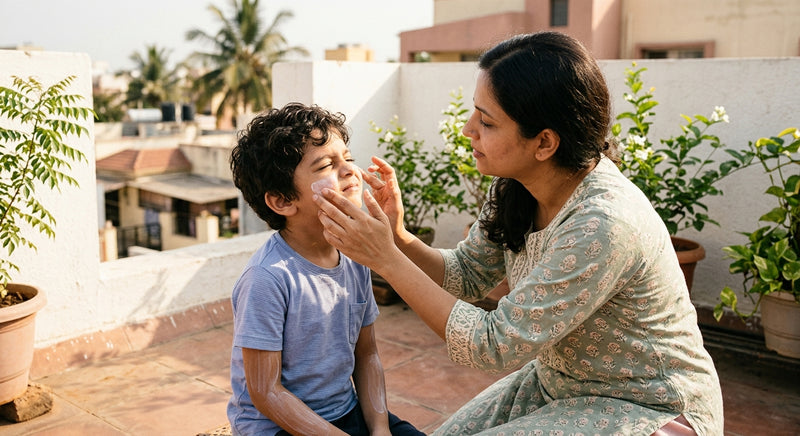
Consistent sun protection really does reduce how obvious it looks across a season, purely by holding the surrounding skin closer to its baseline tone. On outdoor-play days, a mineral kids' sunscreen with SPF 40 PA+++ on the face and arms will do more for the appearance of pityriasis alba than any brightening product ever will.
What can I safely do tonight?
None of this needs a diagnosis first, and none of it will muddy what a doctor sees later.
- Photograph it properly. Daylight, near a window, no flash. Put a coin or your child's fingertip beside the patch for scale. Repeat in the same spot and the same light in 10 days. Change over time is the single most useful thing you can carry into a consultation.
- Stop everything abrasive on that area. No ubtan scrub. No besan paste rubbed in. No loofah, no "rubbing till it goes". Friction thickens and dulls the surface, and a dulled surface looks paler, not clearer — the same optical trap we've written about in why scrubbing won't fix your child's chicken skin.
- Shorten and cool the bath. Five to seven minutes, comfortably warm water, a gentle cleanser on the dirty bits only. The patch doesn't need cleaning.
- Moisturise within three minutes of towel-drying, while the skin is still slightly damp. Of everything on this list, this is the step that visibly changes a dry patch fastest.
- Keep nails short if there's any itch. And change sweaty clothes rather than letting a damp collar sit against the chest all evening.
- Don't reach for a leftover tube. Not yours, not an older sibling's, not one handed across the counter at the medical store.
Why a moisturiser changes how pale a patch looks (the formulation bit)
Most parents treat moisturiser as passive comfort. It isn't. A dry patch is a patch where the topmost corneocytes have lifted at their edges. Each lifted flake is a tiny mirror, and hundreds of them together throw back diffuse white light, so the patch reads paler than the pigment underneath actually is. Lay those flakes flat with lipids and water and the surface goes optically clear again. That's why pityriasis alba often looks noticeably better within a fortnight of consistent moisturising, without a single ingredient touching melanin.
The flattening comes from a layered formula, not one hero ingredient. Humectants (glycerin) to pull water in. Emollients (fatty acids, plant butters) to slot between the cells. An occlusive fraction to slow water loss, so the first two get time to work. On a child's cheek, where skin is thinner and loses water faster than an adult's — roughly 20–30% thinner in a newborn — a balm texture usually beats a thin lotion, simply because it stays on the skin longer. In our own lab work, formulation designed this way helped support the skin barrier, with increased Keratin-10 and Filaggrin expression. Filaggrin is the protein that eventually breaks down into your skin's own natural moisturising factors. Keratin-10 is structural. A chronically dry patch needs both.
If the pale patches sit mainly on shins and calves and flake after every bath, read our piece on ashy, flaky legs after a bath. That pattern is usually hard water plus over-cleansing rather than anything on this list. And for the cheek-patch presentation specifically, we've gone deeper in our explainer on pityriasis alba on a child's face.
When to see a doctor
Book a paediatrician or paediatric dermatologist — don't wait it out — if any of these are true:
- The patch is sharply bordered and truly chalk-white, with no scale and normal texture.
- Pale patches are appearing around the mouth, eyes, fingertips or over the knees and elbows, or the eyelashes or a tuft of hair in the patch have turned white.
- The area is spreading week to week, or new patches keep arriving.
- There's itching, a raised active edge, oozing, crusting or pus, or other family members are developing similar patches.
- The patch has lost feeling. A pale patch with reduced sensation always needs medical assessment.
- Six to eight weeks of gentle, consistent moisturising has changed nothing at all.
None of these mean something is going wrong. They mean the answer needs an examination, often a two-minute one, instead of another night of scrolling. Diagnosis — and any treatment for vitiligo or a fungal infection — belongs entirely with your doctor. Our job is the dry, uncomfortable surface around it.
Until that appointment, the kindest thing for a dry, flaky pale patch is a simple barrier routine: a gentle bath, then a lipid-rich balm like our Hydra Healing Moisturizing Balm on damp skin, twice a day.
In summary
- Check three things in daylight — border, surface and site — before assuming the worst about a pale patch.
- Fuzzy edge, fine dry scale and cheeks or upper arms usually points to pityriasis alba, a dry-skin pattern.
- Sharp chalk-white borders, spreading patches, lost sensation or an itchy scaly ring all need a doctor's assessment.
- Stop scrubbing the area, shorten baths, and moisturise damp skin twice daily to flatten the flakes that make a patch look paler.
- Never apply a leftover adult cream or an over-the-counter steroid-antifungal combination on a child's face while you're still guessing.
Frequently asked questions
Is pityriasis alba a form of vitiligo?
No. Pityriasis alba is a dry-skin pattern where patches are lighter but still hold colour, with soft blurry edges and a fine powdery surface. Vitiligo involves complete loss of pigment, giving chalk-white patches with sharp borders and normal texture. They are unrelated conditions, and one does not turn into the other. Only a doctor can confirm which you are looking at.
How can I tell if a white patch on my child is fungal?
Fungal patches such as pityriasis versicolor usually appear on the chest, upper back, neck or armpit folds rather than the cheeks, carry a fine bran-like scale that lifts when lightly scratched, and often itch a little with sweat. They multiply in monsoon and humid heat, and new spots appear over weeks. A paediatrician can usually confirm it in a single visit.
Will moisturiser make the white patch go away?
Moisturising will not change pigment, but it changes how the patch looks. Dry lifted skin cells scatter light and read as paler than the skin actually is, so laying that surface flat with a humectant-plus-emollient formula often makes a pityriasis alba patch far less noticeable within two to three weeks. If nothing shifts in six to eight weeks, see a doctor.
Why did the patch appear after the summer holidays?
It probably did not appear then — it became visible. The skin around the patch tanned while the drier patch tanned less evenly, so the contrast jumped. Daily sun protection on the face and arms keeps surrounding skin closer to its baseline tone and genuinely reduces how obvious the patch looks across a season.
Can I use an over-the-counter antifungal or steroid cream while I wait?
Please don't. Combination creams mixing a steroid with an antifungal are widely sold in India and are a poor idea on a child's face: they can thin skin and make a fungal infection harder to recognise and treat. Stick to gentle cleansing, moisturising and sun protection until a doctor has seen the patch.
Does a UV torch at home tell me what the patch is?
No. The Wood's lamp used in clinics is read in a properly darkened room by someone trained to interpret the glow, and a consumer UV torch produces false reassurance as often as false alarm. Take clear daylight photographs ten days apart instead — change over time is far more useful to a doctor.