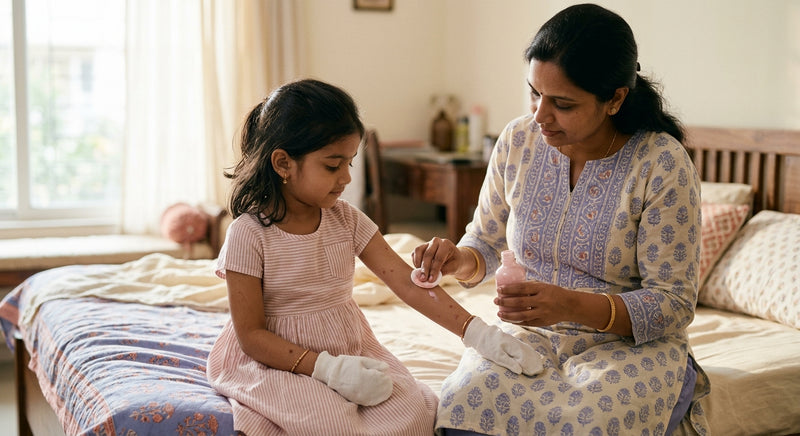
You towel your child off after the evening bath, and there it is again — the shins look dusty, greyish, almost chalky. Drag a fingernail lightly across and a faint white line shows up. Parents ask me all the time: is it a fungus? A soap allergy? Something in the water? Almost always, none of those. Ashy, flaky legs right after a bath are simple dryness — and the bath itself usually set it off. It's quick to fix, once you can see what's actually happening on the skin.
"Ashy" is just what dry skin looks like on legs and arms, where there are fewer oil glands to start with. The top layer loses water, the flat surface cells curl and lift, and light scatters off them — so brown skin reads grey and dusty. It's cosmetic, not dangerous. But it's a signal that the skin barrier needs help, and that's why it's worth reading alongside our complete guide to kids' dry skin and the skin barrier.
At a glance
- Ashy, flaky legs after a bath are dryness, not an infection — the bath removed the skin's natural oils.
- Hot water and long soaks are the biggest culprits, and hard water makes it worse across most Indian cities.
- The single highest-impact fix: moisturise damp legs within 3 minutes of stepping out.
- It flares in dry winter and inside AC in summer; monsoon humidity usually eases it.
- See a doctor if it's itchy, red, cracked, weepy, or won't budge with daily moisturising.
Why does my child's skin go ashy right after bathing?
Picture the outer skin as a brick wall — flat cells for bricks, held together by a mortar of natural oils and ceramides. That mortar keeps water in. Hot water and soap are very good at dissolving oil; that's what makes them clean. Trouble is, they don't stop at the dirt. A long, hot bath strips the mortar too, so water evaporates out of the top layer within minutes of drying off. The cells shrink, curl at the edges, and lift. That's the flaking. The grey cast is just light bouncing off all those lifted edges.
Children get this more than adults, and there's a real structural reason: a child's skin is 20-30% thinner than an adult's, with a less mature barrier and fewer oil glands on the legs. The same bath that leaves your skin fine can leave your child's shins looking chalky.
Is it the water in our city?
Often, yes — partly. Most Indian metros, and plenty of smaller towns, run on hard water: thick with calcium and magnesium. Hard water does two things to skin. It reacts with soap to leave a fine mineral-and-soap film — that squeaky, tight feeling — and the minerals themselves disrupt the barrier and leave skin drier. If the ashiness got worse after you moved house, or switched to borewell or tanker water, that's not your imagination. I've written more on this in our guide to why scrubbing won't fix rough, bumpy skin — because the instinct with dry, flaky legs is to scrub harder, and that's exactly backwards.
Does the season change it? (India edition)
A lot. Ashy legs are seasonal, and the fix shifts a little through the year.
| Season | Why legs go ashy | What to adjust |
|---|---|---|
| Dry winter (Nov-Feb) | Cold, dry air pulls water out; hot baths feel irresistible | Lukewarm water, a thicker balm, moisturise twice a day |
| Summer + AC | Air-conditioning is bone-dry; it dehydrates skin like winter | A light lotion morning and night; don't skip it because it's "hot" |
| Peak summer heat | Frequent baths, harsh scrubbing to feel fresh | Shorter baths, gentler wash, moisturise after each one |
| Monsoon | Humidity usually helps — but damp clothes can irritate | Often the easiest season; keep skin dry and lightly moisturised |
The one that catches parents off guard is summer AC. They assume ashy skin is a winter thing, then wonder why their child is flaky in May. A bedroom held at 22°C overnight dries the skin as hard as a Delhi January. If your child sleeps in AC, treat it like winter skin.
The 3-minute rule: the one habit that fixes most of this
If you take one thing from this article, take this. Moisturiser doesn't add water to skin — mostly it traps the water that's already there. So the moment to use it is while the skin is still slightly damp, straight out of the bath, before it can evaporate. Wait twenty minutes and the window's gone. Do it after every bath, and most ashy legs settle on their own.
- Keep the bath to 5-10 minutes in lukewarm water — test it on your inner wrist, it should feel barely warm.
- Use a gentle, soap-free wash on the body; skip harsh soap bars on already-dry legs.
- Pat — don't rub — the skin with a soft towel, leaving it slightly damp.
- Within 3 minutes, smooth on moisturiser while the legs are still a little wet. Use enough to leave a light sheen, not a dry film.
- In winter or AC, add a second application before bed.
What actually helps — and what to look for in the jar
This is the part I care about most as a cosmetologist, because the label tells you far more than the marketing does. For ashy, flaky legs, you want three kinds of ingredient pulling together:
- Humectants (glycerin, aloe) — draw water into the top layer.
- Emollients (oats, almond oil, avocado oil, ghee) — fill the gaps between the lifted cells so skin feels smooth again.
- Occlusives (butters, beeswax-type ingredients) — sit on top and slow evaporation, which is the whole battle here.
A good body lotion for a child covers all three. On the very dry, flaky patches — shins and ankles in winter, especially — a thicker balm holds moisture in far better than a runny lotion. That's the trade-off: lotions spread easily for everyday use; balms seal deeply for the stubborn spots. Look for something that helps support the skin barrier, not just something that "feels nice." Skip heavy fragrance and harsh soaps on dry legs — on already-compromised skin, they're a common cause of itch.
For everyday post-bath care, a light body moisturising lotion with almond oil, ghee and oats, smoothed onto damp skin, is usually all a child needs. For the worst winter shins and ankles — the kind that go flaky no matter what — layer a richer balm on top.
Is it definitely just dryness?
Usually — but two look-alikes are worth ruling out, because the fix is different. Pale, faintly scaly round patches on the face or arms that ignore moisturiser could be pityriasis alba, the harmless white patches a lot of Indian children get. Deep, painful splits at the heels are their own problem — see our guide to cracked heels in children. Ashy legs, by contrast, are diffuse and dusty, and they improve within days once you moisturise properly. If yours don't, that's your cue to look closer.
When to see a doctor
Ashy dryness is harmless and answers to a good routine. Book a paediatrician or dermatologist if you see any of these instead:
- Itching your child can't leave alone, especially at night, or scratching that breaks the skin.
- Redness, weeping, oozing or yellow crusting — signs of eczema or infection, not plain dryness.
- Cracks that bleed, or skin that's painful to touch.
- Flaky patches that don't improve at all after 1-2 weeks of daily moisturising.
- Ashiness with hair loss, nail changes, or a child who seems generally unwell.
These need a look in person — a moisturiser routine isn't the answer for eczema, a fungal infection or a sensitivity, and a doctor can tell them apart quickly.
In summary
- Ashy, flaky legs after a bath are simple dryness the bath triggered — not an infection.
- Keep baths short and lukewarm, and use a gentle soap-free wash instead of harsh soap.
- Moisturise damp legs within three minutes of the bath — this one habit fixes most cases.
- Treat summer AC like winter: it's just as drying, so don't skip moisturiser.
- See a doctor if the skin is itchy, red, cracked, weepy, or won't improve in one to two weeks.
Frequently asked questions
Why are my child's legs ashy and flaky only after a bath?
The bath is the trigger. Hot water and soap dissolve the skin's natural oils, so water evaporates out of the top layer within minutes of drying off. The surface cells then curl and lift, which looks grey and flaky. It shows most on legs because they have fewer oil glands. Moisturising damp skin within three minutes usually fixes it.
Is ashy skin on my child a sign of infection or a disease?
Almost never. Ashy, dusty, flaky legs are simple dryness, and they're cosmetic, not dangerous. Infection or eczema tends to look different — red, itchy, weepy, crusted or painful, rather than just dry and grey. If it's itchy, cracked, oozing, or doesn't improve after one to two weeks of daily moisturising, see a paediatrician or dermatologist.
Does hard water make my child's legs ashy?
It can contribute. Most Indian cities have hard water, high in calcium and magnesium. It reacts with soap to leave a drying film and can disrupt the skin barrier directly. If ashiness got worse after moving house or switching to borewell or tanker water, hard water is likely part of it. A gentle soap-free wash and prompt moisturising help offset it.
How often should I moisturise my child's dry legs?
At least once daily, right after the bath on slightly damp skin, within three minutes. In dry winter or if your child sleeps in air-conditioning, add a second application before bed. The goal is to never let the legs feel tight and dry for long. Consistency matters more than the amount you use at any one time.
Should I use a lotion or a balm for ashy legs?
Both work, for different jobs. A light lotion spreads easily for everyday post-bath care and suits most children. A thicker balm seals moisture in far better on the stubborn spots — winter shins and ankles that stay flaky. Many parents use a lotion daily and layer a balm on the worst patches. Look for humectants, emollients and occlusives together.