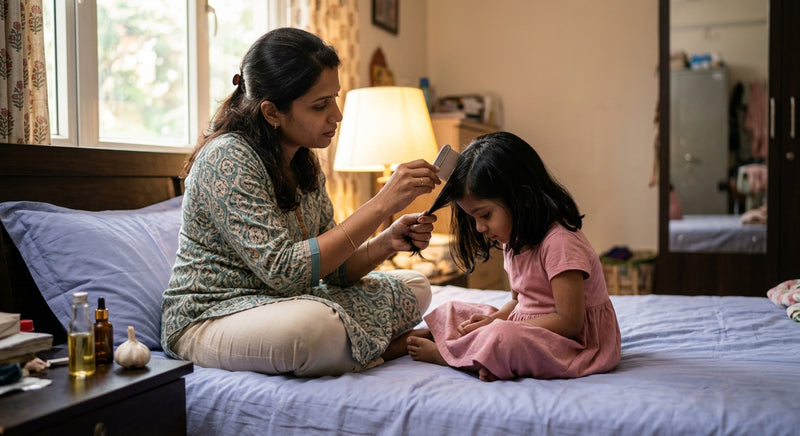
You plait it at 7:05am. Smooth, neat, a smear of oil down the length. By the time the school van turns off your lane there's a halo of fine hair standing straight up around her face and the plait has gone fuzzy from the ears down. Same hair. Forty minutes.
The mechanism is dull and physical. Hair is hygroscopic: it pulls water straight out of damp air. That water swells the strand, lifts the cuticle scales that lie over it like roof tiles, and lets the hydrogen bonds inside the hair re-set in a new, bent shape. Every strand bends its own way, stops lying flat against its neighbours, and stands out. And the drier and more porous the hair already is, the faster it drinks that water in. Frizz in humid weather is rarely a sign of too much moisture. Far more often it's a sign of too little.
So the advice I hear every June — the air is already damp, so stop oiling, wash it more often, keep it dry — makes frizz worse. I'll take the common beliefs one by one. Several are half-right, and that is precisely why they have lasted. The season-by-season version of all this sits in our complete guide to seasonal frizz in kids' hair.
At a glance
- Humid air doesn't create frizz on its own. It exposes hair that is already dry, porous or roughed up at the cuticle.
- The frizzier the hair, the more water it absorbs and the faster it swells. Smooth, well-conditioned hair swells less.
- Shampoo can't fix frizz. It's a rinse-off cleanser with seconds of contact. Conditioner and whatever you leave in do nearly all the work.
- Brushing dry hair to "smooth it down" separates the strands and makes frizz worse within minutes.
- A halo of short broken hairs at the crown or hairline isn't humidity at all. That's breakage, usually from tight bands and rough combing.
Why does humid weather make my child's hair frizzy?
Hair trades water with the air all day. In dry Nagpur April air it gives some up. In a Mumbai or Chennai August, or anywhere in India through the monsoon, it takes water on. The trade happens through the cuticle, the outer layer of overlapping scales. When those scales lie flat the strand is slippery, water moves in slowly, and light bounces off in one direction. That is what we read as shine.
Now damage that cuticle. Hard water minerals, chlorine, sun, a rough towel, a comb dragged through knots, a tight elastic: each one lifts and chips those scales. Lifted scales do two things. Water gets in much faster, and the surface turns rough enough to catch on the strand beside it. That is porosity, and porosity is what decides the whole thing. Two children can stand in the same 85% humidity and only one comes home fuzzy, because only one of them has a raised, thirsty cuticle.
Curly and wavy hair frizzes more, and the reason is structural. A cuticle cannot lie perfectly flat around a bend, and scalp oil struggles to travel down a coiled strand, so curly hair starts out drier and more porous. Fine, straight hair frizzes differently: you get the halo of flyaways rather than an all-over puff.
Myths about frizz in kids, and what's really going on
| What parents often believe | What's actually happening |
|---|---|
| "Humidity puts too much moisture in the hair." | Water moves in and out unevenly, and the hair that takes up the most is the driest, most porous hair. Frizz is a dryness problem wearing a moisture costume. |
| "Stop oiling in monsoon, it makes hair heavier and frizzier." | Half true. Heavy scalp oiling in humid weather is worth easing off. A light pre-wash oil on the lengths does the opposite of harm: it reduces how much the strand swells during washing. |
| "An anti-frizz shampoo will fix it." | Shampoo sits on the hair for seconds and is built to leave. Conditioner, and whatever you leave in, do almost all the anti-frizz work. |
| "Brush it more and it'll lie down." | Brushing dry hair breaks up the way strands clump together and roughs the cuticle further. It buys thirty seconds and costs you the morning. |
| "The hair is damaged forever — cut it short." | Short hair frizzes too. You are looking at surface friction and porosity, and both answer to conditioning within a wash or two. |
| "Conditioner is an adult product." | A kids' conditioner is a light detangler. Its job is to cut the force needed to comb, which prevents the breakage that becomes next month's frizz. |
"The air is damp, so stop oiling"
This one deserves a proper answer, because coconut oil is unusual and Indian households have been right about it for a long time. Its main fatty acid, lauric acid, has a straight chain and a low molecular weight, small enough to move into the cortex instead of only sitting on the surface, and published work has shown it reduces protein loss from hair. In monsoon that buys you less swelling and de-swelling through a wash, and that repetitive stress is what lifts the cuticle in the first place.
So: 15-20 minutes of a light coconut oil on the lengths before shampoo. Not a heavy overnight scalp oiling in 90% humidity. A damp, oiled scalp under a tight plait for eight nights of monsoon buys you itching and flaking instead.
"Wash it more often — it's the sweat"
Frequent washing with a harsh cleanser strips lipids, raises porosity, and hands you more frizz by the weekend. A sweaty scalp after games period does need attention, though, and we've written separately about whether a daily wash is really necessary after PE. The compromise most Indian families land on: a mild wash 2-3 times a week, a plain water rinse on the other sweaty days, and conditioner every single time the hair gets wet.
"Just brush it down before school"
Please don't. On frizz-prone hair, and on curls especially, dry brushing is the most counterproductive thing in the whole morning routine. Comb when the hair is wet and slippery with conditioner. Wide-tooth comb, ends first, working up in sections. Then stop touching it. Once it's dry the shape is set, and every pass of a brush re-roughens it.
Two kinds of frizz, and they need different fixes
Parents are usually surprised by this one, and it changes what you do tonight.
Humidity frizz is whole strands lifting away along the length. It shows up within an hour of walking outside, it's worst near the face and at the nape, and it vanishes the next time the hair is properly conditioned. Moisture and a smoother surface fix it.
Breakage frizz is a fixed halo of short, blunt-ended hairs at the crown, the hairline, or exactly where the elastic sits. The weather makes no difference to it. The cause is mechanical: tight school plaits, metal-jointed rubber bands, dry detangling, hair tied while still damp. Damp hair is at its weakest, which is why we're firm about never braiding a child's hair while it's still damp. No conditioner fixes breakage frizz. It grows out once you stop causing it.
Take her to the window and look at the ends of the flyaway hairs in daylight. Tapered and long means humidity. Blunt and short means breakage. Most Indian schoolgirls in a tight daily plait have some of both.
What actually helps: the ingredients doing the work
Turn the bottle over. In order of how much they matter for frizz:
Cationic conditioning agents. Behentrimonium chloride, behentrimonium methosulfate, cetrimonium chloride. They carry a positive charge and damaged hair carries a negative one, so they park exactly where the cuticle is roughest, lay the scales down and cut combing friction dramatically. This is the workhorse inside every conditioner ever made, and it's why conditioner beats any "smoothing" shampoo.
Fatty alcohols — cetearyl alcohol, cetyl alcohol, stearyl alcohol. Parents see "alcohol" and put the bottle down. Don't. These are waxy emollients that soften and coat, nothing like the drying alcohols (alcohol denat., SD alcohol) you'd find in a setting spray.
Light emollient oils: almond, avocado, argan. They mostly sit on the surface, which is precisely what you want for slip and for slowing water exchange, even though they don't penetrate the way lauric acid does.
A humectant, but a moderate one. Glycerin, honey and aloe pull water toward the hair. In very high humidity a humectant-heavy leave-in can pull in more water than the strand can hold, puffing it up. In dry winter air the same ingredient pulls water out of the hair. Humectants are lovely in the middle and awkward at both ends, so in peak monsoon I'd take a conditioner with a proper emollient and cationic base over a glycerin-forward gel or a DIY aloe spray.
And the water itself. Hard water is the one nobody suspects, and across most of urban India it works steadily. Calcium and magnesium deposit on the hair, roughen the surface, dull the colour, and by the end of the week everything feels coarse. One mug of stored, filtered or boiled-and-cooled water for the final rinse, just the last mug, and you'll feel the difference within a fortnight. Low-tech, and it works.
The routine to do tonight
- Before the bath, work a teaspoon of coconut oil through the mid-lengths and ends and leave it 15-20 minutes. Skip the heavy scalp massage on humid nights.
- Wash with lukewarm water, never hot. Shampoo the scalp only; the lengths get cleaned by the runoff.
- Conditioner from the ears down, every wash, no exceptions. Leave it 2-3 minutes.
- While it's still in, comb through with a wide-tooth comb: ends first, then mid-lengths, then roots.
- Rinse with cooler water. If your tap water is hard, keep a mug of filtered water aside for the last rinse.
- Blot with a cotton t-shirt or a microfibre towel. Never rub with a terry towel; that's a scrubbing brush on a lifted cuticle.
- Let it dry loose and untouched. No tying, plaiting or clipping until it is fully dry.
- Once dry, leave it alone. No dry brushing before school. If she needs a quick tidy, dampen the front hairline with a wet palm and smooth it with fingers.
If you change one step in the routine, make it the conditioner — and when you're reading the label, look for a light kids' formula with a cationic conditioning agent (behentrimonium or cetrimonium) high in the ingredient list and fatty alcohols behind it. Ours is the Rejuvenating & Detangling Conditioner, formulated to cut combing friction on fine and curly kids' hair, which is where frizz begins.
When to see a doctor
Frizz itself is a hair-surface issue, not a medical one. But take your child to a paediatrician or dermatologist if you see a patch of scalp where the hairs are broken off short with a scaly, grey or boggy surface — that pattern needs a doctor's eye rather than a change of shampoo, and scalp problems that look like this are common in humid Indian weather and are treated on prescription. Get it looked at too for persistent itching or flaking that hasn't settled in two weeks, sudden diffuse hair fall, painful bumps, or a thinning line at the hairline where tight plaits sit. Any real hair loss in a child deserves a proper examination rather than a guess.
In summary
- Humid air triggers frizz, but the hair that frizzes worst is the driest and most porous — treat it as a moisture problem, not an excess-moisture one.
- Condition from the ears down every single wash, leave it 2-3 minutes, and comb only while it is wet and slippery.
- Keep a light pre-wash coconut oil on the lengths in monsoon; ease off heavy overnight scalp oiling instead.
- Check whether you are seeing long lifted strands (humidity) or short blunt ones at the crown (breakage) — the fixes are completely different.
- Stop terry-towel rubbing, damp plaiting, metal-jointed elastics and dry brushing before you buy anything new.
Frequently asked questions
Why does my child's hair get frizzy only in humid weather?
Hair absorbs water from damp air. That water swells the strand and lifts the cuticle scales, so each hair bends its own way instead of lying flat with its neighbours. Dry, porous hair absorbs water fastest, so it frizzes most. The humidity is the trigger, but the underlying dryness and cuticle roughness are the actual cause.
Does oiling hair make frizz worse in monsoon?
Not on the lengths. A light coconut oil applied 15-20 minutes before shampoo reduces how much the strand swells during washing, which is one of the things that lifts the cuticle over time. What is worth easing off in humid weather is heavy overnight scalp oiling, especially under a tight plait, because a damp oiled scalp can get itchy and flaky.
Should I use conditioner on a child's hair?
Yes, from around three years or whenever the hair is long enough to tangle. A kids' conditioner is essentially a light detangler with positively charged conditioning agents that lay the cuticle flat and cut the force needed to comb. Less combing force means less breakage, and less breakage means fewer short broken hairs standing up later. Apply from the ears down only.
What is the difference between frizz and breakage?
Look at the flyaway hairs in daylight. Long, tapered strands lifting along the length are humidity frizz, and they settle with conditioning. Short, blunt-ended hairs forming a fixed halo at the crown or hairline are breakage, usually from tight bands, dry combing or hair tied while damp. Breakage does not respond to conditioner; it grows out once the cause stops.
Can hard water cause frizzy hair in kids?
It contributes. Calcium and magnesium in hard water deposit on the hair shaft, roughen the surface and make hair feel coarse and look dull. Rough surfaces catch on each other, which reads as frizz. A practical fix used in many Indian homes is a final rinse from a stored mug of filtered or boiled-and-cooled water. Two weeks is usually enough to notice.
Will cutting my child's hair short stop the frizz?
Short hair frizzes too, so a haircut alone will not solve it. What a trim does help with is removing split, worn ends that are the most porous part of the strand. Combine a trim with regular conditioning, wet-only combing and gentler hair ties, and you address the cause rather than just shortening the visible fuzz.