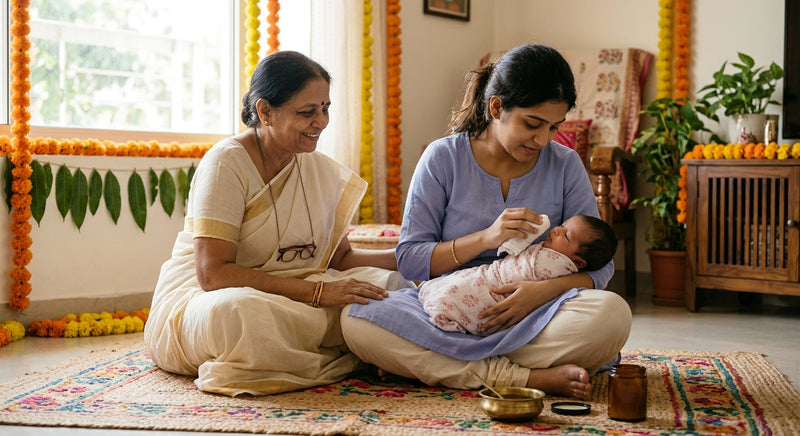
My aunt arrived with a steel katori of ghutti when my first baby was eleven days old, and she was genuinely trying to help. So here is the answer I wish someone had handed me that morning: there is no age — one month, one year or twelve — at which ghutti becomes the right thing to put in a child's mouth. Below six months a baby needs breastmilk or formula and nothing else, not even water. After six months the question quietly stops being "is this safe yet?" and becomes "why am I still giving this?"
What does change with age is the risk profile. A 2 kg newborn and a 9-year-old are not exposed to the same hazards from the same spoon. Nobody explains that part. So, band by band. And if you want the wider picture afterwards, this sits inside our complete guide to traditional baby-care practices and what the evidence says.
At a glance
- 0–6 months: milk only. Ghutti, gripe water, honey, water, janam ghutti "ek boond" — all of it is out, with no exceptions for age in months.
- 6–12 months: solids starting does not make ghutti a food. Honey stays off until the first birthday, in any preparation.
- 1–3 years: the drowning and choking risk drops, but dosing-by-eye and unlabelled ingredients don't. This is the age most families actually ask me about.
- 3–12 years: ghutti usually turns into "digestive churan" after a heavy meal. Same unanswered questions, just a bigger child.
- The real danger at every age is the same: a symptom that gets home-treated for a week instead of looked at.
What actually changes from 1 month to 12 years?
Age moves a few things. How much a child's body can absorb a dose that was measured by eye. Whether a swallow goes into the lungs instead of the stomach. How well they can tell you something feels wrong. What it does not move is the fundamental problem: a home-ground or loosely-labelled preparation has no dose per kilo, no batch testing, and no list you can check against anything.
| Age | What changes | What is never appropriate |
|---|---|---|
| 1–6 months | Nothing in your child's favour. Tiny body weight, immature liver and kidneys, a gut that only has room for milk. A few millilitres displaces a whole feed. | Any ghutti, gripe water, honey, sugar water, ajwain water, or "just one drop on the tongue". Also: finger-feeding, droppers while drowsy, a katori propped at the mouth. |
| 6–12 months | Solids begin, so parents assume the gate has opened. It hasn't. Swallowing is better; the dosing problem is identical. | Honey in any form, including a honey-and-ghutti paste on the gums. Nutmeg (jaiphal) and poppy seed (khus khus) in a home grind. Ghutti instead of a feed. |
| 1–3 years | Choking risk falls. Body weight rises, so a fixed "family dose" is less extreme — but it is still a dose nobody calculated. | Daily or habitual dosing. Anything given to make a toddler sleep, settle or go quiet. Ghutti in place of a visit for repeated vomiting, loose motions or poor weight gain. |
| 3–12 years | A child can tell you their stomach hurts and where. That's genuinely useful. Ghutti becomes churan, saunf-mishri, hing water. | Treating recurring pain at home for weeks. Giving an adult-strength preparation. Assuming "it's herbal" means there's nothing in it that interacts with a prescribed medicine. |
1 to 6 months: why the answer stays no, every single month
This is the band where the stakes are highest, and also where the room is fullest of advice. The baby cries. Everyone has an opinion. Meanwhile a newborn's stomach is the size of an apricot. Every few millilitres of anything that isn't milk is a few millilitres of milk not taken — and at this age, milk is both the food and the water.
Two practical things I didn't know as a first-time mother. One: a dose given by finger or dropper to a half-asleep baby can go the wrong way, and a baby who is sputtering is not a baby who has been soothed. Two: a traditional grind is rarely one herb. Jaiphal turns up often, and it is the ingredient paediatricians flag most, because "a scrape on the sil-batta" is not a measurable amount. We've gone through this properly in an ingredient-by-ingredient paediatric read of janam ghutti — worth ten minutes before you accept a bottle from anyone, however loving.
6 to 12 months: solids started, so is ghutti allowed now?
No — and this is the most common mix-up I hear. Starting dal paani and mashed banana at six months means your baby can now handle food. Ghutti isn't food. It's an unmeasured preparation given for a symptom, which puts it in a completely different category.
The hard line in this band is honey. Nothing with honey in it, before the first birthday, in any form — not on the gums, not to make a bitter grind go down. If a shop-bought ghutti lists honey or "madhu", that bottle is simply not for a baby under one. Our label-reader's guide to janam ghutti in the Janma Journal walks through what the wording on these packs actually means.

1 to 3 years: the age families actually ask about
Honestly, most of the messages I get are about this band, not newborns. The toddler is eating off everyone's plate, the motions have changed, and a family dose of churan after dinner feels harmless.
My honest view: a one-off pinch of saunf-mishri after a heavy festival meal, in a healthy two-year-old, is not what keeps me up at night. Habit is. Daily dosing is a different animal. It normalises reaching for a bottle before you look at a pattern. It masks something that might need weighing and measuring. And in a child who is already a fussy eater, it blunts the appetite for actual food. If you've been giving it most days for a month, that — not the ingredient list — is the thing to mention to the doctor.
And one firm no at this age: nothing given to settle or quiet a child. A toddler who goes unusually floppy or sleepy after a dose has not been helped. That's a same-day call.
3 to 12 years: churan, hing water and the "it's herbal" trap
By three, your child can point to where it hurts. Use that. Ask where, when, how often, and whether it happens on school mornings. A pattern you can describe is worth more to a paediatrician than any remedy you can buy.
The trap in this band is the assumption that herbal means inert. It doesn't. If your child takes anything prescribed — for asthma, seizures, thyroid, ADHD, anything long-term — a daily unlabelled preparation is a genuine conversation to have with the treating doctor, not an afterthought. The same logic we apply to home remedies on a child's skin — which ones are safe, which aren't, and when to stop applies with more force to anything swallowed.

The routine to follow instead, starting tonight
Most ghutti is given for wind, crying or a hard tummy. So this is the sequence I'd run, in order, before anything goes in your child's mouth. Costs nothing. Works at any age, with small adjustments.
- Feed slower, not more. For a baby under six months: pause mid-feed, sit them upright, let them re-latch. A hurried feed swallows air. If bottle-feeding, keep the teat full and hold the baby at an angle rather than flat.
- Burp for a full two minutes — upright against your shoulder, firm flat palm up the back. Most parents stop at twenty seconds. Two minutes is where the burp usually lives.
- Do the clockwise tummy massage. Warm hands, a little oil or balm, and slow strokes in the direction of the bowel — down the left side, across, down again. Three to five minutes, roughly an hour after a feed, never on a full stomach.
- Bicycle the legs, then knees-to-chest for ten slow repetitions. For toddlers, turn it into a game. For older kids, a walk around the building beats lying down after a heavy meal.
- Tummy time while awake and watched — five minutes, a few times a day. Pressure on the abdomen helps more than most things in a bottle.
- Write down what you see. Three nights of notes: when the crying starts, how long, feeds, nappies or motions, weight if you have a scale. This is the single most useful thing you can hand a paediatrician.
- Check the room, not the gut. In an Indian summer, an overheated, overdressed baby cries exactly like a gassy one. Loosen a layer, drop the fan speed a notch, feel the back of the neck for sweat.
- Then stop. If three nights of this hasn't shifted anything, that's the signal to book an appointment — not to escalate to a stronger remedy.
How to say no to a loving elder
The practice usually isn't the hard part. The relationship is. What has worked for me is making it the doctor's instruction rather than my opinion, and never doing it in front of an audience. "Doctor ne bola hai, six months tak sirf doodh" ends the conversation far faster than any article I could quote. Then give the elder a real job — the malish, the burping, holding the baby upright after a feed. People press remedies on you because they want to be useful. Let them be useful.
And if you want to raise it with your paediatrician yourself, keep it factual: name the preparation, say who gives it and how often, show your three nights of notes, and ask directly whether it should stop. The same question comes up around oil massage on a vaccination site — ask plainly, and you'll almost always get a plain answer.
When to see a doctor
Stop home remedies and get your child seen — same day, not next week — if there is:
- Any fever, poor feeding, unusual sleepiness or floppiness in a baby under 3 months.
- Vomiting that is forceful, green, or won't stop; blood in vomit or motions.
- Fewer wet nappies, a sunken fontanelle, no tears, a dry mouth, or a baby who seems drained.
- A swollen, hard, tender tummy, or inconsolable crying that goes on for hours.
- Breathing trouble, choking or sputtering after a dose was given.
- Weight that has stalled or dropped, or motions that have changed for more than a few days.
- Recurring tummy pain in an older child — especially if it wakes them at night or keeps them off school.
Nothing here is a diagnosis. It's a list of reasons to let a paediatrician look, which is always the better call than a second dose.
A last, honest note on us: Janma makes nothing you swallow — we're a topical skincare brand, made in our own GMP-certified facility in Nagpur, and that's where our competence ends. For the tummy massage above you just want something that spreads slowly and doesn't sting, and our Hydra Healing Moisturizing Balm comforts dry, sensitive skin while your hands do the actual work.
In summary
- Below six months, give only breastmilk or formula — no ghutti, gripe water, honey, water or "ek boond".
- Starting solids at six months does not make ghutti a food, and honey stays out until the first birthday in any preparation.
- From one to three years the danger shifts from choking to habit — daily dosing masks patterns and blunts appetite.
- Run the routine first: slower feeds, two full minutes of burping, clockwise tummy massage, leg bicycles and three nights of notes.
- Any fever or floppiness under three months, forceful vomiting, fewer wet nappies or recurring tummy pain means see a paediatrician the same day.
Frequently asked questions
At what age can a baby be given janam ghutti?
There is no age at which it becomes the recommended option. Below six months a baby needs only breastmilk or formula, so nothing else belongs in their mouth. After six months, starting solids does not make ghutti a food — it is still an unmeasured preparation given for a symptom. If your family gives it, raise it with your paediatrician and ask directly whether it should stop.
Is ghutti safe for a 1-month-old baby?
No. At one month a baby's stomach is tiny and their liver and kidneys are still immature, so even a few millilitres of anything other than milk displaces a feed and delivers an unknown dose. Dosing by finger or dropper to a drowsy newborn also risks it going down the wrong way. Burping, slower feeds and gentle tummy massage are the safer first steps.
Can I give ghutti to my 2-year-old for gas?
A one-off pinch of saunf-mishri after a heavy meal in a healthy toddler is not the thing I worry about most — habit is. Daily dosing can blunt appetite and hide a pattern worth investigating. Try slower meals, a clockwise tummy massage and a walk after dinner first. If tummy trouble keeps returning, that recurrence is what the doctor needs to hear about.
Why is honey not allowed in ghutti before one year?
Honey is kept out of every food and preparation for babies under twelve months as a standard safety precaution, including honey used to make a bitter grind easier to swallow or rubbed on the gums. If a shop-bought ghutti lists honey or madhu anywhere on the pack, that bottle simply is not for a child under one, whatever the age range on the front says.
Is churan safe for school-age children after meals?
Many families use churan, saunf or hing water occasionally and most children are fine. Two cautions. Don't give an adult-strength preparation to a child, and don't assume herbal means it cannot interact with anything. If your child takes regular prescribed medicine, mention the preparation to the treating doctor rather than deciding for yourself that it is neutral.
How do I refuse ghutti without upsetmy my child's grandparents?
Make it the doctor's instruction rather than your opinion, and say it once, privately — "doctor ne bola hai, six months tak sirf doodh" closes the subject faster than any argument. Then hand the elder a real job: the malish, the burping, holding the baby upright after feeds. Most people press remedies because they want to help, so give them a way to help.