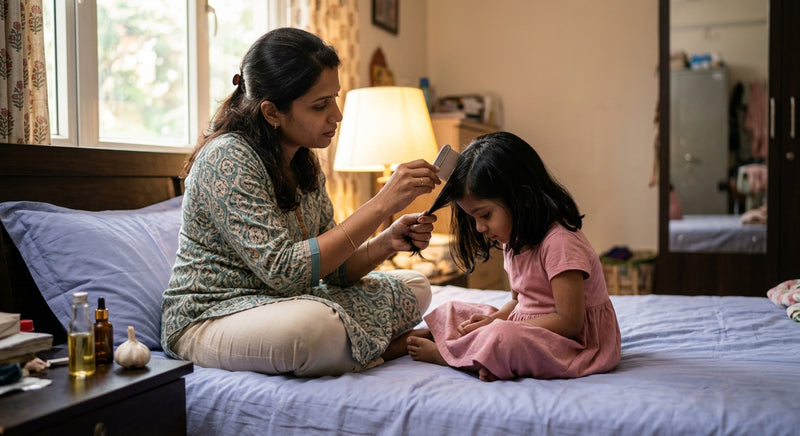
The ingredients worth your money in a kids' conditioner are the boring ones. A cationic conditioning agent — behentrimonium methosulfate or cetrimonium chloride. A fatty alcohol, usually cetearyl alcohol. A humectant, panthenol or glycerin. That trio is what makes a comb glide instead of catch. The twelve herbs, the keratin, the salon-smooth promise on the front of the bottle: priced, not proven.
Parents send us photos of ingredient lists at odd hours, usually with the same two questions attached. Is this okay for a six-year-old, and why is it ₹700? Fair. A conditioner is one of the simplest formulas in the bathroom, and the distance between a good one and an expensive one is often just a marketing budget. So here is the unglamorous version: what to pay for, what to walk past, and the wash-day order that gets more out of whatever bottle you already own.
At a glance
- Look for a cationic conditioner (behentrimonium methosulfate, cetrimonium chloride) in the top five ingredients — that is the actual detangler.
- Cetearyl and cetyl alcohol are fatty alcohols. They soften hair. They are not the drying kind.
- Anything listed after the fragrance and preservative is present in a whisper. Do not pay extra for it.
- Skip menthol, heavy perfume, colourants and "keratin repair" language on a child's bottle.
- Application beats price: ears down, comb it through in the shower, rinse after a minute or two.
What does a conditioner actually do to a child's hair?
Think about what a child's hair has been through by Wednesday. Washed, rubbed with a towel, pulled into a school braid, dragged through with a comb. The outer layer ends up roughed up, and those damaged spots carry a slight negative charge. Conditioning agents carry a positive one, so they settle exactly where the damage is and lie the cuticle flat again. Less friction at the comb, so fewer knots and less breakage.
That is the whole job. Nothing is being fed, nothing structurally repaired, nothing made to grow. A rinse-off conditioner lowers the force needed to pull a comb through — and for a child with waist-length hair and a school bus to catch, that is the thing that matters.
Which kids' conditioner ingredients are worth paying for?
The cationic base. Behentrimonium methosulfate, behentrimonium chloride or cetrimonium chloride. If none of these — or a close cousin — turns up in roughly the first five ingredients, you have bought a scented lotion. One thing causes real confusion at the shelf, so it is worth saying plainly: behentrimonium methosulfate is not a sulfate detergent. It comes from rapeseed oil, it is one of the mildest conditioning agents in cosmetics, and it is the one ingredient I will not compromise on for a child.
Fatty alcohols. Cetearyl alcohol, cetyl alcohol, stearyl alcohol. Parents see "alcohol" and put the bottle down — I have watched it happen in a pharmacy aisle. These are waxy, solid, oil-derived softeners with nothing in common with the alcohol that dries skin out. They give the product its body and leave hair feeling smooth.
Panthenol and glycerin. Humectants. They help the hair fibre hold a little water, and a fibre holding water slides past its neighbours instead of gripping them. Cheap, old, well understood, and they work.
A small amount of the right oil. Coconut oil is one of the few that actually gets inside the hair shaft rather than only coating it, which is why generations of Indian grandmothers were not wrong about the Sunday champi. Almond and argan sit on the surface and soften. In a conditioner you want them measured into the emulsion, not slathered on. A greasy conditioner just means more shampoo next time.
| On the label | What it actually does | Worth paying for? |
|---|---|---|
| Behentrimonium methosulfate / cetrimonium chloride | The real detangler — clings to the roughed-up parts of the hair and lays them flat | Yes. This is the money ingredient |
| Cetearyl / cetyl alcohol | Fatty alcohol. Softens, thickens, nothing like drying alcohol | Yes |
| Panthenol (pro-vitamin B5), glycerin | Helps hair hold water so strands stop gripping each other | Yes |
| Coconut, almond or argan oil in the blend | Softens; coconut is small enough to enter the shaft | Yes, in small amounts |
| Hydrolysed wheat / rice / silk protein | Temporary surface smoothing that rinses away | Nice to have, not essential |
| Dimethicone / amodimethicone | Slip and shine; can build up on fine hair in hard water | Your call — a preference, not a safety issue |
| Alcohol denat / SD alcohol high in the list | Thins the formula; can leave hair squeaky and rough | Skip |
| Menthol, peppermint, heavy perfume | Tingle and scent. No conditioning at all | Skip for kids |
| Amla, bhringraj or hibiscus listed after the fragrance | Present in trace amounts. Mostly a label story | Do not pay extra |
What you can skip on a kids' conditioner
Fairy dusting. The ingredient list runs in descending order of quantity down to 1%, and below that the order is free. Fragrance and preservative almost always sit near the bottom. So if the fourteen-herb Ayurvedic blend on the front appears below the fragrance on the back, you are paying for a photograph of hibiscus.
Keratin and "repair" language aimed at children. Hydrolysed keratin in a rinse-off is harmless and mildly smoothing. That is not the problem. The problem is the association it borrows from salon keratin smoothing — an entirely different, formaldehyde-releasing process that has no business near a child's head.
Strong fragrance and colour. A rinse-off product does not need a CI number in it. And a scalp that is already itchy in September humidity does not need a heavy perfume load on top. Lightly scented is fine. A bottle you can smell across the bathroom is not.
Essential oils high in the list for younger children. Tea tree, lavender, peppermint. They get sold as scalp-stimulating; for a three-year-old they are mainly a sensitisation risk with no detangling benefit.
"Chemical-free" and "100% natural". Water is a chemical. And a preservative-free conditioner sitting in a warm, wet Indian bathroom for four months is the genuinely risky option, not the safe one. Phenoxyethanol or a mild preservative blend at the end of the list is a formulator doing their job. When a brand leads with what it does not contain, I read the back of the bottle twice.
How to read the label in 30 seconds
Standing in the shop, four checks and nothing else. Find a behentrimonium or cetrimonium ingredient in the first five. Make sure any "alcohol" is a fatty one — cetearyl, cetyl, stearyl — and not alcohol denat. Locate the fragrance, then mentally discount everything printed after it. Last, check the age on the pack and make sure it is meant for children rather than decanted adult marketing. Four passes and the bottle will work. It very likely costs less than the one beside it, too.
The wash-day routine that makes a conditioner earn its price
Most of the complaints I hear about conditioners doing nothing turn out to be application problems. Try this order tonight. It is about four minutes of actual work.
- Detangle dry, before the bath. Wide-tooth comb, starting at the ends and working up in sections. Wet hair stretches and snaps — never start the fight in the shower.
- Oil first if you oil. Warm oil on the scalp and lengths 30–45 minutes before the wash, not the night before. Overnight oiling in humid weather usually means two rounds of shampoo the next day.
- Shampoo the scalp only. Lather at the roots and let it run down the lengths on its way out. Something mild and tear-free is enough for school-age hair — ours is the Loving & Balancing Shampoo.
- Squeeze the water out. Press with your hands or an old cotton tee. Conditioner applied to dripping hair slides straight down the drain — this is the step almost everyone skips.
- Apply from the ears down. A pea-sized amount for a bob, a ₹10-coin blob for waist-length hair. Nothing on the scalp for kids whose roots go oily by day two.
- Comb it through while the conditioner is in. Wide-tooth comb, ends first. This is the moment the tangles actually leave. Everything before it is preparation.
- Wait 1–2 minutes. One song. Then rinse with cool-ish water until the hair squeaks slightly less than you expect — a faint softness left behind is correct, not a rinsing failure.
- Blot, do not rub. Cotton tee or a soft towel, pressed. Then let it dry loose.
Adjusting for Indian seasons
Monsoon first. Glycerin-heavy formulas can pull moisture out of humid air and puff fine hair into frizz, so go lighter and rinse more thoroughly. Dry north-Indian winter is the opposite — leave the conditioner on the extra minute and stay generous on the last four inches. A child who swims through the summer gets conditioner at every wash, no exceptions; chlorine plus rough combing is a worse combination than either alone. And no tight braids on damp hair for school. That is where most of the breakage near the hairline is coming from.
If you are choosing shampoo and conditioner together rather than one at a time, we have gone through the pairing in more detail in our guide to the best shampoo and conditioner combo for kids in India over in the Janma Journal.
When to see a doctor
A conditioner is a comfort product, not a treatment. See your paediatrician or a dermatologist if your child has a flaky, itchy scalp that has not settled in two weeks, patchy hair loss or a distinct bald spot, sores, crusting or pus on the scalp, persistent itching (especially with a lice notice from school), or any rash, swelling or hives after a new product. Stop the product and take the bottle with you so the doctor can see the ingredient list.
If you want a conditioner built on those basics rather than on a front label — cationic detangling agents, fatty alcohols and gentle botanicals, made in our own GMP-certified facility — that is what our Rejuvenating & Detangling Conditioner was formulated to be.
In summary
- Check that a cationic agent such as behentrimonium methosulfate or cetrimonium chloride sits in the first five ingredients — that is what actually detangles.
- Cetearyl and cetyl alcohol are softening fatty alcohols, not the drying kind, so do not reject a bottle over the word alcohol.
- Discount anything listed after the fragrance and preservative; those botanicals are present in trace amounts and should not raise the price.
- Squeeze water out first, apply from the ears down, comb it through while the conditioner is in, then rinse after one to two minutes.
- In hard-water cities, finish with a mug of stored or filtered water over the lengths, and never braid damp hair tightly for school.
Frequently asked questions
At what age can a child start using conditioner?
Usually around two to three years, and really it is about hair length rather than birthdays. A toddler with a short crop does not need it. Once hair reaches the shoulders, or the morning comb-out starts producing tears, a mild kids' conditioner earns its place. Apply from the ears down, keep it off the scalp, and rinse well.
Is behentrimonium methosulfate a sulfate? Is it safe for kids?
No, it is not a cleansing sulfate like SLS, despite the name. It is a cationic conditioning agent derived from rapeseed oil and is one of the mildest detanglers available. It is a rinse-off ingredient used at low levels and is widely used in gentle children's formulas. If you see it high in the list, that is a good sign, not a red flag.
Are silicones bad in a kids' conditioner?
Not unsafe, no. Dimethicone and amodimethicone reduce the force needed to comb hair, which means less breakage. The honest caveat is build-up: on fine hair washed in hard water, heavy silicones can leave a dull, coated feel over a few weeks. If that happens, switch to a lighter formula rather than assuming the ingredient is harmful.
Can I just use my own conditioner on my child?
Occasionally it will do no harm, but adult formulas are usually more fragranced and often carry actives aimed at colour-treated, dandruff-prone or chemically straightened hair — none of which apply to a child. A kids' conditioner is typically lighter, less scented and designed for the scalp to tolerate frequent use. Keep separate bottles if you can.
Do I still need a detangler spray if I use a conditioner?
Most children do not. A rinse-off conditioner combed through in the shower handles the majority of tangles. A leave-in spray helps if your child has very curly or very long hair, or if mornings involve a fresh comb-out on dry hair. Treat it as an add-on for the second and third day, not a replacement for wash day.
Will a conditioner fix hair damaged by hard water?
It helps considerably — the acidic pH and cationic agents smooth the cuticle after hard water has roughened it — but it cannot remove mineral deposits. The bigger win is a final rinse with stored or filtered water over the lengths. If your tap water is very hard, that mug does more for your child's hair than upgrading to a costlier bottle.