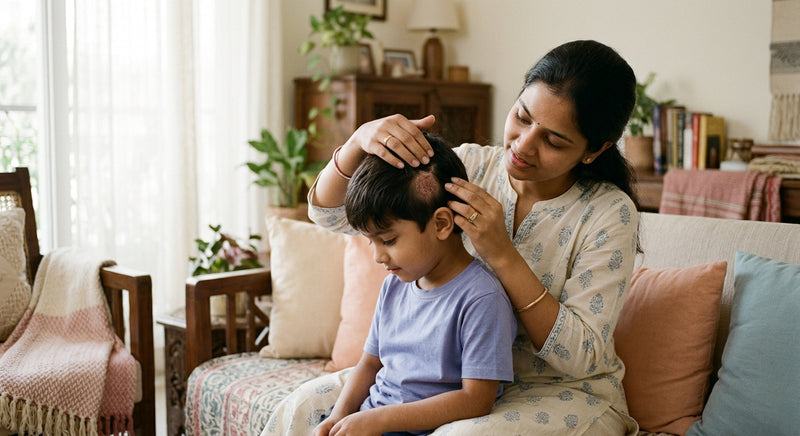
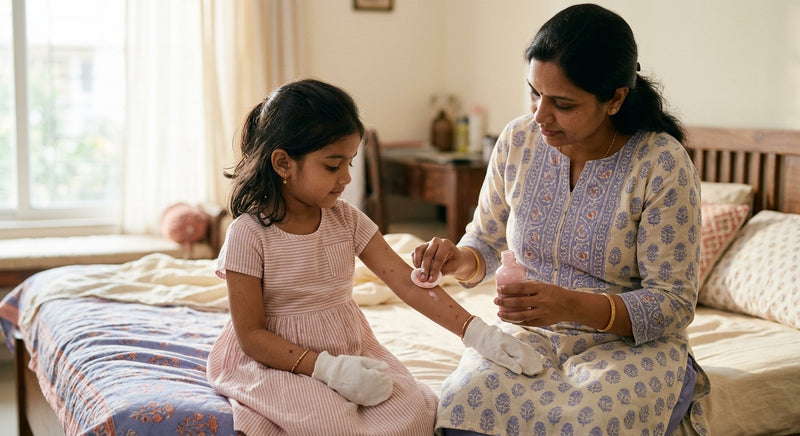
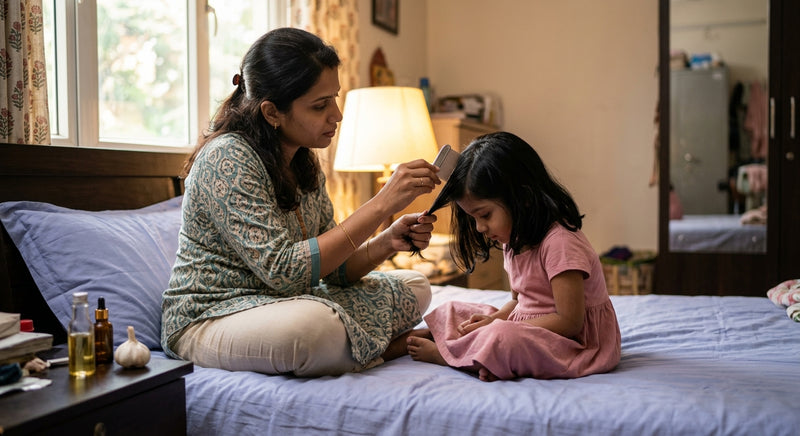
Long hair doesn't catch lice more easily than short hair. Loose long hair does. Head lice move head to head, and a curtain of open hair just makes contact easy — in the assembly line, bent over one phone screen, during a hug at the school gate. Tie it up properly. Check it twice a week. That removes most of the opportunity, and nothing else about your child's day has to change.
If a note has gone home from your child's school — “a few cases of head lice in Class 3” — the first instinct is usually to worry about hair length. Resist it. Lice need head-to-head contact, so the thing actually worth changing is how much of your child's hair is free to touch another child's head. The tie-up is the one variable you fully control before 7:30 am.
Mid-outbreak right now? Start with our complete guide to kids' scalp and lice care, then come back here for the daily habits that stop it coming back.
At a glance
- Lice spread by direct head-to-head contact. Not hair length, not hygiene, not long hair itself.
- Open or half-tied long hair makes that contact easy. A plait folded up and pinned at the nape makes it hard.
- Detangle before you tie. Knotted hair can't be combed through later, and that's when lice get missed.
- Two three-minute scalp checks a week catch an infestation while it's still three or four lice.
- Clips, bands, caps and a shared pillow at a sleepover matter far less than head contact. Stop sharing them anyway — they're easy wins.
Does long hair actually get lice more often?
Not because it's long. A louse can't jump or fly. It walks, and it needs two scalps close enough for the walk to be short.
Length only helps it indirectly. Open hair moves — it brushes the girl sharing the school-van seat behind. And long hair is harder to comb all the way through, so a small infestation hides for longer and gets more time to multiply.
So the fix isn't “cut her hair”. A haircut doesn't make a scalp any less appealing to lice, and it usually costs your child something she cares about. Containment plus regular checking does the work.
The 5-minute morning routine that cuts spread
Everything else hangs off this. Keep the order — that's what makes it fast.
- Detangle first, on dry or barely damp hair. Start at the ends with a wide-tooth comb and work up in sections. Never drag a comb from the crown down through a knot. Hair snaps and you still don't get through.
- Add slip if the hair is thick, curly or past the shoulder blades. A pea-sized amount of conditioner on the mid-lengths and ends, or two drops of your usual oil. The comb passes instead of fighting. It's the same prep that makes a nit comb work later.
- Two sections, one plait each side. Firm, not tight. You should be able to slide a fingertip under the plait at the hairline. If her forehead skin pulls when she raises her eyebrows, loosen it.
- Fold each plait up and pin it. Everyone skips this step, and it's the one that matters. A swinging plait still touches other heads. Folded and pinned at the nape, nothing hangs.
- Tuck in the nape and hairline wisps. Lice settle behind the ears and at the nape because it's warmest there. Loose baby hair at those exact spots is the bridge.
- Fabric-covered band, or a scrunchie. Not a bare rubber band — it grips and tears, and torn hair means more breakage and more tangles tomorrow.
- One rule, said once, no drama: we don't share clips, bands, caps, dupattas or helmets. Not even with a best friend.
Which tie-up actually holds through a school day?
| Style | Still holding at 3 pm? | Head-contact risk |
|---|---|---|
| Open hair, or half-tied with a clip | No | Highest — hair touches whatever is next to it |
| Single low ponytail | Usually | Moderate — the tail swings and brushes neighbours |
| Single plait, hanging | Yes | Lower — contained, but still mobile |
| Twin plaits folded up and pinned | Yes | Lowest — nothing hangs, nape covered |
| High bun | Often loosens by lunch | Lower, if it holds — redo at games period |

The twice-weekly check: three minutes, good light
Pick two fixed slots. Sunday morning and Wednesday after bath works for us, because damp hair slows lice down and they're easier to spot. Stand near a window, or under a bright lamp. Not under a ceiling-fan light at night.
- Comb the hair out fully first.
- Part a 2 cm section and look at the scalp, not the hair. Behind both ears, then the nape, then the crown.
- Nits are tiny and teardrop-shaped, and cemented to the hair shaft close to the scalp. If it flicks off easily with a fingernail, it is more likely dandruff or product residue than a nit — and if you can't tell, let your paediatrician look rather than guessing.
- Run a nit comb through a few sections over a white tissue. Look at what comes off.
- Write the date on a sticky note on the bathroom shelf. Memory is unreliable at 7 am.
Found something? Don't put the whole house on treatment. Our calm, step-by-step plan for a school lice outbreak covers who to check, who to treat, and the order to do it in.
Habits that don't help — and two that backfire
Washing her hair every single day doesn't deter lice. They hold onto clean hair just as well, and over-washing leaves a school-age scalp dry and itchy — which muddles the very itch signal you're relying on. Two or three washes a week with a mild, tear-free shampoo is plenty for most Indian school routines. More in summer, when the sweat is constant. Gentleness is the thing to look for, because you may be washing more often than usual for a fortnight: a mild gentle tear-free shampoo for kids won't strip the scalp while you're combing it daily.
Also pointless: fogging the house, treating the dog, throwing out soft toys. A louse off a human scalp is dying within a day or two. Hot-wash the pillowcases, her uniform collar and the hair accessories she used in the last two days. Stop there.

If one child in the house has lice
Check every head on the same day, yours included. Treat only the heads with live lice — a paediatrician or pharmacist can recommend the right lotion for your child's age, and the label's repeat timing exists because of the egg cycle, so don't skip the second application. Separate towels, hairbrushes and pillows for two weeks. Keep plaiting the long hair up. And keep the Sunday-Wednesday check going for a full fortnight after the last louse, because that's how reinfestation from a classmate gets caught early instead of in week three.
Tell the class teacher too. Nobody enjoys sending that message. But an outbreak nobody mentions just circles back through the same six girls. Lice are not a sign of a dirty home or bad parenting. They're a sign that children sit close together, which is the whole point of school.
When to see a doctor
See your paediatrician if the scalp is weeping, crusted, has yellow discharge or tender lumps at the neck — a scratched scalp can get infected, and that needs real treatment. Go in as well if two correctly applied courses of a recommended lotion haven't worked, if your child is under two years old, or if the itching, broken skin and sleeplessness are continuing after treatment.
Go in if you're simply not sure what you're looking at, too. One minute with a doctor's magnifier settles it, and a wrong guess means weeks of unnecessary combing.
On long hair, none of this works without the detangling step. What to look for is a mild, child-appropriate conditioner that gives a comb enough slip to pass from scalp to ends — nothing in a bottle removes lice; the combing does. Our Rejuvenating & Detangling Conditioner is the one we make for that job.
In summary
- Lice spread by head-to-head contact — long hair raises the odds only when it hangs loose, so contain it rather than cut it.
- Detangle before tying, then plait, fold the plait up and pin it, tucking the nape and hairline wisps in.
- Swap bare rubber bands for fabric-covered bands, and make no sharing of clips, caps, bands or dupattas a flat rule.
- Check the scalp twice a week in bright light for three minutes, and keep going two full weeks after the last live louse.
- Skip kerosene, garlic and neat essential oils entirely, and see a paediatrician if the scalp is weeping, crusted or two correct treatments have failed.
Frequently asked questions
Should I cut my daughter's long hair because of lice at school?
No. Hair length doesn't attract lice — head-to-head contact spreads them. Cutting it removes a lot of what she likes about her hair and changes very little. A firm plait folded up and pinned at the nape contains long hair just as effectively, and twice-weekly scalp checks do the rest. Save the haircut for a reason she agrees with.
Do plaits or a bun really reduce lice spread?
They reduce opportunity, which is what you can control. Lice have to walk from one scalp to another, so hair that doesn't hang or swing gives them fewer bridges. Twin plaits folded up and pinned, with the nape and hairline wisps tucked in, are the most reliable school-day option. Keep them firm but never tight enough to pull at the temples.
How often should I check my child's scalp during a school outbreak?
Twice a week, three minutes each time, in bright daylight. Comb the hair out first, then part 2 cm sections and look at the scalp behind the ears, at the nape and the crown. Nits are cemented to the hair shaft near the scalp; anything that flicks off easily is dandruff. Keep checking for two weeks after the last live louse.
Does washing hair daily prevent head lice?
It doesn't. Lice grip clean hair perfectly well, and daily washing can leave a school-age scalp dry and itchy — which muddles the itch signal you're watching for. Two or three washes a week with a mild, tear-free shampoo suits most Indian school routines, with an extra wash in peak summer sweat. Combing matters far more than washing frequency.
Can I use oil or conditioner to help remove lice?
Oil and conditioner won't kill lice, and shouldn't be sold to you as a treatment. What they genuinely do is add slip, so a nit comb can pass from scalp to ends instead of catching in knots — and thorough combing is the step that removes lice and nits. Use a little on mid-lengths and ends before combing, never neat essential oils.
What should I wash at home if my child has lice?
Less than you think. A louse away from a human scalp survives only a day or two, so fogging the house or bagging every soft toy isn't necessary. Hot-wash pillowcases, uniform collars, towels and the hair accessories used in the last two days. Give each person their own comb, brush and pillow for a fortnight, and skip the deep clean.