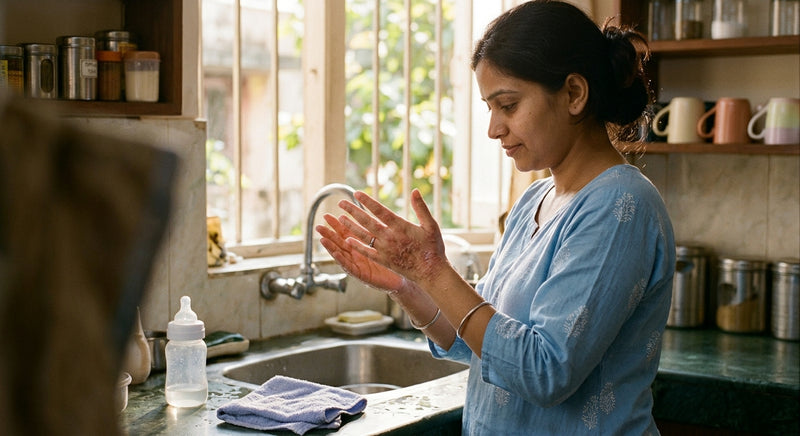
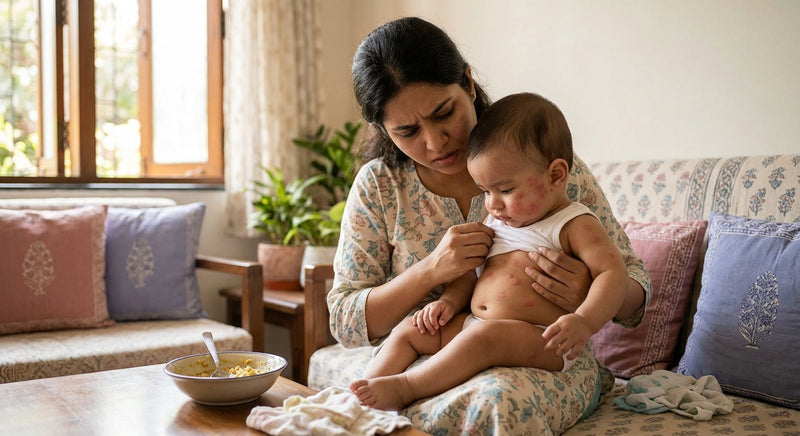
Diwali eve. Your daughter has just watched her cousin get a full palm done, there's a cone on the table from the stall by the sweet shop, and she wants hers now. Plain henna paste — ground Lawsonia inermis leaves, water, lemon, sugar — is generally fine on most children over about three, provided you patch test it 48 hours first. What is not fine, at any age, is the cone sold as "black mehndi" or "instant kaala". That one contains a hair-dye chemical called PPD, and it is the ingredient behind the serious henna reactions doctors warn about after festival season.
Which makes this a question about which cone, what age, and what you do before and after. Not mehndi, yes or no. It's also what parents write to us about most between Teej and Karwa Chauth — there's more on the whole festive stretch in our complete guide to festival and seasonal skin care for kids.
At a glance
- Natural henna stains orange, then brick-brown over a day or two. A cone that promises black in 20 minutes isn't henna alone.
- "Black henna" usually contains PPD (para-phenylenediamine) — a strong sensitiser that can blister, weep and leave a mark shaped exactly like the design.
- Patch test a coin-sized dot on the inner forearm 48 hours before the festival. Not an hour before.
- Skip mehndi on babies and under-3s, and on any skin that is broken, raw or mid-eczema-flare.
- Afterwards: scrape, don't scrub. Dry paste comes off with a spoon edge and a little oil — no lemon, no bleach, no steel scrubber.
Is mehndi actually safe on my child's skin?
Most of the time, yes — if it's real henna. Henna has been going on Indian hands for centuries, and plain paste sits on the surface; the lawsone molecule binds to the top layer of keratin and stains it. It doesn't need to be absorbed to work. That's part of why it has such a long track record.
Two things change that for a child.
Start with the skin itself. A child's skin is thinner and more permeable than yours — a baby's skin is 20–30% thinner than an adult's, and that gap hasn't fully closed in a four-year-old. Anything mixed into the paste gets a friendlier ride in. Barely matters for lawsone. Matters enormously for additives.
Then there are the additives. Market cones get "boosted" for a darker, faster stain — strong terpene-rich essential oils (eucalyptus, clove, cajeput), kerosene or petrol-smelling solvents, and in the worst cases PPD. I've opened cones in Nagpur that smelled like a salon. That smell is the tell. A plain henna cone smells of crushed leaves, tea and a little lemon: green, slightly sour, nothing sharp or chemical.
One more reason to be careful with the very young. Henna has been linked to a sudden drop in red blood cells in infants and toddlers who have G6PD deficiency, an inherited enzyme condition that isn't rare in parts of India. It's documented in medical case reports, and it is a key reason to keep henna off babies altogether. If G6PD deficiency runs in your family, ask your paediatrician before any henna goes on your child at all.
What is "black mehndi", and why do doctors keep warning about it?
Because the damage it does is shaped like the design, and it can last.
PPD is a black hair-dye intermediate. Stirred into henna paste, it gives a jet-black stain in under half an hour instead of a patient orange-to-brown over two days. At hair-dye strength, straight on skin, left on for hours, it is a well-recognised strong contact sensitiser. The reaction usually shows up one to three days later — so parents blame the wrong thing. The sweets. A new soap. The weather.
What it looks like: itching, then raised redness, then small blisters or weeping, all tracing the outline of the paisley or the vine. Once it settles it can leave a pale or dark mark in exactly that pattern — a "ghost tattoo" — that takes months to fade and occasionally doesn't fully go. And once a child is sensitised to PPD, that sensitivity can persist for years: black hair dye, some dark textile dyes, certain sunscreen and local-anaesthetic chemicals can set it off long afterwards. That's the part worth minding. A rash heals. A long-lasting sensitisation at age six is a different kind of cost.
| Tell | Plain henna | "Black" / boosted cone |
|---|---|---|
| Paste colour | Khaki-green to olive-brown | Near-black, sometimes glossy |
| Smell | Leaves, tea, lemon | Hair dye, petrol, solvent, or very strong eucalyptus |
| Stain at 30 min | Faint orange | Already dark |
| Final colour | Brick-brown by day two | Black immediately |
| Label | Ingredients listed, manufacturer and expiry printed | "Instant kaala", no ingredient list, no expiry |

How do I check a cone before Karwa Chauth or Eid?
Buy it a few days early. That one habit does most of the work here, because it leaves you room to patch test properly — and room to throw the cone away if something's off.
- Read the pack. You want a manufacturer name, an ingredient list and a date. A cone with nothing printed on it is a cone nobody is accountable for.
- Open and sniff. Green, leafy, slightly sour — good. Chemical, dye-like or fuel-like — bin it.
- Squeeze a drop onto white paper. Natural paste reads olive-brown. Black or blue-black paste is not henna alone.
- Patch test 48 hours out. A dot the size of a one-rupee coin on the inner forearm. Let it dry, scrape it off after two hours, then look at it at 30 minutes, 12 hours, 24 hours and 48 hours. Any itch, burning, bumps or blistering = that cone is done.
- Consider mixing your own. Good Rajasthani or Sojat henna powder, sieved, with strong brewed tea, a squeeze of lemon and a teaspoon of sugar. Rest it 6-8 hours, then cone it. You know exactly what's in it, and for sensitive-skinned kids it's what I'd pick.
- Choose placement, not just paste. Palms and the backs of hands only. Keep it off the face, away from eyes and lips, off the neck, and off any patch that's cracked, scratched raw or flaring.
If an artist is coming home for a wedding, ask them straight: what's in the cone, and is there any black henna in the kit. A good artist answers without flinching. If the answer wanders, your child uses the plain cone you bought.
What age is too young for mehndi?
My own line is no mehndi before three, and nothing on a baby or toddler at all. Not because plain henna is aggressive — because of what toddlers do. They suck their fingers. They rub their eyes. They will not sit still while a design dries, so paste travels to places you never intended. Put that next to thinner skin and the G6PD point above, and it isn't a close call. A one-year-old loses nothing by sitting out one Diwali.
From three to about six, keep it small — one motif on each palm, not full hands. After that, follow their skin rather than their age. A child with eczema-prone skin, or one who has reacted to a new product before, needs the patch test taken seriously every single time. Even with the same brand of cone that was fine last year.

How do I get mehndi off, and what should I do for the skin after?
You remove the paste, not the stain. The stain is in the top layer of skin and it leaves when that layer does, over one to three weeks. Trying to speed that up is exactly where skin gets damaged. It's the same mistake we see after an annual-day dance programme — hence our notes on cleaning pancake and kumkum off young skin gently and on taking stage makeup off a child safely.
- Let it dry fully — 2-6 hours is plenty for a child's design. Overnight wrapping is an adult-bride practice; a kid doesn't need it.
- Scrape, don't wash. Flake the dry paste off with the edge of a spoon or your thumbnail, over a newspaper.
- Rub in a little oil. Coconut or mustard oil lifts the last crumbs and deepens the colour. Keep water off for 6-12 hours if you can.
- Next day, wash gently. A mild, soap-free cleanser rather than a detergent bar — hard water plus a harsh bar after a festival day is what leaves hands tight and ashy. Our Kids Gentle Body Cleanser suits this job for a 3+ child.
- Moisturise while hands are still damp. Everybody skips this step. It's the one that keeps palms comfortable for the rest of the festive week.
No lemon-and-baking-soda. No bleaching powder, hot-water scrubbing or loofah to pull the colour out faster. All of it strips the barrier, and you trade a brown pattern for sore, stinging skin. Through a crowded festive stretch — mehndi one day, smoke and diyas the next — that barrier is already working hard, which is the subject of the post-Diwali week guide.
When to see a doctor
See your paediatrician — the same day, not after the festival — if you notice any of these:
- Blisters, weeping, oozing or crusting along the design
- Redness and swelling that spreads beyond the pattern, or swelling of the hand
- Burning or intense itch rather than mild tingling
- A raised, hard outline of the design
- Fever, unusual tiredness, very pale skin, or dark/tea-coloured urine after henna on a young child — this needs urgent attention
- A pale or dark patch shaped like the mehndi that is still there after a few weeks
Carry the cone or its wrapper with you. Knowing whether PPD was involved changes how your doctor manages it, and it tells you what your child may need to avoid for years. Nothing in a skincare routine, ours included, is a treatment for a chemical reaction — that's a doctor's call.
After a long day of paste, oil and washing, a thicker barrier cream on small hands at bedtime helps dry, sensitive skin feel settled. Our Hydra Healing Moisturizing Balm is what I keep by the bed through wedding season.
In summary
- Use plain henna only — olive-green paste that smells of leaves and lemon, never a cone promising instant black.
- Patch test a coin-sized dot on the inner forearm 48 hours before the festival and check it again at 12, 24 and 48 hours.
- Skip mehndi completely on babies and under-3s, and ask your paediatrician first if G6PD deficiency runs in your family.
- Scrape dried paste off with a spoon edge and a little oil — no lemon, bleach, hot water or loofah to chase the colour out.
- Blistering, weeping, spreading swelling, fever or dark urine after henna needs a paediatrician the same day; take the cone with you.
Frequently asked questions
Is natural henna safe for a 4-year-old?
Generally yes, if it is plain henna and you patch test it first. Put a coin-sized dot on the inner forearm 48 hours before the festival, scrape it off after two hours, and check it at 12, 24 and 48 hours. Keep the design small, palms only, and avoid any skin that is cracked or mid-flare. Skip henna entirely for babies and under-3s.
How do I know if a mehndi cone has PPD in it?
Three quick checks. Smell it — PPD cones smell of hair dye, solvent or fuel, not leaves and lemon. Squeeze a drop on white paper — natural paste is olive-brown, not black or blue-black. And read the pack for a manufacturer, ingredients and expiry. Any cone marketed as black henna or instant black should not go on a child's skin.
What does a black henna reaction look like, and when does it start?
It usually appears one to three days after application, not immediately. Expect itching first, then raised redness, small blisters or weeping, all following the outline of the design. Afterwards it can leave a pale or dark mark in that exact pattern for months. See a paediatrician the same day you spot blistering, and take the cone or wrapper with you.
Can mehndi be applied on a baby's hands for a naming ceremony?
We would not. Babies and toddlers put their hands in their mouths and rub their eyes, their skin is thinner and more permeable, and henna has been linked to a sudden drop in red blood cells in young children with G6PD deficiency. A tiny tilak of plain turmeric or a soft bangle marks the occasion without any of that risk.
How can I remove mehndi colour from my child's skin quickly?
You cannot safely rush it — the stain sits in the top layer of skin and fades over one to three weeks as that layer renews. Avoid lemon and baking soda, bleaching powder, hot-water scrubbing and loofahs; they strip the barrier and leave hands sore. Wash gently with a mild soap-free cleanser and moisturise while the skin is still damp.
Is it safe to put mehndi on a child's face or feet?
Keep it to palms and the backs of hands. Facial skin is thinner, and anything near the eyes or lips risks paste getting into the eye or being licked off. Feet are usually fine for older children, but socks and shoes smear fresh paste, so do them on a day your child is at home and barefoot.