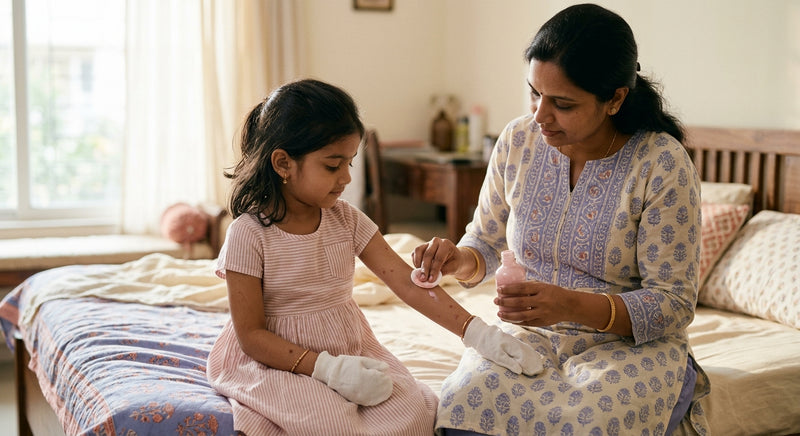
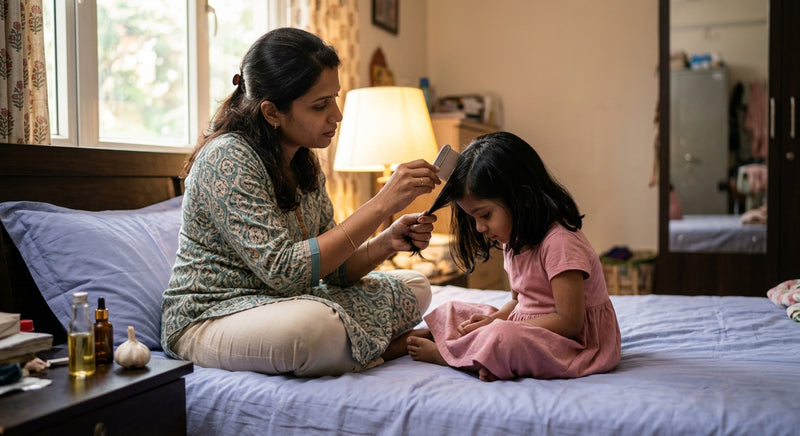
Thirty-odd weeks in. 11pm. A bar of oatmeal soap in one hand, and an itch across your belly that no amount of not-scratching will settle. Here's the short answer. For itchy, stretched pregnancy skin, a syndet bar (pH around 5.5-7) is almost always the better choice than a true saponified "oatmeal soap" (pH 9-10). Colloidal oatmeal is a useful ingredient. But in a rinse-off bar it gets maybe 40 seconds on your skin. The bar's job is to not make things worse. What you put on afterwards does the actual soothing.
At a glance
- Most bars sold here as "oatmeal soap" are real soap. Sodium palmitate, sodium stearate, pH 9-10. Healthy skin sits near pH 5.
- A syndet bar uses synthetic detergents instead of saponified fats, so it can be pH-adjusted down into skin's own range. Same shape on the shelf, different chemistry inside.
- Colloidal oatmeal helps soothe and helps hold water in the skin. It is not a scrub, and it is not the ground oats in your kitchen jar.
- Read where the oatmeal sits on the INCI list. Near the end, it's decoration. In the first half, someone made a formulation decision.
- Hard water changes the answer. Soap plus Indian hard water leaves a gritty film on skin. Syndet bars don't do that.
- Itchy palms and soles with no rash, worse at night, is a doctor call the same week. Not a bar-of-soap problem.
I formulate for a living, in our own GMP-certified facility in Nagpur, and no question comes up more often from our own team than this one. Pregnancy skin is not baby skin, and it isn't the skin you had last year. It's skin under mechanical stretch, losing more water, sometimes carrying a third-trimester itch that a clinician needs to look at, and running without half the actives you'd normally use. If you want the wider map first, we keep a complete guide to pregnancy-safe skincare in India that covers the leave-on side. This piece is only about the bar in your hand.
What does colloidal oatmeal actually do for itchy, stretched pregnancy skin?
Colloidal oatmeal is oat kernel milled very fine and suspended, not dissolved. That's the "colloidal" part. What it brings to a stretched belly:
The beta-glucan and starches hold water. They lay down a soft, slightly slippery film that slows water leaving the skin. On a belly that has gained surface area faster than the skin can keep up, that film is the difference between tight-and-itchy and simply dry.
Avenanthramides help calm the look of redness. These are oat's own polyphenols. In the published literature they're associated with reduced itch signalling and less visible redness. Let me put that plainly: they help soothe. They don't treat a skin condition, and a bar that says otherwise is overselling.
Oats also carry lipids and a little saponin, which is why oatmeal has cleaned skin in Indian homes for generations. The ubtan tradition is not wrong about oats. It's just that a fistful of dry-ground oats works as a physical scrub too, and scrubbing is the one thing stretched, itchy skin does not need.
Is "oatmeal soap" the same thing as a syndet bar?
No. They look identical on the shelf, they're often priced the same, and chemically they are different products.
A true soap is made by saponifying fats with alkali. On the label that reads sodium palmitate, sodium stearate, sodium cocoate, sodium palm kernelate. The reaction leaves the bar alkaline at pH 9-10, and no amount of formulating gets around it. Superfat it. Add glycerin. Add oats. Still alkaline. On contact it lifts your skin's surface pH, which loosens the lipid packing in the outer layer, and for the next few hours the skin loses water faster. That's the tight feeling after a bath. On a stretched third-trimester belly, tight reads as itchy inside the hour.
A syndet bar — synthetic detergent — uses mild surfactants instead. Look for sodium cocoyl isethionate, disodium laureth sulfosuccinate, sodium lauroyl sarcosinate, coco-glucoside, sodium methyl cocoyl taurate. Because no saponification is happening in the bar, the formulator can buffer it to pH 5.5-7. That is the entire point of the format.
| True "oatmeal soap" | Syndet bar with colloidal oatmeal | |
|---|---|---|
| Label tells | Sodium palmitate / stearate / cocoate; "saponified oils of…" | Sodium cocoyl isethionate, sulfosuccinates, glucosides |
| pH | 9-10, unavoidably | Can be adjusted to 5.5-7 |
| In hard water | Forms calcium/magnesium soap scum — a gritty film on skin and in folds | No scum; rinses clean |
| After-feel on stretched skin | Squeaky, tight, itch often returns within an hour | Slippery-soft, less tightness |
| Oatmeal's contribution | Mostly marketing at the pH it sits at | Meaningful if dosed properly and high in the list |
| Honest use case | Underarms, feet, oily backs — not a stretching belly | Daily whole-body wash through pregnancy |
Now the India-specific bit: water. Across most of Delhi, Jaipur, Hyderabad, Chennai and large parts of Maharashtra, what comes out of the tap is hard. Calcium and magnesium react with true soap to form insoluble metal soaps. Scum. It settles under the breasts, in the groin crease, along the underbust band where the skin is already damp and rubbing. Parents ask us about this constantly for their babies. The chemistry is identical for you. We've written about what to keep, swap or pause in an Indian pregnancy routine in more detail, and the bar swap is one of the cheapest, highest-return changes on that list.
How do I pick one in India? What should the label actually say?
Ignore the front of the pack. "Oatmeal", "gentle", "dermatologically tested" — a marketing team wrote all of that, including mine. Turn it over.
- Find the surfactant first. If the first ingredient is a sodium-something-ate (palmitate, stearate, cocoate), it's true soap. Put it back if your belly is itching.
- Check for a stated pH. Indian labels aren't required to print it. So when a brand does, it's usually because the number is good. "pH 5.5" on a bar is a real signal.
- Read where the oatmeal sits. INCI lists run in descending order down to 1%. Avena sativa (colloidal oat) in the first half of a short list is a formulation choice. Last, after the fragrance and the preservative, it's a sprinkle for the label.
- Know which oat you're getting. "Colloidal oatmeal" (whole milled kernel) is the soothing, film-forming one. "Avena sativa kernel oil" is an emollient lipid. "Oat extract" tells you nothing about what's in there or how much. Three different ingredients.
- Fragrance: skip it for now. By month seven, pregnancy nausea and a sharpened sense of smell can make a scented bar unbearable, and fragrance is the most common contact irritant in a wash product. Unscented is the easier call.
- Essential-oil "natural fragrance" is still fragrance. Some of them — clary sage, rosemary, jasmine — are ones obstetricians routinely ask pregnant women to avoid. Unscented removes the question entirely.
- Look for a licence number and a manufacturing address on the back. A bar made by a contract manufacturer with no named site behind it tells you nothing about batch-to-batch consistency, and consistency is what you need for the next four months.
What routine actually stops the 2am itch?
The honest hierarchy, from the person who has to decide where the money goes in a formula: the leave-on moisturiser does most of the work, the bar much less, and the water temperature does more than people expect. Start tonight.
- Drop the water temperature. Warm, not hot. If your skin goes pink, it was too hot. Hot water strips the outer lipid layer and the rebound itch peaks about an hour later, right as you're trying to sleep.
- Keep the bath to 8-10 minutes, bucket or shower. Long soaks in hard water don't hydrate. They swell the skin, then leave it drier.
- Use the bar only where you're actually dirty: underarms, groin, feet, under the breasts. Water alone is enough for your belly, arms and back most days. This one change helps more than switching brands.
- No towel-rubbing. Press the towel on, lift it off. Leave the skin slightly damp.
- Moisturise within three minutes, while damp. This is the step that matters. A thicker balm over the belly, hips and outer thighs. A lighter lotion elsewhere if a balm feels heavy in humid weather.
- Second application at bedtime, belly only. Reapplying at night is what breaks the 2am wake-up, more reliably than anything you can add to a wash.
- Cotton, loose, one size up. A synthetic waistband sitting on a stretched, itchy belly undoes the rest of it.
For the leave-on step, look for humectants (glycerin) plus real occlusives — butters, a well-built lipid blend — rather than a thin lotion that vanishes in ten seconds and leaves nothing behind. We go through how to judge that in our piece on choosing a pregnancy moisturiser for an itchy, stretching belly. The face behaves differently in pregnancy, so that has its own piece: how to choose a pregnancy-safe face moisturiser in India. Our own Hydra Healing Moisturizing Balm was built for exactly this brief: barrier-first, unfragranced, and in a lab study it increased Keratin-10 and Filaggrin expression, which is the technical way of saying it helps support the skin barrier.
When to see a doctor
Some pregnancy itch you can manage at home. Some of it needs a clinician, and it's worth knowing which is which before 2am.
Call your obstetrician the same week if: the itch is on your palms and soles, is worse at night, and there is no visible rash (this pattern needs a liver-function and bile-acid check, and it is time-sensitive in the third trimester); your urine turns dark or your stools go pale; you notice yellowing of the eyes; itchy hives or papules spread rapidly from stretch marks across the belly; the skin is broken, weeping, crusted or yellow from scratching; or the itch is keeping you awake despite doing everything above. Also go if you've had a fever alongside it. None of this is something a bar of soap fixes, and no moisturiser should delay the call.
If you want a gentle, unfragranced balm to layer over damp skin tonight, our Hydra Healing Moisturizing Balm is the one I'd reach for on a stretched, itchy belly.
In summary
- Choose a syndet bar at pH 5.5-7 over a true saponified "oatmeal soap" at pH 9-10 for itchy, stretched pregnancy skin.
- Check the first two ingredients: a sodium-something-ate means real soap; cocoyl isethionate or a sulfosuccinate means syndet.
- Colloidal oatmeal helps soothe and hold water, but only if it sits in the first half of the ingredient list — and never as a kitchen-oat scrub.
- Use the bar only where you're actually dirty, keep baths warm and under ten minutes, then moisturise within three minutes on damp skin.
- Itchy palms and soles at night with no rash needs an obstetrician the same week — that is not a soap problem.
Frequently asked questions
Is oatmeal soap safe during pregnancy?
Using it is not a safety risk in itself. The issue is comfort: most bars sold as oatmeal soap are true saponified soap at pH 9-10, which leaves stretched pregnancy skin tighter and itchier afterwards. A pH-balanced syndet bar with colloidal oatmeal suits an itchy belly far better. Either way, the moisturiser you apply within three minutes of the bath matters more than the bar.
How do I tell a syndet bar from a soap bar on an Indian label?
Read the first two or three ingredients. Sodium palmitate, sodium stearate, sodium cocoate or the phrase "saponified oils of" means it is true soap and will sit at pH 9-10. Sodium cocoyl isethionate, disodium laureth sulfosuccinate, sodium lauroyl sarcosinate or coco-glucoside means it is a syndet and can be pH-adjusted to skin's own range.
Can I just use ground oats from my kitchen instead?
Not as a scrub. Kitchen oats are coarse enough to abrade skin that is already under stretch, and they leave residue in skin folds. The safe traditional version is a soak: tie a handful of oats in muslin, squeeze it into warm bath water, and sit in it without rubbing. Colloidal oatmeal in a formulated product is milled far finer and stays dispersed.
Does colloidal oatmeal help with stretch marks?
It helps soothe the itch and dryness that come with stretching skin, which is a real comfort win. It does not prevent or remove stretch marks, and no rinse-off bar stays on skin long enough to influence how a stretch mark forms. Treat oatmeal as itch comfort and barrier support, not as a stretch-mark product.
Why does my bathroom soap leave a gritty film on my skin?
Hard water. Calcium and magnesium in the tap water react with true soap to form insoluble metal soaps, better known as scum. It settles in damp, rubbing areas such as under the breasts and in the groin crease. Syndet bars do not form scum, so switching the bar usually fixes it without any extra step in your routine.
Is unscented really better, or is that just marketing?
For pregnancy, genuinely better. Fragrance is the most common contact irritant in wash products, a heightened sense of smell makes scented bars unpleasant by the third trimester, and several essential oils used as "natural fragrance" are ones obstetricians routinely ask pregnant women to avoid. Unscented removes all three problems at once.