A mother in Gurgaon wrote to us the first week of December. The blower runs all night in the children's room. By morning her four-year-old's cheeks are chapped scarlet and the backs of his hands have fine splits that sting at the washbasin. Her question was blunt: is the heater doing this?
Partly. Though not the way most parents picture it. A room heater does not suck water out of the air. It heats the air, and warm air holds far more water vapour than cold air, so the same moisture in the room becomes a much lower relative humidity. That thirsty air pulls water off your child's skin faster than the skin can replace it. The heater is the trigger. The cracking is a barrier problem, and a barrier problem you can usually improve at home with a consistent daily routine.
At a glance
- Heaters don't remove water from a room — they raise the temperature, which drops relative humidity and speeds up water loss from skin.
- A fan/blower heater pointed at a child chaps skin fastest. Moving hot air is the real culprit, not the heat itself.
- Moisturise within three minutes of a bath, while the skin is still slightly damp. Timing matters more than the price of the cream.
- A humectant on its own in dry indoor air can backfire. It needs an occlusive layer over it to hold the water in.
- Deep cracks that bleed, ooze, crust yellow or hurt enough to stop your child using their hands need a paediatrician, not a stronger cream.
This piece sits inside our complete guide to dry skin and the skin barrier in kids. It's the seasonal chapter — written for Delhi, Lucknow, Jaipur, Chandigarh and every north Indian house where the heater goes on in November and stays on till February.
The belief: "the heater is drying the air"
Half true. And the wrong half is the half that decides what you do about it.
Absolute humidity — the actual grams of water floating around your room — barely moves when you switch a heater on. What changes is how much water that air could hold. Take it from 10°C to 24°C and its capacity roughly doubles. Nothing has left the room. The air has simply got greedier. A north Indian winter afternoon starts out dry; heat it indoors and you have desert-grade air sitting against your child's face for fourteen hours a night.
Skin behaves like any wet surface. Water moves out through the stratum corneum continuously — transepidermal water loss, in the dermatologist's phrase — and the drier the air above it, the steeper that gradient gets. Cold does its own damage. It stiffens the lipids between skin cells and slows sebum output, so the mortar holding the brickwork together turns brittle exactly when it is under the most stress. Then add the school run: cold wind on the cheek at the gate, warm dry air at home twenty minutes later, four switches a day.
Does the type of heater matter?
It does. Every heater lowers relative humidity, but they don't all go after the skin the same way.
| Heater type | What it does to the room | What that means for your child's skin |
|---|---|---|
| Fan / blower heater | Fast, noisy, pushes hot air across the room | Hardest on skin. Moving air strips surface water far faster than still air at the same temperature. Never aim it at a cot or a sleeping child. |
| Halogen / quartz rod | Radiant heat — warms bodies, not really the room | Skin sitting close to a glowing rod gets intense localised drying, plus a real burn risk for a toddler who walks into it. Keep it well out of reach. |
| Oil-filled radiator | Slow, even, no fan and no exposed element | Gentlest of the electric options. It still lowers relative humidity, but there's no jet of hot air on the face. |
| Convection / PTC heater | Warms the whole room, usually with a small fan | In between. Fine if it's across the room and the child isn't in the airstream. |
Myth: "a bucket of water in the room fixes it"
Half right, and useful enough that I won't wave it away. An open vessel of water does evaporate into a heated room, and it does nudge humidity up. But evaporation off a still bowl is slow. A wide, shallow steel parat beats a narrow bucket, because of the surface area. Two damp towels over a chair near the heater — near, not on — beat both.
The real fix is a proper humidifier, or the low-tech version most homes already run: dry the day's washing indoors in the heated room instead of out on the terrace. In a lot of north Indian houses that one habit does more for a child's cheeks in January than any change of cream.
One caution. Push humidity too high in a closed, damp room and you invite mould and dust mites, both of which irritate eczema-prone skin. Comfortable, not tropical. If the windowpanes are streaming every morning, you've overshot.
Myth: "more moisturiser means more relief"
Quantity helps. In dry air the type helps more.
Three mechanisms are doing the work. Humectants (glycerin, sodium PCA, honey-derived sugars) attract water. Emollients (light oils, esters, butters) slot into the gaps between skin cells and make skin feel smooth. Occlusives (waxes, heavier butters, petrolatum-type ingredients) sit on top and physically slow water escaping. There's a longer piece on how cleansers can quietly undo all of this, because a harsh morning wash cancels a good night cream.
In genuinely dry air, a humectant-heavy lotion with nothing sealing it can pull water upward out of the deeper layers of skin and hand it to the room. Glycerin doesn't care where the water comes from. That is why a thin, watery lotion on a wind-burnt cheek in a heated Delhi bedroom feels lovely for ten minutes and leaves the skin tighter than it started. It needs an occlusive over the top, or it needs to be richer to begin with.
So: light lotion for arms, legs and the everyday post-bath layer. A thicker balm — built around butters, waxes and barrier lipids — for whatever is actually cracking. Cheeks. Knuckles. The backs of the hands. Shins. The outer thigh where the wool rubs. Look for ceramides or barrier lipids on the label, and skip anything with denatured alcohol high in the list, or a heavy fragrance load, on skin that's already broken. Our Hydrating & Soothing Moisturizing Lotion is the daily all-over layer here. The balm is what you save for the cracks.
What to do tonight for cracked cheeks and hands
- Cut the bath to five minutes and drop the water temperature — warm on your elbow, not steaming. Hot water in winter feels wonderful and strips lipids fast.
- Use a soap-free, pH-appropriate cleanser only where the child is actually dirty. Plain warm water is enough on arms and legs most nights.
- Pat dry, don't rub. Leave the skin slightly damp.
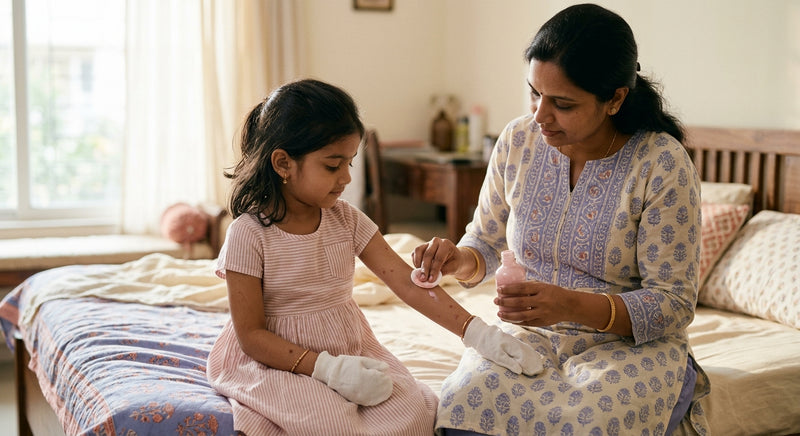
- Within three minutes, apply the moisturiser — downward, in the direction of hair growth, not scrubbed in circles.
- Go over the cracked spots a second time with a thicker balm. Cheeks, knuckles, shins.
- Reapply to the hands after every wash. This is the most-skipped step of the lot, and the reason knuckle cracks never close.
- Put a cotton layer between wool and skin. Wool straight onto a chapped forearm keeps the itch cycle running all night.
- Move the heater's airflow away from the bed, and shut it off once the room is warm.
Myth: "the lips are chapped because of a vitamin deficiency"
Deficiencies do sometimes show on skin, and that is your paediatrician's call to make. But in a heated north Indian bedroom the usual story is mechanical. The lips dry. The child licks them. Saliva evaporates and takes more water with it. The skin around the mouth reddens into a ring, and round it goes again, with the digestive enzymes in saliva adding insult. What ends it is a thick, bland balm applied often enough that licking stops being tempting. Not a supplement.
Same for the pale, dry patches that turn up on cheeks and upper arms every winter. Parents ask us about calcium and worms constantly. We've laid out why those two explanations are almost always wrong, and there's a separate guide to telling the different kinds of white patch apart if that's what you're looking at.
When to see a doctor
Most heated-room dryness settles within a week of a proper routine. See your paediatrician or a dermatologist if the cracks bleed or weep, if there's yellow crusting or spreading warmth and swelling (possible infection), if your child is losing sleep to the itching, if the skin has gone thickened and leathery in the creases of the elbows and knees, or if two weeks of consistent moisturising has changed nothing. Broken skin on a child is worth a real examination.
The short version
Your heater isn't the villain. Winter air, a warm room and a thin, still-developing barrier — that's the villain, and the heater tips the balance. Turn the airflow away from the bed. Lift the room's humidity a little. Shorten the bath. Put the right texture on the right body part at the right moment.
For the cracked spots, what you want is a rich, low-fragrance balm with barrier lipids that stays put on a chapped cheek rather than sinking in and vanishing. Our Hydra Healing Moisturizing Balm is the one we make for that job — it comforts dry, sensitive skin, and it is clinically tested, with lab work showing it helps support the skin's natural barrier through increased Keratin-10 and Filaggrin expression.
In summary
- Heaters don't remove water from a room — they raise the temperature, which drops relative humidity and speeds water loss from skin.
- Keep blower and rod heaters aimed away from your child, and switch them off once the room is warm.
- Raise indoor humidity the easy way: dry washed clothes indoors, or run a humidifier at a moderate setting.
- Moisturise within three minutes of a five-minute warm bath, and reapply to hands after every wash.
- See a paediatrician if cracks bleed, weep, crust yellow, or fail to improve after two weeks of consistent care.
Frequently asked questions
Do room heaters really dry out a child's skin?
Indirectly, yes. A heater doesn't remove water from the room — it raises the air temperature, and warm air holds much more moisture, so relative humidity falls sharply. That drier air pulls water out of your child's skin faster than the skin can replace it. Blower heaters make it worse because moving air strips surface water even faster than still warm air does.
Which type of room heater is best for sensitive or eczema-prone skin?
An oil-filled radiator is usually the gentlest choice. It has no fan and no exposed glowing element, so there's no jet of hot air hitting the face and no burn risk from a curious toddler. It still lowers relative humidity like any heater, so you'll still need a humidifier or damp laundry in the room and a proper moisturising routine alongside it.
Does keeping a bowl of water near the heater actually help?
A little. Water does evaporate into heated air, but a narrow bucket has too small a surface area to matter much. A wide, shallow steel parat helps more, and damp towels hung near the heater help more still. The most effective low-cost fix in a north Indian home is drying the day's washed clothes indoors in the heated room.
How often should I moisturise my child in winter?
Twice a day as a baseline — once within three minutes of the bath while the skin is still slightly damp, and once before bed. Hands need more: reapply after every wash, because that's why knuckle cracks never close. Use a lighter lotion all over and a thicker balm only on the cracking spots like cheeks, knuckles and shins.
Can I use a humidifier in my child's room all night?
Yes, at a moderate setting. Aim for comfortable, not tropical — if you wake to condensation streaming down the windows, it's too high, and that dampness encourages mould and dust mites, which irritate eczema-prone skin. Clean the tank regularly with plain water, refill it daily, and keep the unit away from where your child can pull it over.
Should I stop bathing my child daily in winter?
You don't need to stop, but shorten it. Five minutes in warm — not hot — water, with a soap-free cleanser used only where the child is actually dirty, and plain water elsewhere. The bath itself isn't the problem; long, hot baths and harsh cleansers are, because they strip the skin's own lipids exactly when winter air is already pulling water out.