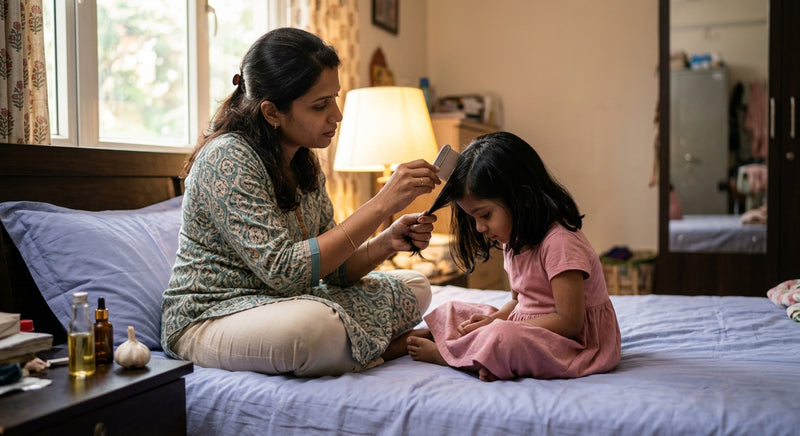
Your mother-in-law spots it across the lunch table — a pale, dry patch on your five-year-old's cheek — and the diagnosis arrives before the dal does. Pet mein keede hain. Worms. Your neighbour is equally certain it's calcium. By evening there's a deworming syrup and a chalky calcium tonic on the kitchen shelf, and the patch is exactly where it was.
Worms and calcium deficiency are rarely what's behind a dry white patch on an Indian child's cheek. One common and harmless explanation doctors describe is pityriasis alba — patches of mildly irritated, dry skin where pigment delivery has temporarily slowed down. Only a doctor who examines your child can confirm what the patch actually is, but where dryness is the driver, steady moisturising and sun protection usually help it settle over time. A tonic won't.
At a glance
- Worms don't cause white patches on skin. The link is folklore, not physiology.
- Calcium deficiency shows up in bones and blood work — not as pale patches on the cheeks.
- The usual culprit is dry, mildly inflamed skin that has temporarily slowed its pigment transfer.
- Scaly skin also scatters light, so a dry patch looks whiter than it actually is.
- Moisturise twice daily and use sunscreen — the contrast fades as the skin evens out, over weeks, not days.
- A milky-white patch with a sharp border and no dryness is different. That one needs a doctor, not a cream.
If dry skin runs through your child's whole year — rough arms in winter, ashy legs after every bath, patches that come and go — read our complete guide to kids' dry skin and the skin barrier alongside this one. White patches are usually one symptom of that same dryness.
Why does everyone say white patches mean worms?
The belief is old, it is everywhere, and I've stopped trying to win the argument in a single sitting. I think it survives because two ordinary things overlap in time. Intestinal worms are common in Indian children. So are dry, pale patches on the face. Both peak somewhere between toddlerhood and early school, so parents see them together and assume one causes the other.
There's no mechanism, though. Worms live in the gut. Melanin — the pigment that gives skin its colour — is made in the basal layer of the epidermis by melanocytes, then handed over to the surrounding skin cells. Nothing about a helminth in the intestine reaches up and switches off that handover in a coin-sized patch on one cheek.
Deworming is its own thing, and a legitimate one. India runs a national deworming programme, and your paediatrician will tell you what's appropriate for your child's age and area. Just don't expect it to move the patch. Parents deworm, nothing changes, and they decide the medicine was fake. It wasn't. It was aimed at a different problem.
Does calcium deficiency cause white patches on skin?
No. I hear this one even more than worms, usually with the syrup already bought.
Calcium deficiency in children shows up in the skeleton and in blood tests. A paediatrician looks at how the bones are growing and at specific lab values. It does not present as pale, scaly patches on the face and arms. And extra calcium a child doesn't need isn't harmless either — so this belongs with your doctor, not at the chemist's counter.
Nutrition does matter, but in a wider way. A child who eats poorly across the board can have skin that's drier and more reactive. Still a paediatrician conversation. Still not a bottle off a shelf.
So what is actually happening in that patch?
Two things, at the same time.
First, pigment transfer slows down. Melanocytes package melanin into little parcels called melanosomes and pass them to keratinocytes, the cells that make up the visible skin surface. When a patch of skin has been mildly inflamed — a bit of eczema, a healed rash, weeks of dryness and scratching — that handover becomes inefficient. The cells rising to the surface carry less pigment than their neighbours, and the patch turns paler. It's temporary. It's also slow to undo, because those cells have to be replaced from below.
Second — and parents almost never hear this part — dry skin looks whiter than it is. A well-hydrated stratum corneum is smooth, and light passes through it fairly evenly. Let it dry out and corneocytes lift at the edges, turning the surface into a field of tiny irregular flakes. Light hits them and scatters instead of transmitting. It's the same optical trick behind ashy, greyish legs after a bath: the skin hasn't changed colour, it's changed texture.
Which is why a good moisturiser makes the patch look better within minutes. It isn't restoring pigment that fast. It's filling those gaps and smoothing the surface so light stops scattering. The real evening-out of colour takes far longer. Hold on to that difference — otherwise the day the quick improvement plateaus, you'll think the cream has stopped working and switch to something else.
Myths vs what's actually true
| What you'll be told | What's actually true |
|---|---|
| "It's worms — deworm the child." | No mechanism connects gut worms to patchy facial pigment. Follow your paediatrician's deworming advice for its own reasons. |
| "It's calcium deficiency." | Calcium status is assessed by a doctor, in bones and blood — not by looking at cheeks. Don't self-supplement. |
| "Scrub the patch off with ubtan or a loofah." | Scrubbing damages an already-compromised barrier and usually makes the patch drier, rougher and more visible. |
| "Use a brightening or fairness cream to even it out." | Backwards. Those products are designed to reduce pigment transfer — the exact process that's already sluggish here. |
| "Apply lemon or toothpaste on it." | Acidic and irritant on thin child skin. It adds inflammation, which is what caused the pale patch in the first place. |
| "Nothing helps, it's permanent." | Dry, scaly pale patches typically even out over weeks to months with consistent moisturising and sun protection. |
But is it definitely pityriasis alba?
Not always, and no blog post can settle that for you. What I can give you is how the common patterns look and feel under your fingers:
- Dry, faintly scaly, fuzzy edges, mostly cheeks and upper arms, more obvious after summer — the classic dry-patch pattern.
- Fine powdery scale on chest, back, neck or shoulders, often in humid or sweaty months — this pattern can be fungal, which only a doctor can confirm, and it needs their assessment, because the treatment is specific and no moisturiser substitutes for it.
- Milky-white, sharply outlined, completely smooth with no dryness or scale — a distinct condition that must be assessed by a paediatrician or dermatologist. Don't experiment with home remedies here.
We've written a longer side-by-side on this — how to tell which white patch your child has. If you finish it still unsure, book the appointment.
What actually helps, starting tonight
- Cut the bath to 5–7 minutes with lukewarm water. Hot water and long soaks strip the lipids that hold moisture in.
- Swap any soap bar for a mild, pH-appropriate cleanser. Hard borewell water plus an alkaline soap is a common reason patches keep coming back — more on that in our piece on whether your child's body wash is causing their dry skin.
- Pat dry, don't rub. Leave the skin slightly damp.
- Moisturise within 3 minutes of the bath, while that water is still in the skin. This single habit does more than any ingredient choice.
- Repeat once more before bed, on the face and arms specifically.
- Sunscreen on exposed skin before school or outdoor play.
- Stop all scrubbing, ubtan on the patch, and any brightening product.
What to look for in the moisturiser
Three jobs, one product. A humectant pulls water in — glycerin is the workhorse, and it belongs high in the ingredient list, not tucked in at the end. Emollients fill the gaps between those lifted corneocytes and smooth the surface, which is what kills the light-scattering greyness. An occlusive layer — shea, kokum, or a well-balanced oil blend — then slows water loss for the next few hours.
After that, look for ingredients that support the barrier rather than just sit on top of it: ceramides and fatty acids, colloidal oatmeal for its soothing avenanthramides. A formula built around those, used consistently, is what a patch like this actually needs.
Skip strong fragrance, essential-oil-heavy blends, alcohol high in the list, and anything sold on brightening actives. And plain coconut oil, since it always comes up: it's occlusive, not a moisturiser. It seals in water that's already there. Over damp skin straight after a bath, fine as a layer. Rubbed onto dry skin at 4pm, it's doing very little.
Why sunscreen matters more than any tonic here
This one surprises parents. The patch isn't getting whiter — the skin around it is getting darker. Normal skin tans in Indian sun. The affected patch, with its slowed pigment delivery, can't keep up. The contrast widens, and by April the patch that was barely visible in December is the one everybody comments on.
So sunscreen isn't cosmetic here. It stops the gap widening while the skin quietly repairs underneath. A mineral formula sits on the surface and suits reactive, dry skin well — a kids' mineral sunscreen at SPF 40 PA++++ on face, ears and arms before the school van covers the realistic exposure. Reapply at lunch if your child is outdoors for sports.
How long before it fades?
Texture improves in days. Once you're moisturising properly, the skin stops looking flaky and grey almost immediately. Colour takes weeks to months, because pigmented cells have to work their way up from the base of the epidermis. Most parents abandon the routine around week three — which is exactly when it's starting to work.
Keep going through one full season. Expect a flare again next summer if the underlying dryness isn't managed. If you want it laid out step by step, we've mapped it in our 3-step daily routine for dry white patches in the Janma Journal.
When to see a doctor
Book a paediatrician or dermatologist if the patch is milky-white with a sharp, clearly defined edge and no dryness; if patches are spreading quickly or appearing in new places; if there's fine powdery scale over the chest, back or shoulders; if there's loss of sensation, numbness or thickened skin; if the patch is itchy, weeping, crusting or clearly infected; or if a child under two develops white patches. Also go if six to eight weeks of consistent moisturising and sun protection has changed nothing at all. A five-minute look in person settles what no article can.
For the everyday dryness sitting under most of these patches, our Hydrating & Soothing Moisturizing Lotion is formulated to comfort dry, sensitive kids' skin and help support its natural barrier — in a lab study, our formulation showed increased Keratin-10 and Filaggrin expression, markers of skin barrier support. Twice a day, every day. That's the whole trick.
In summary
- Worms and calcium deficiency do not cause white patches on skin — the usual cause is dry, mildly irritated skin with temporarily slowed pigment transfer.
- Dry skin also scatters light, so a flaky patch looks whiter than it truly is; moisturising smooths that optical effect within minutes.
- Stop scrubbing, ubtan, lemon and any brightening or fairness product on the patch — they all point the wrong way.
- Moisturise within 3 minutes of a short lukewarm bath and again at bedtime, and use sunscreen daily so the surrounding skin doesn't tan away from the patch.
- Expect texture to improve in days and colour to even out over weeks to months; see a doctor for sharply defined milky-white patches, rapid spread, or no change after six to eight weeks.
Frequently asked questions
Do white patches on my child's face mean worms?
No. There is no physiological link between intestinal worms and pale patches on skin. Worms live in the gut; pigment is made and transferred in the top layers of skin. The two things are common in the same age group, which is probably why the belief persists. Follow your paediatrician's deworming advice for its own reasons, but don't expect it to change the patch.
Can calcium deficiency cause white spots on skin?
No. Calcium deficiency in children is assessed through bone development and blood tests by a doctor, not by looking at the face. It does not present as dry, pale patches. Giving a child calcium supplements they don't need can cause its own problems, so if you're genuinely worried about nutrition, take it to your paediatrician rather than the chemist.
Why do the patches look worse in summer?
The patch isn't getting whiter — the skin around it is getting darker. Unaffected skin tans in strong Indian sun while the affected patch, where pigment delivery has slowed, doesn't keep up. The contrast widens. Daily sunscreen on the face, ears and arms is the single most effective way to stop that gap from growing while the skin repairs.
Will scrubbing or ubtan remove the white patch?
No, and it usually makes things worse. These patches sit on skin whose barrier is already compromised, and physical scrubbing lifts more of the surface layer, increasing dryness, roughness and the light-scattering that makes the patch look whiter. Stop all scrubs, loofahs and abrasive ubtan on the area, and switch to a gentle cleanser plus regular moisturising instead.
How long do dry white patches take to fade?
Texture improves within days of consistent moisturising — the skin stops looking flaky and grey. Colour takes far longer, typically weeks to months, because pigmented cells have to travel up from the base of the epidermis. Most parents stop the routine around week three, just as it begins working. Give it a full season before judging results.
When should I take my child to a doctor about a white patch?
See a paediatrician or dermatologist if the patch is milky-white with a sharp border and no scaling, if patches are spreading quickly, if there's fine powdery scale across the chest or back, if there's numbness or thickened skin, if it's weeping or crusting, if your child is under two, or if six to eight weeks of proper moisturising and sun protection has changed nothing.