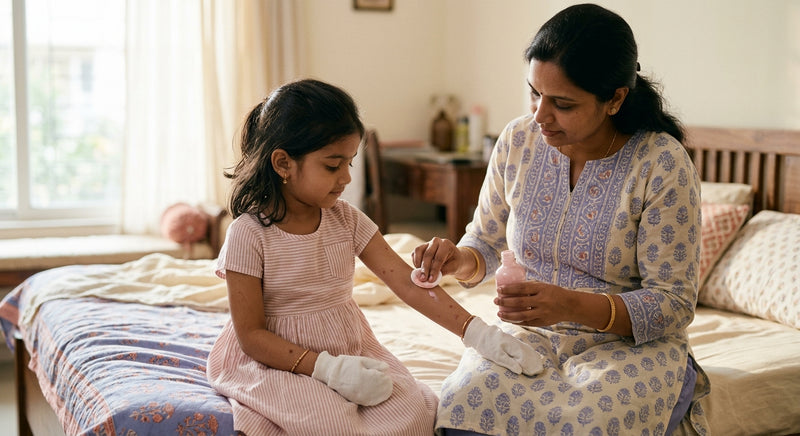
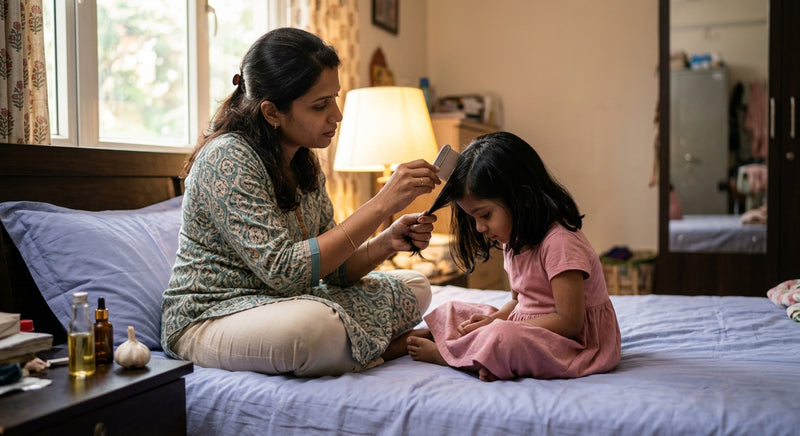
You get home from the temple at half past nine. Your seven-year-old is asleep in the back seat with a bare head, a smear of sandal paste drying above one ear, and a thin pink line where the barber's blade caught a bump of skin. The question keeping you awake is a small, practical one: what goes on that head tonight?
Almost nothing. Rinse with plain lukewarm water, pat dry with a clean cotton cloth, and leave it alone. From tomorrow morning the routine is three things on repeat: a gentle wash, a light moisturiser, and sun protection on skin that has never once seen the sun. Stubble shows properly at around two to three weeks. It looks uneven for a month or so. And nothing you put on it changes how thick the hair comes back.
A tonsure at five or eight is a different job from a baby's mundan, which is why it gets its own piece inside our complete guide to kids' hair and styling damage. An older child goes to school, plays outside at noon, and sweats through games period. And scratches. That last one is what parents underestimate.
At a glance
- First 48 hours: water, a clean cotton cloth, nothing else. No oil, no haldi, no chandan paste, nothing scented.
- A razor removes part of the skin's outer layer along with the hair, so for two days that head is freshly abraded skin.
- Sun is the biggest change. The crown takes the heaviest overhead UV dose of any part of the body, and there is no hair left to shade it.
- Patchy regrowth at three weeks is normal. Follicles run on independent clocks, not damaged ones.
- Mundan does not change follicle count, hair colour or hair thickness. It changes the cut end, which is a different thing.
What a razor actually does to the scalp
A blade doesn't only cut hair. Dragged across skin, it takes off part of the stratum corneum, the outermost layer of flattened cells that holds water in and keeps irritants out. With that layer thinned, the skin holds on to water less well for a few days. In your bathroom it is a head that feels tight, stings under a shampoo it never minded before, and goes pink at the first whiff of fragrance.
Which is the whole reason for the 48-hour rule. For two days you are not looking after a scalp. You are looking after a shallow abrasion that happens to be on a head.
Age changes the maths a little. A baby's skin is 20-30% thinner than an adult's, so a newborn mundan is delicate work. By five or eight your child's skin is much closer to adult skin. Sturdier, certainly. But shaved far closer at a temple than any home clipper manages, and back in full sun and sweat the very next day.
The first 48 hours: the short list
- Rinse with plain lukewarm water only. No shampoo, no soap, no cleanser on the first night.
- Pat dry with a clean, soft cotton cloth. No rubbing, and not with the family towel.
- Leave nicks uncovered and dry. If one is still oozing, clean water and light pressure; cover it only if your doctor says to.
- Skip oil, haldi, chandan paste, ubtan and any cooling balm for two full days. Turmeric stains a raw patch, and camphor or menthol stings badly on broken skin.
- Nothing scented near it: no talc, no perfumed powder, no fragranced wipes.
- Fresh cotton pillowcase that night.
- Cut the nails short. Honestly, the most useful five minutes of the whole week.
Why an older child's mundan is a different job from a baby's
| Baby mundan (under 2) | Temple tonsure at 4+ | |
|---|---|---|
| Where the scalp spends the day | Indoors, in your arms, mostly shaded | School ground, cycle, cricket at noon |
| Sun | Low and controllable | Daily and overhead — the crown takes the heaviest dose |
| Sweat | A little, in a pram or sling | Games period, a school cap, a helmet strap |
| Scratching | Mittens solve it | They will scratch, with dirtier nails |
| How they feel about it | No opinion at all | Often self-conscious in class |
| Wash | Water and a mild baby wash | A proper mild shampoo every second day |
The routine for the next three months
From day three, this is the whole thing. Four minutes a day.
- Wash every second day with a mild, low-fragrance kids' shampoo. A blob the size of a ten-rupee coin is plenty on a bare head.
- Lukewarm water, never hot. Rinse until the skin stops feeling slippery under your palm.
- Pat dry, then a pea-sized amount of a light lotion worked in with finger pads, not nails.
- Sunscreen over the whole scalp every school morning: crown, hairline, tops of both ears, back of the neck.
- A cotton cap or wide hat for anything outdoors between 10am and 4pm, and a reapply every two hours on a sports day.
- Oil massage twice a week, but only once every nick has closed. Warm, light, five minutes.
- Once a week, look at the scalp under good light: new bumps, yellow crusting, or a patch that stays bald.
Which shampoo suits a freshly shaved scalp?
For the first month you are washing skin, not hair. That changes what matters. Sixty seconds of contact time on bare skin is a much harsher test of a formula than the same shampoo run through a plait.
So turn the bottle over and read the surfactants. Mild blends built on coco-glucoside, decyl glucoside, cocamidopropyl betaine or sodium cocoyl isethionate clean perfectly well without stripping, and they sting far less on skin that has lost a bit of its barrier. A high-foam sulphate sitting first on the list will feel dramatic on a bare head. Keep the fragrance load low, leave anything heavy on essential oils for later, and pick a formula held around pH 5. That is the skin's own range, and the range at which the barrier repairs most comfortably.
Oil after mundan: the tradition, done at the right time
Oiling a freshly tonsured head is old practice and I have no argument with it. My argument is with the timing. Oil on an open nick traps debris against a wound and gives bacteria somewhere comfortable to sit. Wait until every cut has sealed, usually two to four days, then start.
Use a light oil. Coconut for most, sesame if your family follows the warming tradition, sweet almond if the skin runs dry. Warm it in your palms rather than on the stove. Five minutes with the pads of the fingers, small circles, no nails, no vigorous rubbing over stubble.
Where it usually goes wrong is overnight. In a Nagpur May, oil plus sweat plus a cotton cap for eight hours on a bare scalp is asking for blocked, angry follicles. Through the hot and humid months, oil in the evening and wash it out the same night. In a dry north-Indian winter, overnight is fine.
Sun on a scalp that has never seen it
This is the part I would not bend on. The top of the head sits perpendicular to the midday sun, so it collects more UV than almost anywhere else on the body, and until last week it had a full head of hair doing the shading. Scalp sunburn on a child is painful, peels for days, and makes every wash afterwards miserable.
A hat is your first line. Sunscreen is your second, not your only one. Mineral filters are the easy choice on newly shaved skin: zinc oxide sits on the surface rather than absorbing in, so there is less sting and fewer surprises. Use roughly what you would use on a face and neck, a generous blob you can see going on. Then go over the ears and the nape, which everyone forgets. Our Daily Defender Kids Mineral Sunscreen SPF 40 PA++++ is a non-nano zinc formula built for exactly this kind of daily Indian sun exposure.
Why the regrowth looks patchy at three weeks
Around week three, a lot of parents are quietly panicking. One side is coming in thick, the crown looks sparse, and there is a suspiciously smooth patch behind one ear.
Follicles don't share a clock. At any moment most are actively growing and a meaningful share are resting, and a resting follicle has nothing to push out. Shaving doesn't reset any of that. It removes the evidence, and lets you see for the first time how staggered the cycle always was. The growing ones surface first, the resting ones follow over the next few weeks, and by month three the head looks even again. Average growth is about a centimetre a month, so plan on roughly three months to a short crop and six or more for anything you can tie.
The other thing you will hear at every family gathering is that the new hair is thicker and darker. It does look that way. A blunt-cut shaft has a flat tip instead of a tapered one, so it feels coarser, and short stubble stands upright instead of lying flat, which reads as denser. That is optics. Follicle number is set before birth, and no amount of cutting adds one. We've made the same point about a different family myth in the Janma Journal, in whether tight braiding really makes hair grow longer.
Razor bumps as the stubble comes through
Small red bumps around the follicles, usually somewhere in week one to three, are common. More so with curly or coarse hair, because a tightly curled tip can curve back and re-enter the skin as it emerges. They itch more than they hurt.
Don't scrub them, don't pick them, and don't shave the head close again to "even it out" — that repeats the exact trigger. Gentle wash, light moisturiser, a loose cotton cap instead of a tight synthetic one, short nails. Most settle on their own once the hair is long enough to clear the skin.
When the hair is long enough to tie again
Somewhere around month four to six there is enough to gather, and this is where three good months of care can quietly undo itself. Short regrowth is slippery, so the instinct is to pull it tighter to make it hold. That is steady tension on a hairline that has only just rebuilt itself. Wide-tooth comb. Loose, low styles for the first few months. Nothing with a metal join on fine new hair. We've written about what that tension costs over time in the hidden cost of tight school braids, and about which ties are actually kind to kids' hair in rubber bands, clips or scrunchies.
Through the regrowth months, what you want from a cleanser is unexciting: mild, low-fragrance, and a wash that never stings. Our Loving & Balancing Shampoo is formulated mild and tear-free, which is what a freshly shaved scalp needs at wash time.
When to see a doctor
Call your paediatrician if you see redness spreading outward from a cut, warmth, swelling, pus or yellow crusting; if your child has fever along with a sore scalp; if a nick keeps bleeding or gapes open; or if the bumps are spreading, weeping or genuinely painful rather than itchy. Ask about tetanus cover if the blade was not a fresh one. And if a smooth patch is still completely bald at three months while everything around it has grown, have it looked at rather than waiting it out. None of this is common. Most tonsures heal without a single event. But a scalp is easy to check, and worth checking.
In summary
- For the first 48 hours use plain lukewarm water only — no oil, haldi, chandan paste or anything scented on freshly shaved skin.
- Sunscreen and a hat on the bare scalp every day is the non-negotiable part, because the crown takes the heaviest overhead sun and has lost its shade.
- Start oil massage only after every nick has sealed, and wash it out the same evening through hot, humid months.
- Expect patchy regrowth at three weeks and an even crop by about three months — follicles run on independent cycles, so that unevenness is normal.
- When the hair is long enough to tie again at four to six months, keep styles loose: short regrowth tempts tighter pulling on a hairline that has only just rebuilt.
Frequently asked questions
Can we apply oil right after mundan?
Wait until every nick has sealed, usually two to four days. Oil on an open cut traps debris against broken skin. After that, a light warm oil massaged in with finger pads twice a week is fine. In hot or humid weather, wash it out the same evening rather than leaving it overnight under a cap, because oil plus sweat plus occlusion tends to irritate follicles.
How long does hair take to grow back after a temple tonsure?
Stubble is visible at around two to three weeks and scalp hair grows roughly a centimetre a month. Expect an uneven look for the first four to six weeks, an even short crop by about three months, and six months or more before there is enough length to tie comfortably. Growth rate varies between children and is not something a product changes.
Does mundan make a child's hair thicker or darker?
No. The number of hair follicles is set before birth and cutting does not add any. New hair only looks thicker because a cut shaft has a blunt, flat tip instead of a fine tapered one, and short stubble stands upright instead of lying flat. Both make it feel coarser and look denser. The follicle underneath is unchanged.
Does a shaved head really need sunscreen?
Yes, and it is the single most important addition to the routine. The crown sits directly under the overhead sun and has just lost the hair that was shading it. Use a hat as the first defence and sunscreen as the second, covering the crown, hairline, tops of the ears and the nape. Reapply every two hours outdoors, especially on games days.
My child's regrowth is patchy after a month. Is something wrong?
Almost certainly not. Hair follicles cycle independently, so at any moment some are growing and some are resting, and a resting follicle has nothing to push out. Shaving simply makes that staggering visible. Things usually even out by month three. If one smooth patch is still completely bald at three months while the rest has grown in, have a doctor look at it.
Can my child go to school and play the next day?
Yes, with three conditions: a cotton cap or hat for outdoor time, sunscreen on the whole scalp before leaving, and short nails so scratching does not break the skin. Skip swimming pools for a few days if there are open nicks, since chlorinated water stings raw skin and the cuts are better off dry and closed first.