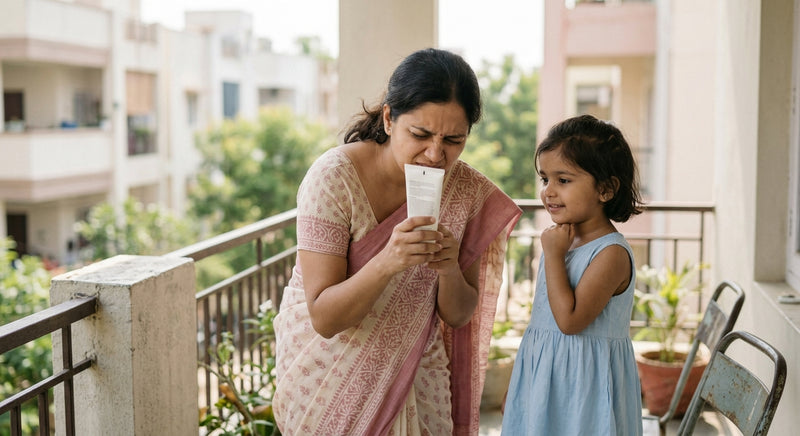
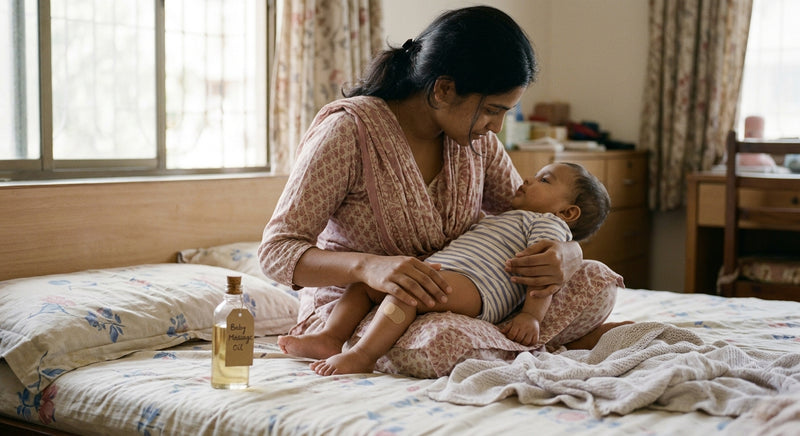
A mother sent us a photo last month from a chemist’s shop in Nagpur. Phone torch held against the back of a baby lotion, forty ingredient names in 5-point type, one line underneath: “which of these is the coconut oil?”
Short answer: Cocos nucifera. Indian baby labels are printed in INCI names, the international naming system — mostly Latin for plants, chemistry for everything else. Almond oil is Prunus amygdalus dulcis. Nobody reads all forty names, and nobody should. Read the first five. Find the preservative. Find the fragrance line. Check the age on the front. That is a minute of your life, and this glossary is the vocabulary you need for it.
At a glance
- Ingredients run in descending order down to 1%. Below 1% they can sit in any order, which is why the last third of a list tells you far less than the first five lines.
- Latin binomials (Cocos nucifera, Aloe barbadensis) are plants. A chemical-sounding name is not automatically the worse one: water is Aqua, vitamin E is Tocopherol.
- A preservative is doing a job. What should worry you is a water-containing product with none.
- “Fragrance / Parfum” is one word standing in for a whole blend. For a newborn, or for eczema-prone skin, it is the first line I skip.
- Match the age band on the front before you read a single word on the back.
How to read a baby label in 60 seconds
I do this in the same order every time. A competitor’s pack in a chemist’s aisle, a friend’s bathroom shelf, doesn’t matter — same order. Work top-down and stop the moment something disqualifies it. The age gate comes first, always, which is why it opens our complete guide to buying baby products by age too.
- Front of pack, age first. Newborn, baby, kids 3+, or mother. A well-made kids’ cleanser is still the wrong product for a two-week-old.
- Turn it over and read the first five ingredients. That is the formula. Water, a humectant like glycerin, one or two emollients, an emulsifier. If the first five are all oils and butters, you are holding a balm — heavy, occlusive, right for winter and dry patches, wrong as an all-over summer lotion.
- Find the preservative. Phenoxyethanol, sodium benzoate, potassium sorbate, benzyl alcohol. Named on the pack is what you want. Missing from a water-based product is a warning, whatever the marketing says about it.
- Find the fragrance line. “Parfum” or “Fragrance”, usually near the end. Newborn or eczema-prone child? Take the version without.
- Check the surfactant if it’s a wash. Glucosides (decyl, lauryl, coco) and sulfosuccinates sit at the gentle end. Sodium lauryl sulfate sits at the harsh end. Sodium laureth sulfate is milder than SLS, and still not what I would use daily on a newborn.
- Read the claim words sceptically. “Mild”, “gentle” and “tear-free” carry specific and surprisingly loose meanings under Indian rules. “Chemical-free” and “100% natural” are misleading under Cosmetics Rules 2020. A brand that prints them is telling you about its marketing department.
- Check the manufacturer line and the batch details. Manufactured by, licence number, batch, manufacturing date, best-before. A brand that makes its own product tends to say so. A marketer-only address means somebody else formulated it.
The A to Z: what those names actually mean
These are the names you meet on Indian baby shelves. Ayurvedic actives, kitchen oils wearing their Latin names, and the workhorse cosmetic ingredients doing the quiet structural jobs nobody markets.
A – C
- Aloe barbadensis — aloe vera. Watery, cooling, mildly soothing. Fine on baby skin. It will not moisturise on its own.
- Aqua — water. Usually first, and usually the largest single part of a lotion.
- Behentrimonium methosulfate — a conditioning agent in detanglers. The name scares people. It is not a sulfate detergent.
- Butyrospermum parkii — shea butter. Rich occlusive. Superb in a December balm, far too heavy for a humid Chennai August.
- Cera alba — beeswax. Structure and occlusion in balms.
- Cetearyl alcohol — a fatty alcohol. Waxy and softening, nothing like the drying alcohol you are picturing. No name on any label causes more unnecessary panic than this one.
- Ceramide NP — a lipid that mirrors the skin’s own barrier lipids.
- Citric acid — pH adjuster. Tiny amounts, there to keep the formula mildly acidic like skin.
- Cocos nucifera — coconut oil. Familiar, well tolerated by most Indian babies, mildly occlusive.
- Colloidal oatmeal — finely milled oats. One of the better-evidenced soothing ingredients for itchy, dry skin.
- Curcuma longa — haldi. Traditionally used in an ubtan. It also stains everything, and in raw kitchen form it can irritate.
D – G
- Decyl glucoside / Lauryl glucoside / Coco-glucoside — sugar-derived cleansers. Gentle, low-foaming, the backbone of most good baby washes.
- Dimethicone — a silicone. Sits on the surface, slows water loss, doesn’t irritate. Safe, though not the texture everyone likes.
- Ethylhexylglycerin — usually a preservative booster, sometimes a mild skin conditioner.
- Glycerin — the humectant. Pulls water into the upper layers of skin. In the first four ingredients of a moisturiser, that is a good sign.
- Glyceryl stearate — emulsifier. Keeps oil and water from separating.
- Ghee (clarified butter / Butyrospermum-adjacent fats) — in formulated products this turns up as a purified butter fraction. In its home form it belongs to massage, not to open or weeping skin.
H – M
- Helianthus annuus — sunflower oil. High in linoleic acid. A good, light, barrier-friendly oil for babies.
- Isopropyl myristate — a light texture agent. Can clog pores on acne-prone older skin; less relevant for infants.
- Garcinia indica — kokum butter. Firm, non-greasy, used widely in Indian formulations.
- Olea europaea — olive oil. High in oleic acid, which can loosen the barrier in very young babies. I use it sparingly and rarely on newborns.
- Prunus amygdalus dulcis — sweet almond oil. The classic malish oil. Light, absorbs well.
- Rubia cordifolia — manjishtha. A traditional Ayurvedic skin herb, used at low percentages.
- Matricaria recutita — chamomile. A calming botanical extract, and a known allergen for a small number of children. Patch test it.
- Mineral oil / Paraffinum liquidum — cosmetic-grade purified petroleum fraction. Inert, highly occlusive, one of the safest occlusives available. Reputation worse than reality.
N – S
- Azadirachta indica — neem. A long-standing botanical in Indian skincare tradition. Strong-smelling, and best in low, formulated concentrations.
- Non-nano zinc oxide — mineral UV filter. The particles are too large to penetrate skin. This is the filter I’d choose for a child’s sunscreen.
- Panthenol — pro-vitamin B5. Humectant and skin-conditioning, and useful on dry, chapped areas.
- Phenoxyethanol — the most common baby-safe preservative, used at up to 1%.
- Parfum / Fragrance — a blend, and the law lets it hide behind one word. Skip it for newborns.
- Petrolatum — petroleum jelly. Nothing in the category is more occlusive. Excellent as a nappy-area shield, unpleasant as an all-over lotion.
- Santalum album — chandan, sandalwood. Cooling in tradition; in cosmetics it is usually the oil at a fraction of a percent.
- Sodium benzoate / Potassium sorbate — mild preservatives, often paired, active in acidic formulas.
- Sodium lauryl sulfate (SLS) — a strong detergent. Not what I would put on a baby daily.
- Sodium laureth sulfate (SLES) — the milder cousin. Better. Still not my first choice for newborn skin.
T – Z
- Tocopherol / Tocopheryl acetate — vitamin E. An antioxidant that protects the oils in the formula as much as it protects the skin.
- Ocimum sanctum — tulsi. A traditional Indian botanical, used at low percentages.
- Urea — a humectant at low percentages, keratolytic at high ones. Low percentages only for children, and I’d take a paediatrician’s view first.
- Vetiveria zizanioides — khus. Cooling aromatic, used in summer formulations.
- Xanthan gum — natural thickener from fermented sugar. Gives a lotion its body.
- Glycyrrhiza glabra — yashtimadhu, licorice root. A soothing botanical. Do not read it as a lightening claim, because that claim has no business on a child’s product at all.
- Zinc oxide — barrier protectant in nappy creams, mineral UV filter in sunscreens. One ingredient, two jobs.
Kitchen name vs the name printed on the pack
This is the table I wish someone had handed my own mother. It is the fastest way to find out whether the oil you trust is actually in the bottle.
| What you call it at home | What it says on the label | What it does in the formula |
|---|---|---|
| Nariyal tel (coconut oil) | Cocos nucifera oil | Emollient, mildly occlusive |
| Badam ka tel (almond oil) | Prunus amygdalus dulcis oil | Light massage emollient |
| Haldi (turmeric) | Curcuma longa extract | Traditional soothing botanical |
| Neem | Azadirachta indica extract | Traditional botanical extract |
| Chandan (sandalwood) | Santalum album oil | Aromatic, cooling |
| Mulethi (licorice) | Glycyrrhiza glabra root extract | Soothing botanical |
| Manjishtha | Rubia cordifolia root extract | Traditional skin herb |
| Oats | Avena sativa / colloidal oatmeal | Soothing, film-forming |
| Water | Aqua | The solvent base, usually the largest part of the formula |
Three things I’d argue with most glossaries about
The preservative is the safety system. Picture where the jar actually lives — a warm bathroom shelf, monsoon damp in the cupboard, wet fingers going in twice a day. Unpreserved, it grows things. Give me phenoxyethanol at 0.8% over a jar of “pure” butter in week three.
A long ingredient list is not a good one. Some of the longest I have read are fifteen botanicals at homeopathic doses, all of them sitting above the preservative. Decorative. Fewer ingredients at meaningful percentages usually performs better, and that assumption gets picked apart properly in our piece on the baby skincare myths Indian parents still believe.
Foam is not cleaning. Parents read foam as cleaning power. Formulators read it as a decision about the surfactant system. A glucoside-based wash foams less and strips less, and ours is built that way on purpose — the Head to Toe Baby Foam Wash uses a gentle glucoside system rather than a high-foam sulfate base, and it’s made in our own GMP-certified facility, which is why I can tell you exactly what’s in it.
Reading the list is half the job. How much to use is the other half. We have set out realistic quantities by age, because most parents under-apply moisturiser and over-apply cleanser.
When to see a doctor
Book a paediatrician if your baby’s skin reacts to a product with spreading redness, swelling, blistering, weeping or crusting. Go too if a rash is painful, has yellow crusts, or comes with fever; if dryness or itching keeps your child awake despite gentle care; or if you suspect a true ingredient allergy and want it identified properly. A glossary helps you choose a product. It cannot diagnose anything, and skin that is worsening rather than settling deserves an in-person look.
If, after all that reading, what your child actually needs is a simple barrier-supporting moisturiser for dry patches and winter skin, our Hydra Healing Moisturizing Balm is the one I’d hand you.
In summary
- Read the first five ingredients, the preservative and the fragrance line — that covers most of the decision in under a minute.
- Latin names are just plants: Cocos nucifera is coconut oil, Prunus amygdalus dulcis is almond oil.
- A named preservative in a water-based product is a safety feature, not a compromise.
- Choose glucoside-based washes over sulfate-based ones for daily baby use, and ignore how much foam appears.
- Match the product to your child's age band before you read anything on the back, and patch test anything new for 24 hours.
Frequently asked questions
Why are baby product ingredients written in Latin?
Labels use INCI, the international naming convention, so the same ingredient reads identically in Mumbai, Manchester and Munich. Plants get their botanical binomial — coconut oil becomes Cocos nucifera oil — and other materials get their chemical name. It looks intimidating, but it removes ambiguity. Once you learn about ten Latin names, most Indian baby labels become readable in seconds.
Are chemical-sounding ingredients worse for a baby?
No. Water is listed as Aqua and vitamin E as Tocopherol, so the name tells you nothing about safety. Cetearyl alcohol is a softening wax, not a drying alcohol. What matters is the actual ingredient, its concentration and whether it suits your child's age and skin. Judge the specific material, not how scientific the word sounds.
Should I avoid all preservatives in baby skincare?
No, and avoiding them can be riskier. Any product containing water can grow bacteria, yeast and mould, especially in a humid Indian bathroom with wet hands dipping into the jar. Named, well-studied preservatives such as phenoxyethanol, sodium benzoate and potassium sorbate keep the formula safe through months of use. An unpreserved water-based cream is the thing I would genuinely worry about.
What order are ingredients listed in on an Indian baby product?
By descending weight, down to 1% of the formula. Below that threshold, ingredients may be listed in any order, which is why a botanical near the end of a long list may be present in a very small amount. Concentrate on the first five lines — they represent most of what is in the bottle — then check the preservative and fragrance.
Is fragrance always a problem in baby products?
Not always, but it is the first line I would skip for a newborn or a child with eczema-prone skin. Parfum is a blend declared as one word, so you cannot see what is inside it, and fragrance components are among the more common contact allergens. For older children with settled skin and no reaction history, a lightly fragranced product is usually fine.
How do I know if the brand actually made the product?
Read the bottom of the pack. A manufacturing address with a licence number means the product is made at that site; a marketer-only address means someone else formulated and produced it. Neither is illegal, but owning the facility means the brand controls the formula, the raw materials and the batch records. We make Janma in our own GMP-certified facility in Nagpur for that reason.