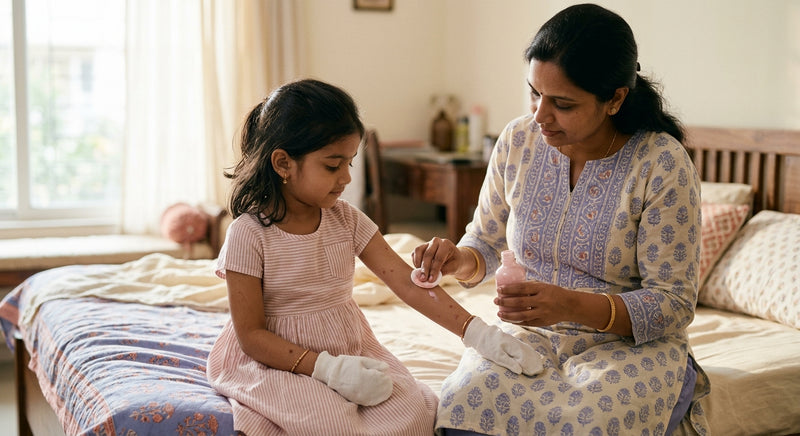
Your nine-year-old comes home from games period, takes a quick bucket bath, and twenty minutes later there are white scratch lines running down her shins. Three bottles on the bathroom shelf. One says baby, one says junior, one is yours. Which one goes on those legs?
"Junior" is a marketing tier, not a regulated skin category - no Indian rule defines what a junior lotion must contain, so the word on the front tells you nothing by itself. The physiology underneath it is real, though. Between roughly 3 and 12, a child's skin makes very little of its own oil - less than it did in the first weeks of life, and far less than yours does now. That one fact explains most of the confusion on that shelf: why a well-made baby lotion usually works beautifully on a seven-year-old, and why your adult lotion usually doesn't.
At a glance
- No Indian rule defines a "junior" lotion. Judge the ingredient list, not the age printed on the front.
- From about 3 to 8, children's sebaceous glands are at their quietest. Low oil output is the defining feature of the 3-12 barrier.
- A baby lotion is chemically fine for a child of 3-12. It may simply be too light for scrubbed, chlorinated, sporty shins.
- The adult bottle is the real mismatch - fragrance load, urea, AHAs and retinoids belong to a different skin.
- Texture decides everything. A lotion that absorbs in half a minute gets used twice a day. A heavy cream a child hates gets used never.
What actually changes between a baby's skin, a junior's and an adult's?
Three different problems share one word: dry. The long version is in our complete guide to kids' dry skin and the skin barrier. The part that decides which bottle you reach for is short.
0-3 years: still under construction
A newborn's barrier is genuinely immature. The outer layer is thinner - a baby's skin is 20-30% thinner than an adult's - the corneocytes are smaller, water moves out through it faster, and the surface acidity takes weeks to settle. There is also a short sebum surge in the first months, borrowed from maternal hormones, and it fades. So babies dry out fast and respond fast, and whatever you put on goes in more readily. That argues for short ingredient lists and low fragrance. Not heroic formulas.
3-12 years: the quiet years for oil
By two or three, the structure has largely caught up. Thickness, cell turnover, acidity - broadly adult-shaped. The sebaceous gland has not. Those glands stay switched off until adrenarche, which for most Indian children begins somewhere around 8-10 (earlier in girls), and only then do they start producing meaningfully again. So for about five years your child walks around with a structurally decent barrier and almost no natural oil film on top of it.
Parents find this harder to accept than almost anything else we explain. Your child is not dry because something is wrong. Your child is dry because the years between the baby sebum surge and puberty are the least oily years of a human life - and we then load them with hot bucket baths, hard water, soap bars, chlorinated pool sessions, PE-period sweat, and a room heater in December. Any one of those is survivable. Together, at low sebum, they leave the shins ashy and the outer arms rough.
Adults: a different problem entirely
You have sebum, a thicker stratum corneum, and years of accumulated sun exposure. Adult body lotions are formulated against that: brisker fragrance so it smells like something, often a keratolytic like urea at 5-10% or lactic acid to shift rough texture, sometimes niacinamide or retinol. None of those are villains. They are solving a problem your child doesn't have, on skin that behaves differently.
So is "junior" a real category or a shelf label?
Both, depending on the brand. Some junior products are a genuine reformulation - lighter emollient system, faster break, a fragrance dialled down or removed, a cleanser pH kept near skin's own. Others are the baby formula in a brighter bottle with a cartoon and a higher price. Flip both bottles over in the aisle and read the two ingredient lists side by side. Ten seconds is enough. If they are identical, you are paying for the graphics.
| What differs | Baby (0-3) | Junior (3-12) | Adult |
|---|---|---|---|
| Own oil (sebum) | Brief surge, then low | Lowest of any life stage | Steady, often plentiful |
| Barrier structure | Still maturing | Largely mature | Mature, sun-aged |
| Usual dryness pattern | Cheeks, folds, whole-body flakiness | Shins, outer arms, knees, heels, cheeks | Shins, back, hands |
| What the formula must do | Replace lipids gently, low irritation load | Replace the missing oil film, hold water, survive a bath and a school day | Hydrate plus resurface / treat |
| Reasonable to avoid | Heavy fragrance, essential-oil blends, actives | Urea above ~5%, AHAs, retinoids, strong fragrance, menthol or camphor | Little restriction |
| Texture that gets used | Anything - the parent applies it | Fast-absorbing, non-sticky (the child has opinions) | Whatever you like |
So the gap between baby and junior is mostly one of weight and sensory feel, not safety. The gap between junior and adult is a real formulation gap, and it runs the wrong way for a child.
What we'd actually look for on the back of the bottle
Every body lotion is an oil-in-water emulsion, and the arithmetic of it explains why some lotions seem to "stop working" in December. A typical lotion is roughly 70-85% water with an oil phase somewhere around 8-15%. A cream carries more. A balm is largely anhydrous - butters and waxes, little or no water. So 10 ml of lotion may deliver only about a gram of actual lipid to the skin, while the same weight of balm delivers nearly all of it. Neither is better. They are different doses of the same idea, and a low-sebum child in a dry Nagpur January often needs the bigger dose on the shins even when a lotion is perfect everywhere else.
- Glycerin in the first five ingredients. It's the workhorse humectant - cheap, well studied, and it pulls water into the outer layer.
- A real lipid you can name - almond oil, avocado oil, ghee, shea or kokum butter. Something has to seal in the water the glycerin drew up.
- Oat (colloidal oatmeal or oat kernel extract) if the skin gets itchy. It comforts a scratchy, reactive surface without any drug-like claim attached.
- Fragrance-free, or a single light one low in the list. Fragrance is the most common avoidable irritant in this whole category.
- Skip for this age: urea above 5%, salicylic acid, glycolic or lactic acid, retinol, denatured alcohol high up the list, camphor and menthol.
- Judge the feel in the shop. Rub a smear on the back of your hand. If it's still tacky after a minute, your child will fight you every night.
What we'd actually do
Almost every child we hear about lands in one of three situations.
1. Ordinary dryness - ashy shins, tight skin after a bath
One good lotion, twice a day, applied within three minutes of towelling off while the skin is still slightly damp. You don't need a bottle that says junior to do this. If there's a decent baby lotion already at home and your child doesn't object to it, finish it - it isn't wrong for a six-year-old, just built for lighter duty. And before you buy anything, check the cleanser. A harsh bar or a foaming body wash is very often the actual cause, which we've written about in is your child's body wash causing their dry skin.
2. Rough patches, cracked heels, a heater-dry December
Lotion everywhere, balm on the stubborn zones. Heels, knees, elbows, the outer upper arms. This is the dose argument above - those sites need more lipid than a water-heavy lotion carries. A richer moisturising balm is worth keeping for exactly these spots, and it suits every age in the house. If you run a room heater at night, read our piece on room heaters and kids' cracked winter skin first - the machine is usually doing more damage than the weather.
3. Pale, dry patches on the cheeks or arms
Very common in Indian children, very often mistaken for a worm infestation or a calcium problem, and usually neither. We've covered the real causes in white patches on kids and given the daily routine we'd follow. The moisturiser choice barely changes here; consistency and daily sunscreen do the lifting.
Across all three, the ingredient family matters more than the age band. In our own lab work, a formulation that supports the barrier showed increased Keratin-10 and Filaggrin expression - the proteins the skin itself uses to build and hold that outer layer. That's the mechanism you want, at 3 or at 12.
A five-minute routine to start tonight
- Bath water warm, not hot. Hot water strips the little lipid there is, and an Indian bathroom in winter tempts everyone to run it too hot.
- Cap the bath at about ten minutes. No bar soap on dry limbs - a gentle cleanser only where the day actually went: underarms, feet, groin.
- Pat dry. Don't rub. Leave the skin slightly damp.
- Lotion within three minutes, head to toe, roughly two teaspoons for a 5-8 year old and more for an older child. Shins first, because that's where it's needed most and where enthusiasm runs out.
- Balm on heels and knees if they're rough or cracked. Socks over the heels.
- Repeat in the morning in winter. One application a day is a summer routine.
When to see a doctor
Book a paediatrician or dermatologist if the dryness is cracking, weeping, bleeding or crusting; if patches are spreading, intensely itchy or waking your child at night; if there's swelling, warmth, pus or fever; if a rash appears suddenly after a new product; or if two weeks of consistent gentle cleansing and twice-daily moisturising changes nothing. Dry skin that doesn't respond to a good routine is a signal to get it looked at, not to buy a stronger cream.
If you'd like one bottle that fits the 3-12 barrier as it actually is, judge it by the checklist above rather than by the age band on the label: glycerin high in the list, a lipid you can name, no urea or acids, and a texture light enough that your child will let you use it every single day.
In summary
- "Junior" is a shelf tier, not a regulated category - judge the ingredient list, not the age on the front.
- Children aged roughly 3-8 make the least sebum of any life stage, which is why their shins go ashy while their barrier is otherwise mature.
- A good baby lotion is chemically fine for a 7-year-old; an adult lotion with urea, AHAs, retinol or heavy fragrance is the real mismatch.
- Look for glycerin high in the list, a named lipid like almond oil, ghee or shea, oat for itch, and little to no fragrance.
- Apply lotion within three minutes of the bath, twice daily in winter, and keep a balm for heels, knees and cracked patches.
Frequently asked questions
Is a "junior" lotion different from a baby lotion?
Sometimes, sometimes not. There is no legal definition of a junior lotion in India, so the word alone guarantees nothing. Some junior formulas are genuinely lighter or less fragranced; others are the baby formula in a different bottle. Flip both bottles and compare the ingredient lists. If they read the same, you are paying for the packaging, not the formulation.
Can my 8-year-old just use my body lotion?
Usually not ideal. Adult body lotions are often built around fragrance and active ingredients like urea, lactic or glycolic acid, or retinol, aimed at thicker, oilier, sun-aged skin. A child's skin has very little sebum of its own and no need for those actives. An occasional use won't hurt, but as a daily lotion it's the wrong tool.
Why is my child's skin drier than my baby's was?
Because children between about 3 and 8 make the least sebum of any age. The sebaceous glands stay quiet until puberty begins, so there is almost no natural oil film on top of the barrier. Add hot baths, hard water, soap, chlorine and sport, and the shins and outer arms dry out faster than a baby's ever did.
Lotion or balm for a 3-12 year old?
Both, in different places. A lotion is mostly water with a small oil phase, so it spreads easily and suits the whole body twice a day. A balm carries far more lipid and belongs on heels, knees, elbows and any cracked patch, especially in winter. Using a balm head to toe usually ends with a child who refuses to be moisturised.
How much lotion does a school-going child actually need?
Roughly two teaspoons head to toe for a 5-8 year old, and more for an older or taller child. Apply within about three minutes of towelling off, while the skin is still slightly damp, so the emulsion seals in the water rather than sitting on dry skin. Twice daily through a dry winter, once daily in summer.
Does a low-sebum child still need sunscreen?
Yes, and it matters more than the lotion choice for pale dry patches. Sun exposure makes those patches more visible and keeps rough texture going. Use a mineral sunscreen on exposed skin on school days and reapply before outdoor play or sports. Moisturiser and sunscreen do different jobs; neither replaces the other.