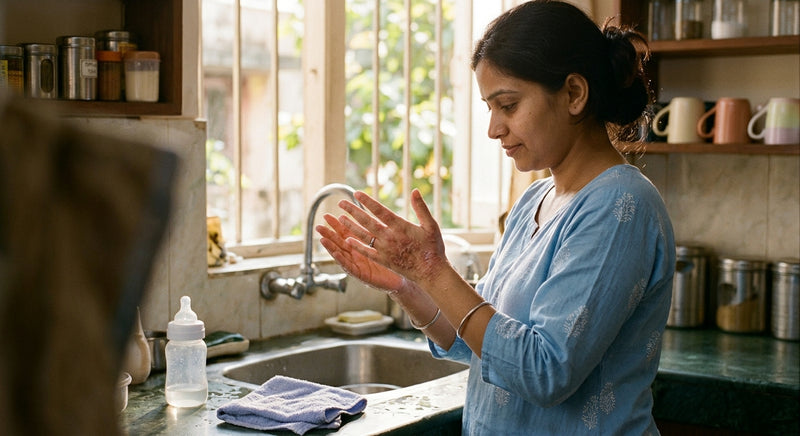
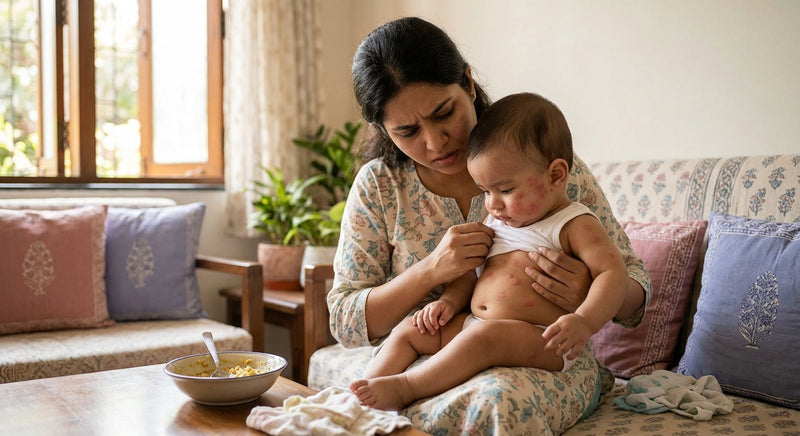
The kurta came out of the packet at six. She wore it for the puja. By the time the diyas were lit there was a red band across the back of her neck and two cross patches where the waistband sat. Nothing else had changed that day. No new cream, no new soap. Just the clothes.
A rash that turns up a few hours after a new outfit is almost always one of three things: chemical finishing still sitting in the fabric, dye that hasn't fully washed out, or plain friction from a stiff tag and a raw overlocked seam. Wash anything new twice before the first wear. Cut the tag out at the stitch line instead of snipping the loop. Skip the fabric softener. That covers most of the photos parents send me.
At a glance
- New fabric arrives carrying finishing chemicals — crease-resist resins, sizing starch, loose surface dye. None of it is declared on the label.
- Wash new clothes twice before the first wear, separately from the family load, with two rinses in hard water.
- Read the pattern. A line across the nape is the tag. Marks at the waistband and thighs are elastic and friction. An all-over flush under a dark synthetic points at dye.
- No fabric softener. No optical-brightener detergent. No bleach on baby clothes. All three are built to leave something behind on the fibre.
- Turn new clothes inside out for the first few wears so the seams face away from skin.
This sits inside our complete guide to reading baby products honestly — because a garment is a product you put on your baby's skin for twelve hours at a stretch, and it deserves the same suspicion you'd give a cream.
Why do new clothes cause a rash at all?
This is the bit that annoys me as a formulator. On a Janma bottle, every single ingredient has to be declared in INCI order — that's the law for cosmetics in India, and our own labels carry it because we make the product ourselves and hold the batch record for it. On a garment you get fibre percentage, a care symbol, country of origin. The chemistry is not disclosed. A cotton romper can be finished, dyed, softened and packed with four or five processing aids, and the tag will say "100% cotton" with a straight face.
The finishing: resins, sizing and loose dye
"Fabric finishing" is everything done to the cloth after weaving to make it behave on a shelf. Three of those steps matter once the cloth is against a baby.
- Crease-resist and easy-care resins. Cotton wrinkles, so mills cross-link the fibres with resins to keep it flat in the packet. Some of those systems release small amounts of formaldehyde, which is a well-known skin sensitiser. It is water-soluble, and laundering washes it down substantially.
- Sizing and starch. That crisp, slightly papery hand on a new shirt is usually starch or a synthetic size, added so the yarn runs cleanly through the loom. It's stiff. It's abrasive. And it holds sweat against the skin instead of letting it wick away.
- Unfixed dye. Dark and bright synthetics, mostly — disperse dyes on polyester, heavy indigo on new denim. Rub a new navy legging with a wet white cloth. If colour comes off, there is dye sitting loose on the surface, and a sweaty neck fold is exactly where it'll transfer.
Then there's storage. Garments sit for months in warehouses through a Nagpur summer and a Mumbai monsoon, sometimes with anti-mould treatment, usually in plastic that traps humidity. That shut-cupboard smell on a new kurta is not nothing.
The hardware: tags, seams and festive trim
Most of the "new clothes rash" I'm shown in a photo is mechanical. The woven care label at the nape is a stiff polyester rectangle sawing at the thinnest skin on the body. Overlocked seams on budget vests leave a ridge of thread running down the armpit. A tailor-stitched outfit has raw seam allowances inside. And festive wear is in a league of its own — zari, gota, sequins and embroidery knots sit on the inside of the garment, where you can feel them with a fingertip if you bother to check. If you can feel it, she can feel it for four hours.
Is it the finishing, the friction, or a real allergy?
You can't diagnose this at home, and you don't have to in order to act tonight. The pattern still tells you where to look.
| What you see | Where | Most likely driver |
|---|---|---|
| A clean line or rectangle of redness | Back of the neck, mid-back | Care tag or printed label |
| Chafed, slightly raw streaks | Waistband, thigh elastic, underarm | Friction plus seam ridge, worse with sweat |
| Diffuse flush wherever the cloth sat tight | Under a dark or synthetic layer | Loose dye and trapped sweat |
| Itchy rash spreading beyond contact, or coming back with every wash load | Anywhere, including washed-old clothes | Needs a paediatrician's view — may be detergent, not the garment |
That last row is where parents go wrong most often. If the rash shows up on old, well-worn clothes too, the garment is innocent and your wash routine is the suspect — we went through that properly in how to wash baby clothes when skin is eczema-prone. And if the marks sit exactly where a thread, anklet or chain touches, read why nickel, kala dhaga and payal set skin off instead.

The new-clothes routine: run this before the first wear
One wash cycle and about ten minutes of hands-on work per batch of new clothes. That's the whole thing.
- Unpack and air it out first. Out of the plastic, onto a line in shade for an hour. The packet smell goes with it.
- Turn it inside out and run your fingertip along every seam — nape, armpits, waistband, crotch, and the back of any embroidery. You're feeling for ridges, knots and sequin backs.
- Cut the care tag out at the stitch line. Don't snip the loop halfway; that leaves a stub sharper than the tag was. Photograph the wash instructions on your phone before you cut it off.
- Wash twice, separately, with a mild detergent. First cycle with your usual baby-safe detergent, at the warmest temperature the fabric allows. Second cycle with detergent again — not just a rinse. Two detergent cycles shift sizing and loose dye far better than one.
- Hard water? Add an extra rinse. In Delhi, Hyderabad or Chennai the detergent doesn't rinse clean the first time and leaves a film. Two rinses, every time.
- No fabric softener, no optical-brightener powder, no bleach. Softener works by depositing a cationic film on the fibre. That's not a side effect, that's the mechanism. You don't want a deposited film on a newborn's vest.
- New darks go in alone for the first three washes. Look at the rinse water. If it's tinted, wash again.
- Dry in sunlight where you can, then shake it out and smooth it by hand. Sun-dried cotton that's been shaken is softer than tumble-stiff cotton.
- First three wears: inside out, and over a washed cotton layer for anything festive or embroidered. A plain soft vest between zari and skin is the whole Diwali fix.
- Brand-new tailored outfit? Ask the darzi to finish or bind the inside seams. It costs very little, and for a child who marks easily it's the single best upgrade you can buy.
What to do tonight if the rash is already there
Stop the contact first. Nothing else works while the rubbing continues. Outfit off, a soft well-washed cotton layer on, and let the area breathe for a bit. Then a short lukewarm bath — two to three minutes, no scrubbing, a small amount of a gentle tear-free baby wash only where it's needed. Pat dry. Chafed skin hates a towel.
Moisturise while the skin is still slightly damp. Friction-irritated skin wants something occlusive that stays put and cuts down further rubbing, so a thicker balm texture does more here than a thin lotion — and keep fragrance and essential oils away from skin that looks broken. In our own in-vivo testing, the balm formulation showed visibly calmer skin in as little as 1 day (24- and 36-month subjects), and in a lab study it increased Keratin-10 and Filaggrin expression, which is how a formulation helps support the skin barrier instead of just sitting on top of it. Please don't reach for dusting powder out of habit. Paediatricians moved on from it for good reasons, and on a sweaty chafed fold it cakes.
And check where the tube has been living. If it's been sitting in a hot car or on a sunny windowsill, Indian heat does real things to a cream's stability.

When to see a doctor
Call your paediatrician if the rash blisters, weeps, crusts or looks infected; if it spreads beyond where the clothing touched; if your baby is febrile, very unsettled or feeding poorly; if the skin is broken; or if it hasn't clearly settled within two to three days of stopping contact and keeping the area clean and moisturised. A rash that keeps returning on clothes you've washed many times needs a proper look — that's a question of patch testing and medical history, not of laundry, and no cream should be substituted for that assessment.
What to look for when you're buying
In the shop, I ignore the swing tag and check how the thing is built.
- Printed labels or heat-transfer labels instead of stitched woven tags — the better babywear brands already do this.
- Flat-lock or French seams. Turn the garment inside out right there at the rack and look.
- Soft, wide elastic in a casing rather than bare elastic sewn straight onto fabric.
- Light or undyed colours for the layer touching skin. Keep the bright navy for the outer layer.
- Skip "wrinkle-free" and "easy-care" claims on baby clothes. That finish is the resin chemistry we just discussed, and a slightly crumpled romper has never bothered a baby.
- Be sceptical of "organic" on a garment unless there's a certification mark behind it. We hold BioCert Organic certification on our own manufacturing, and the paperwork behind a real certification is substantial — which is exactly why an uncertified claim is so cheap to print.
Clothes are the product your baby wears longest each day, and they're the one category that arrives with no ingredient list. Two washes and a fingertip along the seams is you doing that labelling work yourself.
In summary
- Wash every new garment twice with a mild detergent before the first wear, with an extra rinse if your water is hard.
- Cut care tags out at the stitch line and run a fingertip along every inside seam, including the back of embroidery and zari.
- Skip fabric softener, optical-brightener powders and bleach on baby clothes — all three leave residue by design.
- Turn new clothes inside out for the first three wears, and put a washed cotton layer under festive or embroidered outfits.
- See a paediatrician if the rash blisters, weeps, spreads beyond where the cloth touched, or keeps returning on clothes you have washed many times.
Frequently asked questions
Should I wash new baby clothes before the first use?
Yes, always — and twice rather than once. New fabric carries sizing starch, finishing resins and unfixed surface dye, none of which appear on the label. Two detergent cycles with a mild baby-safe detergent, plus an extra rinse if your water is hard, removes far more than a single wash. Air the garment out of its plastic packet first, and cut the care tag out at the stitch line.
Does washing actually remove formaldehyde finishing from clothes?
It reduces it substantially, because the formaldehyde released by easy-care resins is water-soluble. Laundering is the standard advice for this reason. It won't strip the resin cross-links themselves, so if your child reacts repeatedly to crease-resist or wrinkle-free fabrics, the practical fix is to stop buying that finish for the layer touching skin rather than to keep washing harder.
Why does my baby react to new dark clothes but not light ones?
Dark and bright shades carry far more dye, and disperse dyes on polyester are among the more common clothing sensitisers. New denim and navy synthetics often have loose colour sitting on the surface, which transfers readily onto a sweaty neck fold or thigh. Wash new darks separately for the first three washes and check the rinse water — if it is tinted, wash again.
Can I use fabric softener to make new clothes less scratchy?
I would not. Softener works by depositing a thin cationic film on the fibre, so you are adding a residue to solve a residue problem, plus most are fragranced. Softness comes better from two proper washes, line-drying in sun and shaking the garment out by hand. For a stiff new outfit, a washed cotton layer underneath does more than any softener.
How do I know if it's the clothes or my detergent?
Look at whether old, well-worn clothes also cause marks. If they do, the garment is not the variable and your wash routine is the suspect — usually detergent residue from inadequate rinsing in hard water, or an optical-brightener powder. If only brand-new items cause it, and the rash sits exactly where a tag, seam or elastic pressed, the garment is the likely driver.
Do I need to pre-wash new woollens and winter wear too?
Pre-wash anything that touches skin directly, following the care label. For sweaters and thermals, the bigger issue is usually the fibre itself plus overheating rather than finishing chemicals — wool prickle is mechanical. The reliable answer for a sensitive child is a soft, washed cotton layer underneath the woollen, so nothing scratchy sits against skin at all.