A mother sent me a photo last month of her nine-year-old's knees, taken under the kitchen tube light, with one question attached: "Is this dirt?"
It almost never is. Dark knees and elbows in children are usually pigment the skin has made on purpose. Months of friction over a joint that bends all day, plus sun landing on exactly those spots during games period. The skin there is thicker, drier and creased by design, and in Indian skin tones melanocytes answer repeated rubbing with more pigment, not less. A small number of cases do need a paediatrician's eye. Those look different: soft, velvety, symmetrical darkening at the back of the neck and in the armpits.
At a glance
- Friction is the main driver. Kneeling, floor seating, desk-leaning, cycling, skating and kabaddi rub the same two square inches every single day.
- Sun is the second. Knees and elbows sit outside the uniform and almost never get sunscreen.
- Deeper skin tones pigment faster and hold it longer. That is melanin working normally, not damage.
- Dryness makes it look worse than it is: lifted, flaky scale scatters light and reads grey.
- Scrubbing, lemon, bleach and adult de-tan creams add fresh inflammation, and fresh inflammation adds fresh pigment.
This article sits inside our complete guide to tanning and pigmentation in kids. The rest of the series is in the Janma Journal if you want the wider picture afterwards.
Why are my child's knees and elbows darker than the rest of them?
Three things are happening at once, and only one of them is obvious.
Start with plain anatomy. Skin over an extensor joint folds hundreds of times a day, so it is built thicker, with a deeper layer of dead cells on top and noticeably fewer oil glands than the cheek or chest. Less sebum, so it dries out first. Dry, lifted scale scatters light in every direction instead of reflecting it evenly, and a knee can look grey and dull before a single extra pigment granule is involved. Parents rarely expect that part. A good share of what you are looking at on a winter elbow is optics, not melanin.
Then friction. Repeated rubbing creates low-grade inflammation, and inflammation is a direct signal to melanocytes to hand more pigment to the cells around them. In brown skin, some of that pigment also drops deeper, into the dermis, where it sits for months rather than weeks. That is why dark marks linger so stubbornly on children with brown skin. School floors. A kneeling prayer posture. Two hours of tuition with both elbows parked on a desk edge. Skating pads. A cycle seat. Each one is small. Each one repeats.
And ultraviolet light. Children's skin pigments readily and tans faster than an adult's, and knees and elbows are the parts of a school-day body that are both uncovered and never, ever given sunscreen. An hour of outdoor games at 11am in a Nagpur April is a daily UV dose landing on two small patches.
Is it friction, a tan, or something to show a doctor?
The shape of the patch and its exact address tell you most of it. One distinction matters more than the rest. Over the joint is friction country. Behind the knee and inside the elbow is a different pattern altogether — itchy, often cracked — and that one is a doctor's call, not a cosmetic routine. The table below is a way of describing what you are seeing so you can report it accurately; it is not a diagnosis, and only a paediatrician or dermatologist can give you one.
| What you see | How to read it | What to do |
|---|---|---|
| Darkening sits exactly on the bony point; skin feels thick, rough, with fine crosshatch lines | The everyday friction-and-dryness pattern | Cushion the contact, moisturise twice daily, stop all scrubbing |
| Follows the hemline of shorts or sleeves; matches the forearms and back of neck; softens over weeks indoors | Sun on uncovered skin | Daily mineral SPF on the exposed edges plus shade at peak hours |
| Behind the knee or inside the elbow, itchy, sometimes cracked or weepy, darker after every scratch cycle | Not a cosmetic pattern — a doctor's call | See a paediatrician or dermatologist; once the itching is under their care, the colour usually settles on its own |
| Round patch with a raised, scaly edge; itchy; spreading outward | Not a cosmetic pattern — a doctor's call | Book a paediatrician; this needs a proper diagnosis, not a moisturiser |
| Soft, velvety, symmetrical darkening at the nape, armpits or groin | Not a cosmetic pattern — a doctor's call | Book a paediatrician before trying anything cosmetic |
How Indian weather moves this up and down
Summer
Longer outdoor hours, shorts instead of trousers, and sweat. Sweat does more damage here than parents expect. A damp, softened stratum corneum abrades far more easily than a dry one, so the same amount of rubbing costs more in May than it does in December. The salt left behind as sweat evaporates is mildly irritating on its own.
Monsoon
Humidity keeps skin damp all day, socks stay wet till the last period, and school floors get gritty. Pigment usually holds steady through these months. This is the season, though, when an itchy, ring-edged patch turns up and gets written off as more dirt on the knee. If it itches and has a defined border, it is a doctor's question.
Winter
This is when the phone photos arrive. Dry air and room heaters pull water out of skin that already has few oil glands, and the elbow goes chalky-white-over-brown. The classic ashy look. The trap is that it looks like grime, so it gets scrubbed harder, which inflames it, which deepens the actual pigment. Winter knees need more moisturiser, not more washing.
Hard water
In much of north and central India, calcium and magnesium in the water react with soap to form an insoluble scum. You can see it as a film on the bucket. It settles on skin, nudges its pH upward and leaves it tight and itchy. An itchy child scratches, and scratching is simply friction with fingernails. If your water is hard, shift to a mild syndet-style wash rather than a soap bar, keep the bath to five minutes, and moisturise while the skin is still damp.
What actually helps — and the cosmetic science behind it
Three jobs. Lay the surface flat, take the friction away, block the UV.
The surface is the fastest win. A well-built emollient fills the gaps between lifted scales and changes how light bounces off the skin, so a rough elbow can read visibly brighter within minutes. That is not lightening. It is optics. But it is most of what parents notice in the first week, and it is honest.
Texture matters more on knees and elbows than on any other body site. A knee flexes thousands of times a day and rubs against cloth for eight hours; a thin lotion is gone by lunch. What survives is a richer emulsion with real occlusive content. Shea or kokum butter, a wax phase, ceramides, with glycerin underneath to pull water in. On knees and elbows I reach for a balm texture rather than a lotion, and I put on enough that the skin looks slightly glossy for a minute or two.
What I would not put on a child's knees: hydroquinone (prescription territory, adults only), kojic acid, strong AHA or BHA peels, any bleach, and adult de-tan creams. Here is why those formulas are wrong for children's skin. Niacinamide at modest levels, in a well-made leave-on, is reasonable for a tween who wants something of their own to use. Moisturiser, sun protection and less rubbing still do the overwhelming majority of the work. The actives add very little on top of that.
- Bath in lukewarm water, five minutes, mild wash — no loofah, no scrubber on knees or elbows.
- Pat dry with a towel. Do not rub the joints dry.
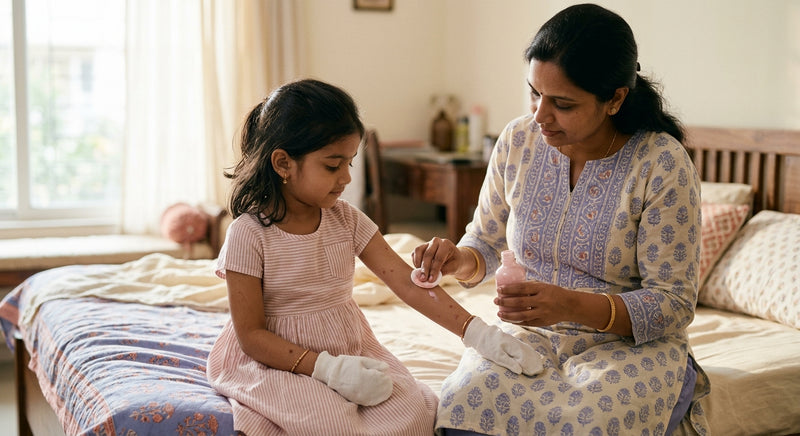
- Within three minutes, on still-damp skin, apply a thick layer of balm to knees and elbows.
- Repeat just on the joints at bedtime, over the day's wear and tear.
- Put a folded towel or mat under the knees for floor activities and homework; a cloth under bare elbows on a stone or laminate table.
- Full-length cotton pyjamas at night reduce the sheet friction nobody counts.
- Trim fingernails short — scratching is friction too.
- Morning: sunscreen on knees, elbows, back of neck and ears before school, not just the face.
Does sunscreen really need to go on knees and elbows?
Yes, and they are the most-missed spots on a child's body. Look for a mineral filter based on non-nano zinc oxide, SPF 30 or above with PA+++ UVA rating. Then look at the texture, because that is what decides whether it actually gets used: it has to glide over dry, rough skin instead of dragging on it. A slightly creamy mineral formula goes on far better over a flaky elbow than an oil-free gel does. Our Daily Defender Kids Mineral Sunscreen SPF 40 PA++++ was built for exactly this daily-use case. Reapplication every two hours is the textbook answer. The realistic school version is a generous layer at 7:30am, a cap, and shade at lunch, with a top-up on sports days and holidays. If your child came back from a camp with sharp lines, we have written separately about which tan lines fade and which do not.
What to skip, honestly
Lemon on the skin before sunlight is risky. Citrus contains furocoumarins that react with UV and can leave a burn-shaped mark far darker than the one you were treating. Baking soda pushes skin pH the wrong way. Besan is fine as a gentle paste, but not as a tool for hard rubbing, and pumice stones and steel scrubbers have no place on a child's elbow. Every one of these works by irritating the surface. Irritation is the exact signal that makes more pigment.
How long before it changes?
Two timelines. The ashy, grey look lifts within days of consistent moisturising, because that part was always dryness. The true pigment is slow, weeks to a few months, and it will not clear at all while the friction continues. That is why the towel under the knees matters as much as the cream. Take a photo in the same light on the first of each month instead of checking nightly. Day-to-day comparison tells you nothing and only makes everyone anxious.
When to see a doctor
- Soft, velvety, symmetrical dark patches at the nape, armpits or groin.
- A dark patch with a raised scaly edge, or one that itches and spreads.
- Darkening in the creases — behind the knees, inside the elbows — with itching, cracking or weeping.
- Pigment that follows a burn, rash or injury and has not started settling after eight to twelve weeks.
- Any patch that is losing colour rather than gaining it, or changing quickly.
- A child who is self-conscious enough about it to cover up in the heat — a dermatologist can reassure and set a safe plan.
For everything else, the answer is dull and it works: cushion the rubbing, protect from sun, keep those joints properly moisturised. Our Hydra Healing Moisturizing Balm is the thick, barrier-supporting texture I would keep by the bed for dry, rubbed knees and elbows.
In summary
- Dark knees and elbows in children are usually friction plus sun, not dirt — washing harder will not shift them.
- Cushion the contact points: a folded towel under the knees for floor activity, a cloth under bare elbows at the study table.
- Moisturise twice daily with a balm-textured product, applied within three minutes of the bath on still-damp skin.
- Put sunscreen on knees, elbows, ears and the back of the neck every school morning, not just on the face.
- Show a paediatrician any soft, velvety, symmetrical darkening at the nape, armpits or groin — that pattern is not cosmetic.
Frequently asked questions
Are dark knees and elbows in children a sign of poor hygiene?
No. The darkening sits in the skin, not on it, which is why washing harder changes nothing. It comes from repeated friction over the joint and unprotected sun on skin that is naturally thicker and drier there. Deeper skin tones pigment more readily, so the same amount of rubbing shows up sooner. Scrubbing only adds irritation, and irritation makes more pigment.
Can dark knees and elbows in kids go away completely?
The dry, ashy grey look usually lifts within days of consistent moisturising, because that part is dehydration rather than pigment. Genuine pigment fades slowly, over weeks to months, and only once the friction stops. If your child kneels on the floor daily or leans on a desk for hours, expect it to hold steady until that habit changes. Photograph it monthly, not nightly.
Is it safe to use a de-tan or brightening cream on a 10-year-old's knees?
Adult de-tan creams and bleach are formulated for thicker, tougher skin and often work by irritating the surface, which is the opposite of what pigmented child skin needs. Skip hydroquinone, kojic acid and strong acid peels entirely at this age. A rich moisturiser twice daily, a mineral sunscreen every morning, and less rubbing will do more than any lightening claim on a label.
Why do my child's elbows look worse every winter?
Elbows have very few oil glands, so they dry out first when the air gets dry and room heaters run. Dehydrated skin lifts into flaky scale that scatters light and reads chalky-grey over brown skin. It looks like grime, so it tends to get scrubbed harder, which inflames the skin and deepens the real pigment underneath. Winter elbows need more moisturiser, not more washing.
Does sunscreen need to go on knees and elbows too?
Yes, and they are the most commonly missed spots on a school-going child. Knees and elbows sit outside most uniforms and collect direct sun during games period. Use a mineral sunscreen of SPF 30 or higher with PA+++, applied generously before school along with the face, ears and back of the neck, and top it up on sports days and outdoor holidays.