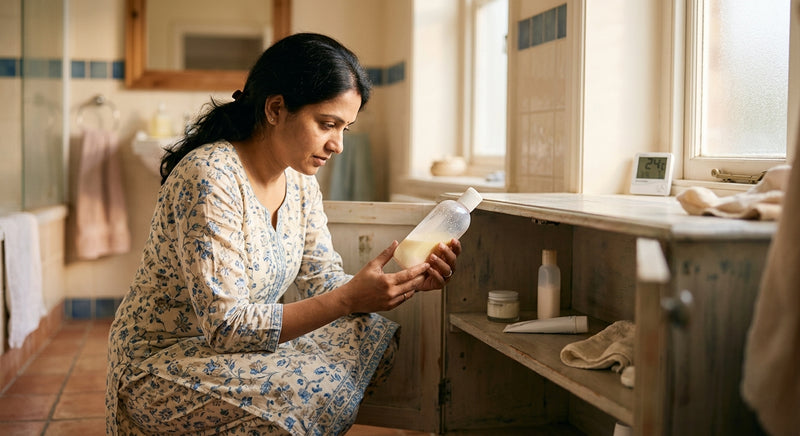
Sunday champi. Warm oil, happy child. Then twenty minutes at the tap, three rounds of shampoo, and the crown is still slippery, so you do a fourth. By Tuesday the hair is flyaway, the scalp itches, and your child is scratching all through the school van ride.
The fix is an order of operations, not a better bottle. Put the shampoo on dry, oiled hair first — not on wet hair. Work it in for a full minute, until the oil turns from clear and slick to pale and milky. Then add water, a little at a time, and let it foam. In that order, most children's hair needs two short washes, not four, and the scalp keeps the lipids it actually needs.
At a glance
- Shampoo goes on dry oiled hair, then water. Wetting first dilutes the shampoo before it ever reaches the oil.
- Two washes beats four. The first one is for the oil. The second one is for the scalp.
- Start with less oil. 1–2 tsp for shoulder-length hair is plenty, and most "won't wash out" problems begin at the oil bottle.
- Hard water is why your shampoo stops lathering. Finish with a rinse from a stored jug instead of reaching for more shampoo.
- Squeaky, straw-like hair after a wash is not clean. It is stripped, and the frizz turns up two days later.
Sorting out the whole routine — frizz, tangles, oiling, seasons? Start with our complete guide to kids' hair through the Indian seasons. This piece is the washing-out half of it.
Why does oil feel impossible to wash out?
Oil and water don't mix. You know that. What shampoo does is bridge them. Surfactant molecules have a fat-loving tail and a water-loving head; they wrap around the oil in tiny spheres called micelles, and the water-loving outsides let the whole bundle rinse away. That is the entire job.
Micelles need two things to do it: enough surfactant for the oil that's present, and contact with that oil. Wet the head first and you lose both. Water spreads a film over the oil. Your shampoo lands on top of that film, already diluted, and instead of emulsifying it slides about making a sad, thin lather. So you add more. Then more. That is your four-wash Sunday. Not a stubborn oil. The wrong order.
Then there's the water itself, and that one is regional.
Is it the oil, or is it your water?
In hard water, dissolved calcium and magnesium react with the anionic surfactants in shampoo and form an insoluble scum. Those molecules are chemically spent after that. They cannot form micelles, cannot lift oil, cannot foam. You feel it as "the shampoo isn't working", and the instinct is to double the dose. Half of that second dose goes the same way, sacrificed to the water.
The scum settles on the hair too, a gritty film that leaves the strands rough while the roots are still oily. Greasy and straw-like at the same time. Parents in Delhi, Hyderabad and large parts of Chennai describe it in nearly the same words. We went city by city on this in our guide to hard water and kids' hair.
The emulsify-first wash, step by step
The order is the whole trick. None of it costs anything.
- Comb the oil through first, dry. Wide-tooth comb, root to tip. It pulls the heaviest deposit off the scalp and down the shaft, away from where you need the most lather.
- Shampoo onto dry hair. About a ₹10-coin for a bob, two for shoulder length. Four or five dots around the scalp, not one blob on the crown.
- Massage 60 full seconds with no water. Fingertips, never nails. You're waiting for the moment it goes cloudy and milky; that's the emulsion forming. Still clear and slippery? Keep going.
- Add water in small amounts. Wet hands, work it in, repeat. The lather blooms all at once. Then rinse properly, 45 seconds minimum, scalp included.
- Second wash, tiny. Half the shampoo, 20 seconds, scalp only. This is the pass that actually cleans the scalp. The first one was busy with oil.
- Conditioner on mid-lengths and ends only. Never on the scalp on a wash-out day. You just spent two rounds getting oil off it.
- Squeeze, don't rub. Press the water out with the towel. Rubbing a child's wet hair is where the frizz and the breakage come from.
For long or dense hair, section it. Two clips, four sections, shampoo each one. Fussy for ninety seconds, and it saves you a whole extra wash.

How much oil should you actually be using?
Most "it won't wash out" problems are decided before the bath even starts. A child's scalp makes its own sebum. Oiling is for the shaft — softness, manageability — and the shaft needs very little. 1 teaspoon for a short crop, 1–2 for shoulder-length, 1 tablespoon for long thick hair. Warmed between the palms, massaged in for five minutes, left for 30–60 minutes.
Overnight oiling is the other half of it. Twelve hours of oil, a pillowcase and a humid night give you a damp, occluded scalp and a dose no single shampoo can clear. With school-going children I'd take a Saturday afternoon over a Friday night every time. We laid the whole pattern out in champi for school kids, without the greasy buildup.
Which oil you reach for changes the wash too, purely on viscosity:
- Coconut oil — the Indian default, and genuinely good for the shaft. It is semi-solid below roughly 24°C, though. In a Delhi or Nagpur winter bathroom it sets in the hair, and lukewarm water won't shift it. Warm the oil going in; run the rinse a touch warmer coming out.
- Sesame and mustard — thinner, stay liquid, wash out noticeably easier. Sesame is the classic abhyanga oil for good reason.
- Castor — extremely viscous, and the single hardest thing to wash out of a child's hair. If you want it, cut it 1 part castor to 4 parts coconut or sesame. Never neat.
How do I know if I'm over-stripping?
Squeaky is not clean. Squeaky means the surfactants went past the oil you put on and took the scalp's own lipid film with them. The signs arrive late, which is why Sunday's wash rarely gets the blame:
- Hair that feels rough and catches on itself straight out of the bath
- A halo of frizz and static by day two
- Scratching, and fine white flakes appearing 48–72 hours later — often a sign the barrier has simply been stripped, though only a doctor can tell you what is actually going on, so get persistent or worsening flaking looked at
- Ends that snap while combing, and a scalp that looks oilier faster than it used to (strip it hard and it rebounds)
That flaking sends a lot of families to the chemist for an adult anti-dandruff shampoo, which is the worst available next move: a heavier surfactant load on an already-bare scalp. We unpicked the oiling-and-flaking link properly in does hair oiling cause dandruff in children, and the frizz side in why humidity frizzes kids' hair.
Does the season change the plan?
It changes nearly all of it. Same child, same oil, four different washes across the year.
| Season | Oil & leave-on | Wash plan | The detail that matters |
|---|---|---|---|
| Summer (Apr–Jun) | Lighter hand; 30 min is enough | 2 washes, 2–3× a week | Sweat has already emulsified some of the oil, so the first wash foams easily. Keep the water warm, not hot. Hot water on a sweaty scalp strips fast. |
| Monsoon (Jul–Sep) | Mid-lengths and ends only, skip the heavy scalp massage | 2 washes, but never leave the scalp damp | Humidity plus oil plus a damp scalp is the combination that itches. Dry fully before braiding, and never braid damp hair. |
| Winter (Nov–Feb) | Normal amount, but warm the oil | 1 thorough wash, once a week is plenty | Coconut oil sets in the cold. Warm oil in, slightly warmer rinse out. Conditioner is non-negotiable here. |
| Hard-water months (any) | Use less, so you need less shampoo | 2 short washes + stored-water final rinse | Don't fight scum with volume. In hard water, more shampoo mostly makes more scum. |

What should a kids' shampoo for oil days actually contain?
This is the part I spend my working life on. To wash oil out of a child's hair you want a surfactant system that is efficient rather than aggressive: enough cleansing power to emulsify a teaspoon of coconut oil in one pass, without the harshness that forces a third wash.
What I look for on a label:
- A mild primary surfactant — sodium cocoyl isethionate, sodium methyl cocoyl taurate, decyl or coco-glucoside. These clean well and rinse clean, with far less lipid removal than a sulfate-forward base.
- An amphoteric partner like cocamidopropyl betaine, which thickens the lather and softens the whole system's effect on the scalp.
- pH around 4.5–5.5. Hair's cuticle lies flat in that range. Alkaline washes swell it open, and that is exactly where frizz and tangling come from.
- Tear-free performance that's actually tested — a genuine ophthalmological/clinical check, not just the word on the front.
- Realistic fragrance and no claim inflation. Avoid "clarifying" and "deep cleansing" positioning on anything meant for a child.
Our own Loving & Balancing Shampoo is built on that logic: a mild, tear-free base made in our own GMP-certified facility. We own our formulations rather than white-labelling them, which is what lets us hold a surfactant ratio this specific.
And the tangles afterwards?
Oil-wash days are tangle days. You've handled the hair three times more than usual. A conditioner on the mid-lengths and ends restores the slip the wash took away and makes combing survivable; a detangling conditioner is far kinder than fighting dry knots with a comb. Comb while the conditioner is still in, wide-tooth, from the ends upwards.
When to see a doctor
Washing technique fixes washing problems. Take your child to a paediatrician or dermatologist if you see: flaking that persists for more than two or three weeks despite a gentler routine; thick yellow or greasy crusts; raw, weeping or bleeding patches; boils or tender swelling on the scalp; a defined bald patch with broken stubble or scaling (this needs a clinical look, as fungal scalp infections need prescription treatment and do not respond to shampoo); or intense night-time itching with visible nits. None of these are an oil problem, and no cosmetic product is the answer to them.
Do this tonight
Nothing to buy. Next oiling day, change two things. Use half the oil you normally would, and put the shampoo on dry hair with a full minute of massage before any water touches it. If your water is hard, keep a jug standing for the final rinse. That is the method, and it usually ends the four-shampoo Sunday on the first attempt.
And when you do restock, read the label against the list above rather than the front of the bottle: a mild, pH-balanced, tear-free base does the work in two passes instead of four, where a "clarifying" one will push you back to three.
In summary
- Apply shampoo to dry, oiled hair and massage a full minute before adding any water — the order is the whole trick.
- Use less oil to start with: 1–2 tsp for shoulder-length hair, left on 30–60 minutes rather than overnight.
- Stop at two washes — one for the oil, one small one for the scalp; squeaky hair means stripped, not clean.
- In hard-water cities, finish with a rinse from a stored jug instead of adding more shampoo.
- Warm the oil and the rinse water in winter, keep the scalp fully dry in monsoon, and condition the ends on every oil-wash day.
Frequently asked questions
Should I wet my child's hair before shampooing out the oil?
No — put the shampoo on dry, oiled hair first. Water spreads a film over the oil and dilutes the shampoo before it can emulsify anything, which is why heavily oiled hair seems to need three or four washes. Massage shampoo into dry hair for a full minute until it turns milky, then add water gradually and let it lather.
How many times should I shampoo to get coconut oil out?
Two washes is the realistic maximum. The first, applied to dry hair, lifts the oil; a much smaller second pass on the scalp alone finishes the job. If you consistently need three or more, the cause is usually too much oil, overnight leave-on, or hard water inactivating your shampoo — not a shampoo that is too mild.
Why does my shampoo not lather on oiled hair?
Two reasons. On wet hair the shampoo is diluted before it reaches the oil, so no micelles form. And in hard water, calcium and magnesium react with the surfactants to form insoluble scum, spending those molecules before they can foam. Adding more shampoo mostly makes more scum — change the order instead, and finish with a stored-water rinse.
Is it bad to leave oil in a child's hair overnight?
For most school-going children I would avoid it. Twelve hours of oil under a pillowcase leaves a damp, occluded scalp and a dose no single shampoo can clear, which pushes you into extra washes. Thirty to sixty minutes on a weekend afternoon gives the shaft all the benefit with far less to remove.
Can I use an adult anti-dandruff shampoo to cut the grease faster?
Please don't. Adult clarifying and anti-dandruff shampoos carry a much higher surfactant load designed for adult sebum, and on a child's scalp they strip the natural lipid film in a single wash. The flaking and itching that follow two days later often get mistaken for dandruff, which leads to more of the same shampoo.
Does the washing routine change in winter?
Yes. Coconut oil is semi-solid below about 24°C, so in a cold north-Indian bathroom it sets inside the hair and lukewarm water will not shift it. Warm the oil before applying, run the rinse slightly warmer than in summer, drop to one thorough wash a week, and always condition the mid-lengths and ends.