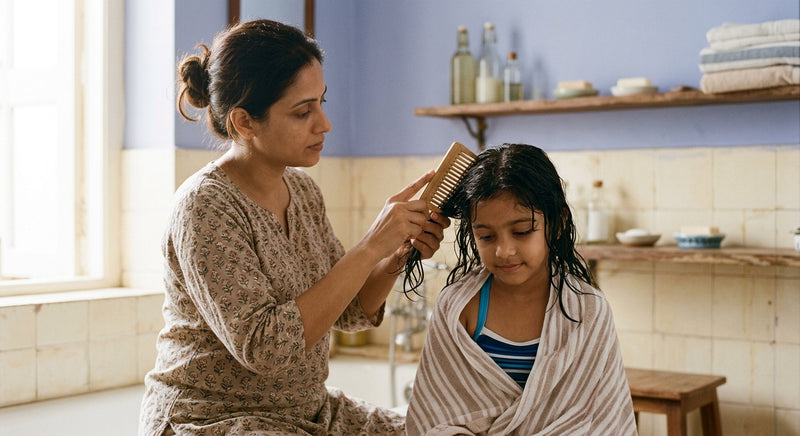
It's 7:40 am. Her hair is still damp from the bucket bath, the school van comes at eight, and the comb has stopped dead somewhere near her shoulder blade. You tug. She yells. Now you're both starting the day annoyed.
Short answer: wide-tooth comb on wet, conditioned hair and on any real knot. Detangling brush on dry-ish hair, for daily smoothing and quick surface tangles. Most Indian homes need both. Which one you pick up should change with the season, because a July morning and a January morning are not the same hair problem. And if your child's hair is curly or very coily, the comb (or just your fingers) wins almost every time.
At a glance
- Wide-tooth comb: wet hair, product-laden hair, thick or curly hair, stubborn knots.
- Detangling brush: dry or nearly dry hair, fine to wavy hair, fast daily tidying.
- Tangles are a friction problem. Slip, from conditioner, does more of the work than either tool.
- Monsoon humidity and hard water both roughen the cuticle. That's why tangles get worse in some months.
- Check any new comb for moulding seams. A rough seam snags hair however wide the teeth are.
Why does hair tangle in the first place?
Every strand is wrapped in overlapping cuticle scales, like roof tiles pointing down towards the ends. Flat scales let two strands slide past each other. Lifted, chipped, or coated in mineral deposit, they catch instead. A catch becomes a knot, and a knot recruits its neighbours.
So detangling is not a test of the tool's strength. Lower the friction first, then take the knot out with the least force you can manage. What lifts those scales to begin with (heat, rubbing, ponytails, sleep) I've written about in why your child's hair tangles so much, and the full method sits in our complete guide to detangling kids' hair.
This is where the bottle matters more than the hardware. Conditioners work through cationic, positively charged ingredients: behentrimonium chloride, cetrimonium chloride, behentrimonium methosulfate. Damaged cuticle carries a negative charge, so those actives head straight for the roughest spots and park there. Add fatty alcohols like cetearyl alcohol and you get a thin, slippery film that lets strands glide instead of grip. That is the whole trick. A ₹1,200 brush through unconditioned hair will still hurt.
Wide-tooth comb vs detangling brush: the real difference
The comb has rigid teeth set far apart. It isolates a few strands at a time, passes through heavy conditioner without clogging, and doesn't drag the rest of the head into the knot. The brush is a different animal. Flexible bristles at different heights sit on a springy bed and spread the pull across many strands, so no single one takes the full load, and it covers a lot of head very fast.
| Wide-tooth comb | Detangling brush | |
|---|---|---|
| Best on | Wet, conditioned, product-coated hair | Dry or barely damp hair |
| Hair type | Thick, curly, coily, very long | Fine, straight to wavy, shoulder-length |
| Knot handling | Excellent — isolates the knot | Fair — can tighten a real knot |
| Speed | Slower, more deliberate | Fast for daily smoothing |
| Scalp feel | Neutral; can scratch if teeth are sharp | Pleasant, massage-like |
| Cleaning | Rinse in 10 seconds | Traps sebum, dust, sunscreen — needs washing |
| Monsoon frizz | Better — less static, less lift | Can puff hair up |
| Winter static | Depends on material | Worse if plastic and hair is dry |
Honestly, most parents I speak to bought the brush because it looks kinder, then use it on soaking-wet hair straight out of the bath. That is the one combination I'd avoid. Wet hair swells and softens, and it stretches a long way before it breaks. A flexible bristle bed lets you keep pulling well past the point where you should have stopped, put the brush down, and worked the knot loose with fingers and slip. The comb is more honest about it. It stops, so you stop.
Which one for which Indian season?
Monsoon (June-September): comb, and more slip
Humid air is the tangling season. Hair is hygroscopic. It pulls moisture out of the air, swells slightly, and the cuticle lifts. Curly and wavy hair frizzes into a halo, and suddenly every strand has more surface catching every other strand. Now add a school braid plaited damp that never fully dries. By evening there are knots sitting at the nape.
Reach for the wide-tooth comb with a leave-in or a rinse-out conditioner, and let hair dry loose instead of plaiting it wet. A brush at this stage mostly separates the frizz and makes the head look bigger.
Summer (March-June): brush in the morning, comb after the wash
Sweat, dust and sunscreen migrating off the face into the hairline leave the scalp sticky and the roots gritty. The tangles are looser, but there are more of them. A detangling brush before school, plus a proper comb-through on wash day, handles this well. Swimming class? Rinse before and after. Chlorine plus friction is a rough combination for the cuticle.
Winter (November-February): the static months
Dry indoor air and low humidity leave hair electrically charged. A plastic brush dragged through dry hair adds more charge, and charged strands repel each other into flyaways that promptly tangle. Two fixes that cost nothing: mist the hair very lightly with water before you start, and detangle right after conditioning, while the film is still on the hair. A wooden or carbon-fibre comb really is less static-prone than moulded plastic. This is one place where material matters and marketing doesn't.
Then there's hard water, all year round
Borewell and municipal supply across much of India, Nagpur very much included, is hard. Calcium and magnesium ions bind to hair and, with soap-based cleansers, leave an insoluble film. The hair feels squeaky and rough, and looks strangely dull. That roughness is friction, and friction is tangles. Milder syndet-style cleansers rinse cleaner in hard water than traditional soap does. So if washes are leaving your child's hair coarse and grabby, start there. A mild, gentle tear-free shampoo and a conditioner after it will do more for tangles than any tool swap.
How do I spot a well-made comb or brush?
Cheap moulded plastic combs carry a seam running down the length of every tooth, a thin ridge of flash left behind by the mould. You can barely see it. It shreds cuticle anyway. Here's the 20-second test I run at the shop counter, before anything comes home.
- Run a cotton ball or a bit of cotton wool along and between the teeth. If it snags or leaves fibres, so will your child's hair. Put it back.
- Press a tooth tip into your inner forearm. It should feel rounded, not pointed.
- For a comb: teeth spaced at least a finger's width apart for thick or curly hair, slightly closer for fine hair.
- For a brush: bristles of varying heights on a flexible cushion, with smooth ball tips. Rigid, uniform bristles are a styling brush, not a detangler.
- Check the handle grip when wet. Most bathroom drops happen with conditioner-slick hands.
- Wash it weekly with a drop of shampoo and warm water. A brush bed loaded with old sebum, dust and hair oil re-deposits all of that onto clean hair.
The routine to try tonight
Order matters more than either tool. Whether you detangle wet or dry is its own decision, and I've laid the logic out in wet vs dry detangling. For a standard wash night, shoulder-length hair or longer:
- Finger-separate the hair into four loose sections before anything touches it. Clip three away.
- Apply conditioner mid-length to ends only, never the scalp, and leave it for two minutes while your child plays with the bubbles.
- With conditioner still in, take the wide-tooth comb. Start at the last 5 cm. Comb clean, move up 5 cm, comb again. Hold the hair above the knot with your other hand so the pull lands on your fist and not her scalp.
- Rinse with the coolest water she'll tolerate. Cooler water helps the cuticle lie flatter.
- Squeeze, don't rub, with a cotton T-shirt or a soft towel. Rubbing is where half the morning tangles are made.
- Once hair is about 80% dry, a few light passes with the detangling brush to finish.
- Loose plait for sleep. Not tight, not wet.
If mornings are the flashpoint rather than wash night, the sequencing shifts a bit, and detangling long hair before school covers that version. Still weighing up whether you need a separate spray at all? detangler spray vs conditioner is the honest comparison.
When to see a doctor
Tools and conditioner solve tangles. They don't solve scalp problems. Book a paediatrician or dermatologist if you notice a spreading bald or scaly patch, persistent itching (especially with visible nits or evening restlessness), broken hair confined to one area, redness, flaking that doesn't respond to gentle washing, sores or pus, or noticeably more hair coming out than usual over several weeks. Sudden hair loss after an illness or fever also deserves a proper look, rather than a new brush.
Whichever tool you settle on, the slip is what does the work. Look for a mild conditioner made for children's hair, with cationic conditioning agents and fatty alcohols, used on the mid-lengths and ends rather than the scalp. Our Rejuvenating & Detangling Conditioner is one option if you want a starting point.
In summary
- Use a wide-tooth comb on wet, conditioned hair and on stubborn knots; use a detangling brush on dry hair for daily smoothing.
- Slip does the real work — conditioner's cationic ingredients and fatty alcohols lower friction so either tool glides.
- Switch tools by season: comb through the humid monsoon, brush-plus-comb in summer, and mist lightly against winter static.
- Hard water leaves a rough mineral film that causes tangles — fix the wash before you blame the tool.
- Test any new comb with a cotton ball for moulding seams, and wash combs and brushes weekly.
Frequently asked questions
Is a wide-tooth comb or a detangling brush better for curly kids' hair?
A wide-tooth comb, used on wet hair with conditioner still in. Curl patterns coil around each other, and a brush's dense bristles disturb the curl clump and pull several coils into one knot. Fingers first, then the comb, working from the ends upward in small sections. Detangle only when the hair is slippery with product, never dry.
Can I use a detangling brush on wet hair?
You can, but it isn't ideal for real knots. Wet hair is softer and stretches more before it breaks, and a flexible bristle bed lets you keep pulling past the point you should have stopped. Use the wide-tooth comb while conditioner is in, rinse, then finish with the brush once hair is about 80 percent dry.
Why does my child's hair tangle more during the monsoon?
Humid air makes hair swell slightly and the cuticle scales lift, so strands catch on each other instead of sliding. Frizz increases the surface area available to tangle. Damp plaits that never fully dry make it worse. Through the monsoon, use a wide-tooth comb with a conditioner or leave-in, and let hair dry loose before tying it.
Does hard water make hair tangle more?
Yes. Calcium and magnesium in hard water bind to hair and, with soap-based cleansers, leave a rough film that increases friction between strands. Hair feels squeaky and coarse rather than smooth. Switching to a mild syndet-style cleanser that rinses clean, and always following with a conditioner on the mid-lengths and ends, usually makes a visible difference within a week.
At what age can a child use a detangling brush themselves?
Around five or six, most children can manage the last few passes on dry hair while you handle the wet, knotted stage. Give them a section that's already detangled so the tool never hurts in their hands. Full independence usually comes closer to eight, and long or curly hair often still needs an adult on wash nights.
How often should I clean the comb or brush?
Once a week. Pull out the trapped hair, then wash with a drop of shampoo in warm water and let it dry bristles-down. A brush bed holds old sebum, hair oil, dust and sunscreen residue, and every stroke puts some of that back onto freshly washed hair. Wooden combs should be dried promptly rather than left soaking.