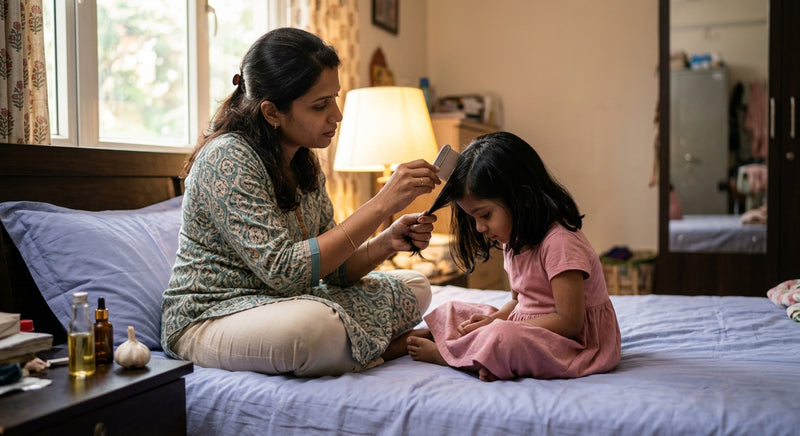
One bottle or two? That is the question I get most at exhibitions, usually from a mother holding a four-year-old by the hand with an eleven-year-old trailing behind her, already bored.
The honest answer is that the SPF and PA rating barely move between three and twelve. Broad-spectrum SPF 30-50 with PA+++ or higher covers all of them. Three things do change: the texture your child will tolerate, how much actually goes on, and who is responsible for putting it there once school and sports arrive. Get those three right and one bottle can serve a whole family.
At a glance
- SPF 30-50 and PA+++ is the target at 3, 6, 10 and 12. The number on the front is not what changes with age.
- Texture is what changes. A squirmy 3-year-old needs a cream that spreads; a 12-year-old needs something that does not shine in a school photo.
- Quantity is where almost everyone falls short - roughly half a teaspoon for face and neck, whatever the age.
- At 3 and 6 you apply it. At 10 you supervise. At 12 you hand it over, then check whether the bottle empties.
- Look for zinc oxide or titanium dioxide, no alcohol high in the list, and a water-resistance claim only if it is stated in minutes.
This one sits inside our complete guide to choosing kids products by age, which handles the other age gates parents ask about - conditioner, deodorant, face wash.
Does my child need a different SPF at 3, 6, 10 and 12?
No. Parents find that hard to believe, because the chemist's shelf is arranged by age and a bigger child looks like they should need a bigger number.
SPF measures protection against UVB, the burning wavelength. Skin burns at much the same rate at three as at twelve. What differs is the dose of sun. A twelve-year-old at cricket practice four evenings a week gets far more of it than a toddler parked under a stroller hood. The number stays put; the routine grows around it.
PA is the UVA rating - the long-wave part that drives tanning and pigment changes, passes through window glass, and stays fairly constant through the Indian day instead of peaking at noon. For our latitude, PA+++ is the sensible floor. PA++++ is not wrong either. It is also no upgrade at all if half the required amount is going on. How you apply it will always outrank what is printed on it.
So what actually changes between 3 and 12?
Behaviour, skin surface, and how much of it they do without you. Here is the map I use.
| Age | What really changes | Texture that works | Rough amount, one school day |
|---|---|---|---|
| 3 | Goes on while they are moving. Rubs eyes, licks lips, hates anything that stings. Exposure is short but unpredictable. | A soft mineral cream that spreads. Anything stiff lands in patches. | Half a teaspoon face and neck, a little more for hands and shins below the uniform. |
| 6 | School has started. Two outdoor breaks, no reapplication happening. A short haircut has just exposed the ears and the back of the neck. | Same cream, but it has to sink in fast enough for a uniform shirt to go on within two minutes. | Half a teaspoon face, neck and ears; a teaspoon for both arms if sleeves are short. |
| 10 | Sports periods, longer exposure, more sweat. Notices white cast, and says so out loud. | Lighter finish, minimal cast. A bad texture ends the habit at this age. | Around a teaspoon and a half in total across face, neck, ears, arms. |
| 12 | Applies it alone or not at all. Cares how it looks. May already be using a face wash and worrying about breakouts. | Non-greasy, no visible residue. Wanting a lighter feel on the face is a fair ask. | Two teaspoons or more - a bigger body and an hour of games. |
Watch the row for 10. More sunscreen habits die at that age than at any other, and the SPF is almost never the reason. It is the chalky finish, in a classroom full of children who notice and comment. Texture at ten decides whether the bottle gets used or migrates to the back of a drawer.
How much sunscreen does one school day actually need?
Most children get a fraction of what the label was tested at. SPF is measured in a lab at a set film thickness. Rub on a thin smear and you are not getting SPF 40. You are getting something considerably lower, and nothing about the way it looks will tell you.
Rules that survive a real morning, van already honking outside:
- Squeeze two full finger-lengths onto your fingers before you touch the face - that is close to half a teaspoon.
- Dot first: forehead, both cheeks, nose, chin, both ears, back of the neck. Then spread. Dotting is what stops the thin-smear problem.
- Do the hairline parting and the tops of the ears. On Indian children those two spots burn more than anywhere else.
- Hands, and the strip of shin between sock and shorts. Nobody remembers shins.
- Apply before the uniform goes on. Collars wipe off whatever you just put on the neck.
- From about age 8, keep a second small tube in the school bag, so reapplication is at least possible.
What should I look for on the label at each age?
This is the part I can speak to properly. It is what I spend my working days on. When we develop a sunscreen at our own facility in Nagpur, these are the decisions that get argued over longest.
Filters first
Zinc oxide and titanium dioxide are the mineral ones. They sit on the surface, work from the minute they go on, and carry a long history of use on young skin - which is why most kids-specific formulations in India are built on them. Look for zinc oxide stated with a percentage. Non-nano grades are preferred for children's products, and the trade-off there is honest: bigger particles are harder to disperse invisibly. Solving that is the formulator's job. It is not a reason to walk away from minerals.
Organic filters, the ones everyone calls chemical, are legal, widely used, and not villains. They do need to be absorbed before sun exposure, and some of them sting badly on a face. For a three- or six-year-old who will rub their eyes inside a minute, I pick mineral.
The things that quietly kill the habit
- Alcohol denat high in the ingredient list. It gives the fast, dry finish adults love, and a sting on a child's face, especially straight after a wash. Check where it sits in the list.
- Essential oils and added fragrance. Fine for many children. A problem for eczema-prone skin. For daily use on the face, less is better.
- Water resistance stated vaguely. A real claim reads as a number of minutes. Waterproof is not a thing.
- Broad spectrum with no PA rating. If UVA protection is not declared, treat it as unknown.
Be careful with the soft words too. Mild, gentle and tear-free are not interchangeable, and only some of them carry a defined meaning here - we unpacked what those words legally mean in India. If a term on the front is not backed by something specific on the back, it is marketing. For decoding the back panel itself, our A-Z ingredient glossary is the one I would keep open on your phone while you are standing at the chemist.
And the step everybody skips: taking it off
Mineral sunscreen is designed to stay on the surface, so it has to come off properly at night. A splash of water will not do it. A half-removed film plus a day of sweat is how the clogged-pore complaints start in ten-year-olds. A normal bath with a gentle cleanser made for kids 3+ is enough. No scrubbing, no double cleansing ritual.
My 12-year-old refuses to wear it. Now what?
Stop arguing about skin cancer. At twelve it is thirty years away and it means nothing.
Two things have worked for me. Let them pick the bottle. Then move the application out of the bathroom to the shoe rack, so it belongs to leaving the house rather than to washing. After that, hand over ownership honestly. A tween who puts it on themselves four days a week is ahead of one you chase every morning and who reapplies nothing all day.
Tanning is usually the argument that lands, and it is the one to handle carefully. Talk about sun damage and uneven patches. Never about fairness. That framing does real harm, and it is one of the ideas we pushed back on in the skincare myths Indian parents still believe.
When to see a doctor
So: hold the SPF and PA steady from three to twelve, scale the quantity and the ownership as they grow, and pick the texture your particular child will let you near. That last one decides everything.
If you want one bottle that covers the ages in this article, our Daily Defender Kids Mineral Sunscreen SPF 40 PA+++ was built for exactly that - Indian sun, Indian mornings, and a child who will not sit still.
In summary
- Keep SPF 30-50 and PA+++ constant from age 3 to 12 - the number is not what changes with age.
- Scale the quantity instead: about half a teaspoon for face, neck and ears, more once arms and shins are exposed.
- Match the texture to the child - a chalky finish is what ends the habit at around age 10.
- Check the label for a stated zinc oxide or titanium dioxide percentage, alcohol low in the list, and water resistance given in minutes.
- Apply it yourself at 3 and 6, supervise at 10, hand it over at 12 - and see a paediatrician for any blistering sunburn.
Frequently asked questions
Is SPF 50 better than SPF 40 for a 3-year-old?
Only marginally, and not in a way you will notice. Above SPF 30 the difference in UVB filtered is small, and it disappears entirely if your child is wearing half the required amount. A well-applied SPF 40 with PA+++ outperforms a thinly smeared SPF 50. Spend your attention on quantity, reapplication and whether the texture is one your child tolerates.
Can my 6-year-old and my 12-year-old share one sunscreen?
Yes, in most families. The SPF and PA target is the same at both ages, and a mineral formulation suitable for a six-year-old is perfectly suitable for a twelve-year-old. The only reason to buy two is texture preference - a tween who dislikes any visible cast may want a lighter finish for the face. Check the label says it suits both age groups.
How much sunscreen does a child need for a school day?
Roughly half a teaspoon for face, neck and ears, plus about a teaspoon more for exposed arms and shins if the uniform is short-sleeved. Two finger-lengths squeezed onto your fingers is a good visual for the face portion. Dot it on first, then spread - smearing a thin film is the commonest reason children get far less protection than the label suggests.
At what age can a child apply their own sunscreen?
Around ten most children can apply it with supervision, and by twelve most can own it entirely. Until then you should apply it yourself, because children miss ears, the hairline parting and the back of the neck almost every time. When you do hand it over, check that the bottle actually empties at a sensible rate - that is your only honest audit.
Does my child need sunscreen if they are only outside for school breaks?
Yes. Two twenty-minute breaks plus travel adds up across a week, and UVA passes through classroom and car windows. For an Indian school day, a single morning application before the uniform goes on covers most of the exposure. If there is a sports period or an outdoor activity, send a small tube in the bag so reapplication is at least possible.